Maximizing Weight Capacity for Casters on Carpeted Surfaces

  • Thread starter Thread starter Quietrabbit
  • Start date Start date
  • Tags Tags
    Force
Click For Summary

Discussion Overview

The discussion centers around the structural integrity and weight capacity of a table designed to support over 500 lbs, specifically when using casters on carpeted surfaces. Participants explore various factors affecting the load-bearing capabilities of the table, including the number and type of casters, the design of the table, and safety considerations for moving it with people on it.

Discussion Character

  • Exploratory
  • Technical explanation
  • Conceptual clarification
  • Debate/contested
  • Experimental/applied

Main Points Raised

  • Some participants suggest doubling up the casters on the legs to increase weight capacity, while others question the feasibility of this approach.
  • Concerns are raised about the stability of the table when moving with people on it, particularly regarding the potential for tipping and the need for a safety rail.
  • Participants discuss the importance of considering the weight of the table itself in addition to the load it must support, with some proposing a safety factor of three times the expected load.
  • There are suggestions to use larger, industrial-strength casters that can better handle the weight and provide improved movement over carpet.
  • Some participants emphasize the need for brakes on at least two casters to prevent movement when people are on the table.
  • Questions are posed about how to distribute the weight of the load to avoid concentrating it on a single leg or caster.
  • One participant mentions the potential for uneven surfaces to affect the performance of smaller casters.

Areas of Agreement / Disagreement

Participants express a range of views on the best approach to ensure the table can safely support the intended load. There is no consensus on whether doubling the casters is sufficient or if larger, higher-capacity casters are necessary. Safety concerns regarding movement with people on the table remain a point of contention.

Contextual Notes

Participants highlight various assumptions, such as the adequacy of the table's structural design and the nature of the carpeted surface. There are unresolved questions about the specific installation of casters and the overall engineering of the system.

Who May Find This Useful

Individuals involved in stage design, prop construction, or those interested in load-bearing structures and safety considerations in moving furniture may find this discussion relevant.
Quietrabbit
Messages
19
Reaction score
1
TL;DR
I have a table and I am planning to put wheels on the four legs. How do I calculate the amount of weight the casters I buy need to hold, given the load
Currently I have 6 casters with a 90lb capacity, but I need this “table” (closest description to the shape) to hold over 500lbs. If I double up the wheels on the “legs” will that increase the weight capacity?
 
Engineering news on Phys.org
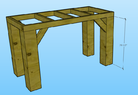
Can you post a sketch of the table? (Use the "Attach files" link below the Edit window)

What is the 500 pound load? What are the consequences if the table fails and the load falls?
 
Remember, three points determine the "plane" of the table.
 
The load is about 3 people (it's the frame for a prop), if it fails we fall :-)
I suppose I am assuming that 6x6s are sufficient to hold us up?
There is also a plywood top I didn't bother CADing.
 

Attachments

  • Screenshot (110).png
    Screenshot (110).png
    38.3 KB · Views: 147
Quietrabbit said:
The load is about 3 people (it's the frame for a prop), if it fails we fall :-)
Hmm, that's not good...

Does this get wheeled around as part of the scenes in the play, or only to move it between scenes? Is it moved with people on it?
 
berkeman said:
Hmm, that's not good...

Does this get wheeled around as part of the scenes in the play, or only to move it between scenes? Is it moved with people on it?
Ideally it would be moved with people standing on it, during the scene. We're not too concerned with how we'll push it since worse case someone gets off.
 
Quietrabbit said:
Currently I have 6 casters with a 90lb capacity, but I need this “table” (closest description to the shape) to hold over 500lbs. If I double up the wheels on the “legs” will that increase the weight capacity?
How do you plan on installing six caster wheels on four legs?

How flat and hard and free of steps and gaps the rolling surface is?
Small wheels easily catch on those surface irregularities.

Jumping backwards from 30 inches high is not so easy: tipping over toward the back of the bodies is the worst situation, as someone’s head may hit the floor.

Is it feasible to spread the location of the casters toward a square footprint?
 
  • Like
Likes   Reactions: berkeman
Quietrabbit said:
The load is about 3 people (it's the frame for a prop), if it fails we fall :-)
How do you know that the three people will not all stand in the same corner, above the same leg?

Maybe you need to look at industrial strength casters that will be capable of supporting 500 lbs each.
https://www.ebay.com.au/itm/175035922479
 
The surface is likely carpet and has no steps. The whole "table" is only 5'x2' so it's unlikely to be too unbalanced because of space constraints of where people can stand, but I see your point. People would likely sit and slide off, so I was hoping the weight of the wood would counteract most of that imbalance, especially if I get casters with brakes.
I didn't really think through how I would fit six casters, but they were small so I kinda figured I could fit 2 side by side on two of the 6x6 posts.
The posts would ideally stay where the are now, but I could add a horizontal brace at floor level in the short direction if you think that would help.

Is the suggestion that I need 500lb each?
 
  • Like
Likes   Reactions: Lnewqban
  • #10
Quietrabbit said:
Is the suggestion that I need 500lb each?
That is the sort of reality I would expect. When you push high up on a structure, that is travelling over, say a carpet that offers resistance to wheel movement, the supported weight is transferred to the front wheels.

Casters for heavier loads also have a greater diameter and floor contact patch, that will roll better over carpet. 4x industrial casters for $50 is a simple solution.
 
  • #11
Quietrabbit said:
Is the suggestion that I need 500lb each?
It is called a safety factor. Especially when human safety is involved, the factor should be generous. Three times the maximum load expected would be reasonable.

Three 200 pound people, plus 200 pounds for the wooden table, gives 800 pounds total. Factor of three for safety gives 2400 pounds, or 600 pounds per leg.
 
  • #12
Quietrabbit said:
The surface is likely carpet and has no steps. The whole "table" is only 5'x2' so it's unlikely to be too unbalanced because of space constraints of where people can stand
The people better not be standing when you try to push that table across carpet! Just trying to start that thing moving with little castors on it will cause a big jerking motion which would easily topple them off. Even when sitting, it will be an uncomfortable ride. At least when (not if) they fall off, it will be onto a carpeted surface and not concrete...
 
  • #13
When calculating the weight capacity needed for the casters on your table, you should consider both the weight of the table and any additional load it will need to support. Start by exploring different caster options, such as the ones found here, [Link to poster's business website redacted by the Mentors] to find those that fit your requirements.

If your table needs to hold over 500 lbs and you currently have 6 casters with a 90 lb capacity each, your present setup supports a maximum of 540 lbs (6 casters x 90 lbs per caster). To ensure a greater margin of safety or manage additional weight, it might be prudent to look for casters with higher capacities.

Doubling up the wheels on each leg can increase weight capacity, but make sure the table's structure can handle the additional wheels and maintain load distribution. Alternatively, using casters with a higher individual weight capacity is a more straightforward solution. For instance, if you use 4 casters, each must support at least 150 lbs to reach a total capacity of 600 lbs, providing a margin above your 500 lbs requirement.
 
Last edited by a moderator:
  • #14
Quietrabbit said:
The load is about 3 people (it's the frame for a prop), if it fails we fall :-)
I suppose I am assuming that 6x6s are sufficient to hold us up?
There is also a plywood top I didn't bother CADing.
There are a few issues that you haven't included. You may have thought about them but they should be included in this discussion as it needs to be a 'complete engineered system'. What you have described is a bit along the lines of a skateboard but worse because there are more than just one passenger. Frankly, the load bearing qualities of the wheels is way down the list of considerations - just use ridiculously big ones and you would have all the advantages that big car wheels have over 'mini' wheels on an uneven surface.

There is no safe way that this table could be moved about freely with three people standing on it. There should be a rail at the back (or even a U of three rails) to keep them from falling off. If one falls off then the other two could also be thrown off (Newton's Third law).

At least two of the casters should have brakes to keep the table still when passengers move about. The table should be moved about by an extra person, standing on the floor, with a rod (fixed at an appropriate height).
 

Similar threads

  • · Replies 1 ·
Replies
1
Views
1K
Replies
3
Views
2K
Replies
13
Views
2K
  • · Replies 5 ·
Replies
5
Views
5K
  • · Replies 17 ·
Replies
17
Views
5K
  • · Replies 16 ·
Replies
16
Views
2K
  • · Replies 7 ·
Replies
7
Views
3K
Replies
33
Views
5K
Replies
3
Views
3K
Replies
3
Views
2K