How to select stepper motor for a Z-axis application with Ballscrew

Join the discussion
Registration is free. Ask a follow-up in this thread, or start your own.
3 replies · 3K views
Vatech
Messages
53
Reaction score
7
TL;DR
it is needed to select stepper motor for a Z-axis application with Ballscrew.
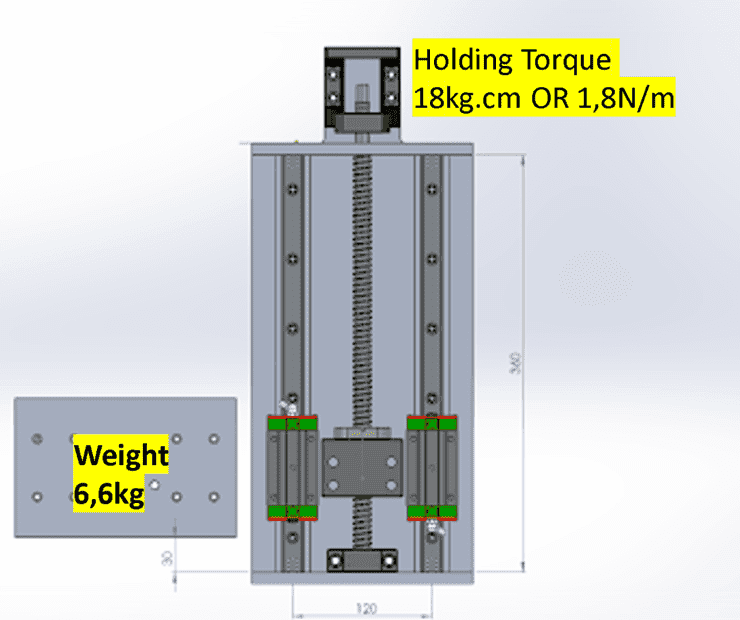
we suppose as knowing data that the z axis is verstical and the load is 6.6kg.
I build a Z-axis (not the one displayed on image). The weight of the Buildplatform is 2.29kg and is going to be used on a MSLA printer, so the weight might get increased 1kg additionally, so 3.29kg. The problem is that when detached from the printed model from Fep film there is a resistive force, this needs tools and test to be calculated so this is unknown data for the time.
That’s why i would like to be able to lift double the weight , meaning 6.6kg.
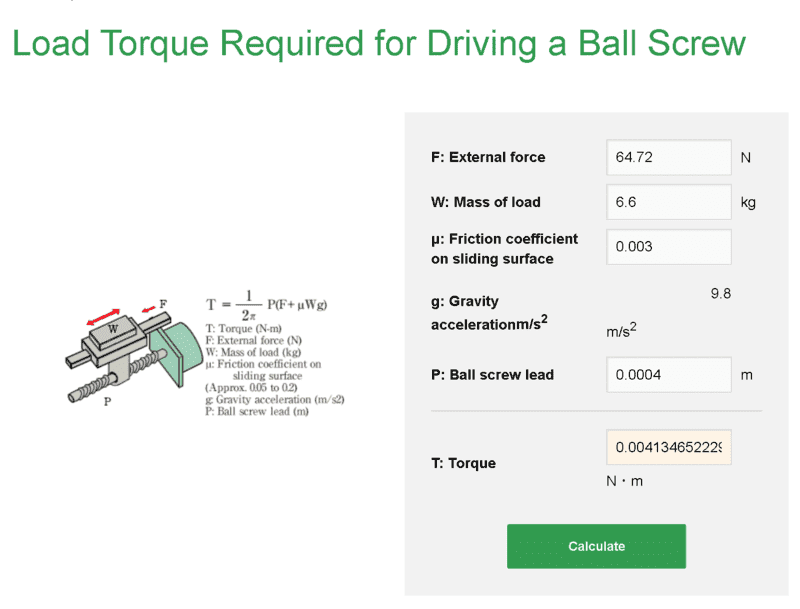
The ball screw is a SFU1204 , meaning 4mm travel per full rotation. Friction
1632326628795.png


I sourced experimental a stepper that has 1.8N holding torque, but how could i calculated the minimum Holding torque of the stepper motor needed to lift up the platform?
1632326436058.png
 
Physics news on Phys.org
Better check your inputs. I have seen ball screws with 4 mm lead, but never one with 0.4 mm lead.

When sizing a stepper motor for a slow speed drive, such as a 3D printer build stage, you can ignore acceleration. With a ball screw drive, include friction when moving up. Sources of friction include the ball screw bearings, the ball nut, and the stage bearings.

Assume zero friction when holding and when moving down. This will be somewhat conservative, but is good practice with the low friction of a ball screw drive.
 
jrmichler said:
Better check your inputs. I have seen ball screws with 4 mm lead, but never one with 0.4 mm lead.

When sizing a stepper motor for a slow speed drive, such as a 3D printer build stage, you can ignore acceleration. With a ball screw drive, include friction when moving up. Sources of friction include the ball screw bearings, the ball nut, and the stage bearings.

Assume zero friction when holding and when moving down. This will be somewhat conservative, but is good practice with the low friction of a ball screw drive.
Sorry for misstyping the 4mm
1632374462003.png

and this are the specs of my motor
1632374540108.png

By the above calculation is needed a Stepper with at least 0.04Nm Holding Torque? So in my case the 1.8Nm is a bit too much? OverEngineered?
 
Vatech said:
So in my case the 1.8Nm is a bit too much?
Maybe.
You have calculated the Running Torque to move the load.
You should also consider the Detent Torque, if any (not all stepper designs have any), and the Holding Torque.

Unless you plan to keep the motor energized to hold the load, it is the Detent Torque that will keep the load where you put it.

A quick explanation is at:
https://www.motioncontroltips.com/faq-whats-the-difference-between-detent-torque-and-holding-torque/

(above found with:
https://www.google.com/search?&q=stepper+motor+holding+torque)

Cheers,
Tom