Maximum Amplitude of a Function

Click For Summary
SUMMARY

The maximum amplitude of a function can be determined by differentiating the function and setting the derivative equal to zero. In this discussion, the maximum time was found to be tm = -0.001012 s, yielding a maximum value of v(tm) = 56.6. Additionally, the amplitude can be calculated using the formula √(a² + b²) for a function of the form a cos x + b sin x = c. This method is supported by standard trigonometric identities and formulas for combining sine and cosine functions.

PREREQUISITES
  • Understanding of calculus, specifically differentiation
  • Familiarity with trigonometric equations
  • Knowledge of amplitude calculations in trigonometric functions
  • Ability to manipulate and combine sine and cosine functions
NEXT STEPS
  • Study the differentiation of trigonometric functions in depth
  • Learn about the derivation of the amplitude formula √(a² + b²)
  • Explore the method of combining sine and cosine into a single sine function with phase shift
  • Practice solving trigonometric equations of the form a cos x + b sin x = c
USEFUL FOR

Students and professionals in mathematics, particularly those studying calculus and trigonometry, as well as anyone interested in optimizing functions for maximum amplitude.

paulmdrdo
Messages
89
Reaction score
2
I was able to find the maximum value for this function by differentiating and equating it to zero and find the time t and substitute it back to the original expression to get the max amplitude.

242398

tm = -0.001012 s
v(tm) = 56.6
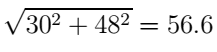
Another method that was presented in my book was
242400
can you explain how did the author came up with this solution? TIA.

(mentor note: moved from another forum to here --> hence no template)
 
Last edited by a moderator:
Physics news on Phys.org
paulmdrdo said:
Another method that was presented in my book
You want a repeat of what's in your book ? Or do you have a specific question about that presentation ?
Do you know how to deal with trigonometric equations like ##a\cos x + b\sin x =c ## ?

[edit] since you apparently managed to solve
paulmdrdo said:
by differentiating and equating it to zero
I must assume you do ... :rolleyes:
 
That is one of the results you derive once and then know. You can repeat what you did with general coefficients a and b and you'll get an amplitude of ##\sqrt{a^2+b^2}##. Alternatively you can look up the formula to combine the sum of a cosine and a sine into a single sine (with a phase shift), the formula for the amplitude has what you are looking for. That formula is derived the same way.
 

Similar threads

  • · Replies 15 ·
Replies
15
Views
2K
  • · Replies 9 ·
Replies
9
Views
1K
Replies
17
Views
3K
Replies
3
Views
1K
Replies
15
Views
4K
  • · Replies 25 ·
Replies
25
Views
4K
  • · Replies 9 ·
Replies
9
Views
2K
  • · Replies 2 ·
Replies
2
Views
2K
  • · Replies 5 ·
Replies
5
Views
2K