Maximum Charge on a Capacitor, Help

Click For Summary

Homework Help Overview

The discussion revolves around determining the time constant for charging a capacitor in a circuit involving resistors R1 and R2, and finding the maximum charge on the capacitor. The subject area includes concepts from circuit analysis and capacitor behavior.

Discussion Character

  • Exploratory, Conceptual clarification, Mathematical reasoning, Problem interpretation, Assumption checking

Approaches and Questions Raised

  • Participants discuss the equivalent resistance of parallel resistors and its impact on the time constant. There are attempts to express the maximum charge on the capacitor in terms of the voltage across R2. Some participants suggest using Thevenin's theorem as a simpler approach. Others question the parallel configuration of R1 and R2 and the implications for current and voltage across the capacitor.

Discussion Status

The discussion is ongoing, with various approaches being explored. Some participants have provided mathematical expressions and reasoning, while others are questioning assumptions and seeking clarification on the setup. There is no explicit consensus yet, but several productive lines of inquiry are being pursued.

Contextual Notes

Participants are navigating the complexities of the circuit configuration and the relationships between voltage, current, and charge. There are references to the behavior of the capacitor at different states of charge, and the need for clarity on the voltage across R2 in relation to the total emf E.

ryeager
Messages
2
Reaction score
0
Hi, thanks in advance to all who help

a) Determine the time constant for charging the capacitor in the circuit given.
b) what is the maximum charge on the capacitor?
R1
______vvvv____________
| | |
| < |
E R2 > C
| | |
|______________|______|

E = emf and C is the capacitor, sorry for the poor illustration.

Mentor's edit: Here's a better illustration:
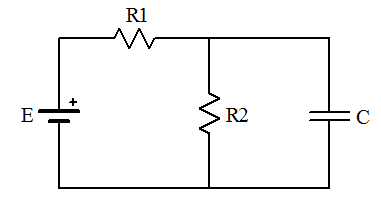
upload_2016-2-8_14-58-30.png


For a, I've determined the equivalent resistance of parallel resistors to be (1/R1 + 1/R2)^-1 = R1R2/(R1+R2), thus the time constant would be tau = CReq = CR1R2/(R1+R2)

For b) I have a feeling Qmax for the capacitor will be Qmax = CV where V is the voltage across R2 since R2 and C are parallel, but I can't figure out V across R2 in terms of E, R1, R2, C. Can anyone help? Thanks again.
 
Last edited by a moderator:
Physics news on Phys.org
ryeager said:
For a, I've determined the equivalent resistance of parallel resistors to be (1/R1 + 1/R2)^-1 = R1R2/(R1+R2), thus the time constant would be tau = CReq = CR1R2/(R1+R2)
I got the same result after solving with differential equations.
Let the time constant be T.
Current supplied by the source is,
I(t)=ET/(R1R2C)*(1-e-t/T)+(E*e-t/T)/R1
From this equation, it can be verified that at t=0, I=E/R1(capacitor acts as a short at t=0) and at t=∞, I=E/(R1+R2)..(capacitor acts as open circuit at t=∞).
ryeager said:
For b) I have a feeling Qmax for the capacitor will be Qmax = CV where V is the voltage across R2 since R2 and C are parallel, but I can't figure out V across R2 in terms of E, R1, R2, C.
In steady state, the capacitor will act as an open circuit. Hence, current will flow though the series combination of R1 and R2.
So, Voltage across C=Voltage across R2 in steady state= E*R2/(R1+R2)
Final charge on the capacitor=Q=CV= ECR2/(R1+R2).
 
  • Like
Likes   Reactions: Ronie Bayron and gracy
The above approach involves some mathematical calculations and a generalized expression for current I(t). Instead, I believe the best and simplest approach to solve these two questions a and b is Thevenin's theorem.
 
  • Like
Likes   Reactions: gracy
ryeager said:
Hi, thanks in advance to all who help

a) Determine the time constant for charging the capacitor in the circuit given.
b) what is the maximum charge on the capacitor?
R1
______vvvv____________
| | |
| < |
E R2 > C
| | |
|______________|______|

E = emf and C is the capacitor, sorry for the poor illustration.

Mentor's edit: Here's a better illustration:
View attachment 95530

For a, I've determined the equivalent resistance of parallel resistors to be (1/R1 + 1/R2)^-1 = R1R2/(R1+R2), thus the time constant would be tau = CReq = CR1R2/(R1+R2)

For b) I have a feeling Qmax for the capacitor will be Qmax = CV where V is the voltage across R2 since R2 and C are parallel, but I can't figure out V across R2 in terms of E, R1, R2, C. Can anyone help? Thanks again.
 
Why do you regard R1 and R2 as being in parallel?
When C is fully charged then the current through the capacitor is ?

Which makes the fial voltage across C ? ?Hence the max charge will be ? ? ?
 
Kenygreen said:
Why do you regard R1 and R2 as being in parallel?
When C is fully charged then the current through the capacitor is ?

Which makes the final voltage across C ? ?Hence the max charge will be ? ? ?
Are those your own queries or are you trying to give hints to the OP?
 
ryeager said:
Hi, thanks in advance to all who help

a) Determine the time constant for charging the capacitor in the circuit given.
b) what is the maximum charge on the capacitor?
R1
______vvvv____________
| | |
| < |
E R2 > C
| | |
|______________|______|

E = emf and C is the capacitor, sorry for the poor illustration.

Mentor's edit: Here's a better illustration:
View attachment 95530

For a, I've determined the equivalent resistance of parallel resistors to be (1/R1 + 1/R2)^-1 = R1R2/(R1+R2), thus the time constant would be tau = CReq = CR1R2/(R1+R2)

For b) I have a feeling Qmax for the capacitor will be Qmax = CV where V is the voltage across R2 since R2 and C are parallel, but I can't figure out V across R2 in terms of E, R1, R2, C. Can anyone help? Thanks again.
Vc=VR2 where R1 & R2 are voltage divider.
I = E/(R1+R2) and VR2=IR2, so Vc =E[R2/(R1+R2)]
 
Ronie Bayron said:
Vc=VR2 where R1 & R2 are voltage divider.
I = E/(R1+R2) and VR2=IR2, so Vc =E[R2/(R1+R2)]
Since C=Q/Vc, Q =C Vc, so the charge Q depends on the value of capacitance you put on your circuit and magnitude of Vc
 

Similar threads

  • · Replies 3 ·
Replies
3
Views
3K
  • · Replies 6 ·
Replies
6
Views
3K
  • · Replies 1 ·
Replies
1
Views
901
  • · Replies 7 ·
Replies
7
Views
2K
  • · Replies 1 ·
Replies
1
Views
4K
  • · Replies 7 ·
Replies
7
Views
2K
  • · Replies 21 ·
Replies
21
Views
3K
  • · Replies 3 ·
Replies
3
Views
2K
  • · Replies 4 ·
Replies
4
Views
2K
  • · Replies 4 ·
Replies
4
Views
4K