Maximum electric field from a blob

  • Thread starter Thread starter Rob2024
  • Start date Start date
  • Tags Tags
    Electric Field
Click For Summary
SUMMARY

The discussion focuses on determining the maximum electric field from a uniformly charged volume, specifically addressing the challenges in part b) of the problem. The equation for the electric field, $$ E = \frac{Qy}{4 \pi \epsilon_0 (x^2 + y^2)^{3/2} } $$ is established as a constant. Participants emphasize the importance of symmetry in the shape of the volume and the distribution of charge, noting that adjustments to surface elements can influence the resultant electric field. The conversation highlights the need for a uniform charge density along a curve to achieve the desired electric field characteristics.

PREREQUISITES
  • Understanding of electric fields and charge distributions
  • Familiarity with the concept of symmetry in physics
  • Knowledge of calculus, particularly in relation to volume integrals
  • Experience with electrostatics, specifically in the context of charged bodies
NEXT STEPS
  • Explore the implications of symmetry in electric field calculations
  • Research methods for optimizing charge distributions in electrostatics
  • Study the relationship between linear charge distributions and point charges
  • Investigate the mathematical techniques for volume integrals in electric field analysis
USEFUL FOR

Physics students, electrical engineers, and researchers focused on electrostatics and electric field optimization will benefit from this discussion.

Rob2024
Messages
39
Reaction score
6
Homework Statement
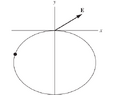
Purcell and Morin EM Exercise 1.49:

A point charge is placed somewhere on the curve shown in
Figure. This point charge creates an electric field at the origin.
Let ##E_y## be the vertical component of this field. What shape
(up to a scaling factor) should the curve take so that ##E_y## is inde-
pendent of the position of the point charge on the curve?
(b) You have a moldable material with uniform volume charge
density. What shape should the material take if you want to
create the largest possible electric field at a given point in
space? Be sure to explain your reasoning clearly.
Relevant Equations
Result for part a is the polar curve ##r^2 = C \sin \theta##
For part a) we have $$ E = \frac{Qy}{4 \pi \epsilon_0 (x^2 + y^2)^{3/2} } = \text{constant} $$
I am stuck on part b). What should the shape of the volume?...
 

Attachments

  • Selection_246.png
    Selection_246.png
    2.4 KB · Views: 53
Physics news on Phys.org
Suppose you have chosen the direction for the resulting field at the target point. Consider the contributions from volume elements on the surface of the body. What can you say about them?
 
they need to be symmetric.
 
Rob2024 said:
they need to be symmetric.
Right, but consider changing the shape a bit by moving some of these surface elements around. If the shape is optimum, what will you find?
 
The problem I have with the argument of trying to use the first solution is that the first problem uses a fixed point charge. I am not too sure if we can turn a linear charge distribution into the point charge...i.e. I am not comfortable to say if we have a curve embedded in a uniformly charged volume will have the same amount of charge along the curve. In other words, maybe we could say find a curve with uniform charge density that yields the same y component electric field. This curve is not the same as the curve in the first solution.
 
Rob2024 said:
The problem I have with the argument of trying to use the first solution is that the first problem uses a fixed point charge.
No, it compares positions where a point charge may be placed. You need to do likewise in part b, as I hinted in post #4.
Please try to answer the question I posed there.
 
#5 has the answer to your question. I understand you are alluding to use the solution from part a) but I am not too sure if that's correct since part a)'s solution uses the condition ##Q## is constant. Thanks for the help. I'll think about this some more.
 
Rob2024 said:
#5 has the answer to your question.
It certainly does not have the answer I am looking for.
Given one shape for the body, you might try to increase the field by shifting little bits at the surface around (in a way that does not alter the direction of the field, by combining symmetric pairs of moves, say). If the shape is already optimum, what will you discover when trying this?
 

Similar threads

  • · Replies 1 ·
Replies
1
Views
960
Replies
11
Views
1K
  • · Replies 11 ·
Replies
11
Views
1K
  • · Replies 7 ·
Replies
7
Views
796
  • · Replies 23 ·
Replies
23
Views
2K
  • · Replies 4 ·
Replies
4
Views
2K
Replies
6
Views
1K
  • · Replies 2 ·
Replies
2
Views
2K
  • · Replies 6 ·
Replies
6
Views
981
  • · Replies 10 ·
Replies
10
Views
3K