Maximum Height Calculation for Elastic Collision on Frictionless Track

  • Thread starter Thread starter ace214
  • Start date Start date
  • Tags Tags
    Collision
Click For Summary

Homework Help Overview

The discussion revolves around a physics problem involving an elastic collision between two blocks on a frictionless track. The original poster attempts to calculate the maximum height reached by one of the blocks after the collision, using principles of conservation of energy and momentum.

Discussion Character

  • Exploratory, Conceptual clarification, Mathematical reasoning

Approaches and Questions Raised

  • Participants discuss the application of conservation of momentum and energy in elastic collisions. The original poster describes their calculations and the resulting height, while others question the correctness of the momentum equation used and suggest the need for additional equations due to multiple unknowns.

Discussion Status

Some participants provide hints and corrections regarding the conservation equations, noting that both blocks are in motion after the collision. There is acknowledgment of the complexity of the calculations, with one participant mentioning they are getting close to the correct answer.

Contextual Notes

There is a mention of a deadline for the homework submission, which may influence the urgency of the discussion. Additionally, participants are exploring the implications of mass in the context of elastic collisions.

ace214
Messages
28
Reaction score
0
Consider a frictionless track as shown in Figure P6.48. A block of mass m1 = 5.55 kg is released from A. It makes a head on elastic collision at B with a block of mass m2 = 11.0 kg that is initially at rest. Calculate the maximum height to which m1 rises after the collision.
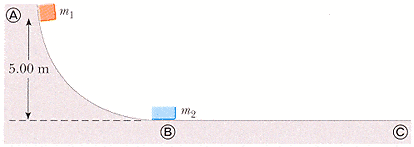
p6-48.gif


I used to .5mv^2 = mgh to get the velocity of the first block at the bottom. That was 9.9 m/s.

Then I did m1vi + m2vi = m1vf + m2vf => m1vi + 0 = 0 + m2vf to solve for the speed of the second block when the first block has gone back up the ramp and stopped. I then used the energy in the first equation and conservation of energy to solve for the final height.

KE = m1gh + .5m2v2f

But this gave me a height of 4.49 meters which WebAssign says is not correct. Thanks for any help. By the way, it's due at 8:30 EST tomorrow morning.
 
Last edited:
Physics news on Phys.org
You're conservation of momentum equation is incorrect. Both blocks are moving after the collision, so [tex]m_1 v_1 = m_1 v_1 _f + m_2 v_2 _f[/tex]

Since there are two unknowns, you need two equations. What else do you know to be true for elastic collisions?

I got to log off, but here's a hint: KINETIC ENERGY.

and there's a really simple way of doing this that doesn't involve squared speeds.
 
Last edited:
Chi Meson said:
You're conservation of momentum equation is incorrect. Both blocks are moving after the collision, so [tex]m_1 v_1 = m_1 v_1 _f + m_2 v_2 _f[/tex]

Since there are two unknowns, you need two equations. What else do you know to be true for elastic collisions?

That energy is conserved. So I use that momentum equation and
KE = m1v1f^2 + 11v2f^2

Solve for v1f and I get 9.9 and -3.3. So I use -3.3 and plug that into a new KE = PE for the amount of energy that the first block has now. And now I'm getting within 10% of the answer so I rounded badly somewhere. Great... Thanks for the help.
 
ace214 said:
That energy is conserved. So I use that momentum equation and
KE = m1v1f^2 + 11v2f^2

Solve for v1f and I get 9.9 and -3.3. So I use -3.3 and plug that into a new KE = PE for the amount of energy that the first block has now. And now I'm getting within 10% of the answer so I rounded badly somewhere. Great... Thanks for the help.

Yeah, it's not 3.3, it's 3.25. You've got 3 sigs here.

And the easier way I mentioned in the edit to my last post is:

the relative velocity between 2 bodies in a 1-D elastic collision stays constant. So: v1 - v2 = v2' - v1'

try it, it saves lots of time.
 
Ah cool. Thanks a lot.

Yeah, I did a quadratic and it was a pain.

I need to look up that equation and stuff cus I don't see off the bat how masses don't matter but ok.
 

Similar threads

  • · Replies 7 ·
Replies
7
Views
5K
  • · Replies 2 ·
Replies
2
Views
3K
  • · Replies 5 ·
Replies
5
Views
2K
  • · Replies 4 ·
Replies
4
Views
5K
  • · Replies 16 ·
Replies
16
Views
4K
  • · Replies 10 ·
Replies
10
Views
4K
  • · Replies 2 ·
Replies
2
Views
2K
Replies
3
Views
6K
Replies
3
Views
2K
Replies
2
Views
2K