Maxwell-Boltzmann Distribution and Probability

Click For Summary
SUMMARY

The forum discussion centers on the derivation of the Maxwell-Boltzmann distribution using entropy maximization techniques from the book 'Macroscopic and Statistical Thermodynamics'. The final expression for the distribution is established as \overline {n_j} = N 4\pi \left(\frac{\beta}{2\pi m}\right)^{\frac{3}{2}} p^2 e^{\frac{-p^2}{2mkT}} dp. The conversation also clarifies the probability of finding a particle with momentum p as P_{[p,p+dp]}=f(p)dp, emphasizing the continuous nature of momentum. The participants confirm the relationship between the average number of particles and the distribution function f(p).

PREREQUISITES
  • Understanding of statistical mechanics principles
  • Familiarity with Lagrangian multipliers
  • Knowledge of entropy and its applications in thermodynamics
  • Basic calculus for integration and probability functions
NEXT STEPS
  • Study the derivation of the Boltzmann distribution using Gibbs' entropy expression
  • Explore the implications of continuous probability distributions in statistical mechanics
  • Learn about the role of Lagrangian multipliers in optimization problems
  • Investigate applications of the Maxwell-Boltzmann distribution in real-world systems
USEFUL FOR

Physicists, students of thermodynamics, and researchers in statistical mechanics who seek to deepen their understanding of particle distributions and thermodynamic principles.

unscientific
Messages
1,728
Reaction score
13
In the book 'Macroscopic and Statistical Thermodynamics' they derived the Maxwell-Boltzmann distribution by maximizing entropy using lagrangian multipliers with constants ##\alpha## and ##\beta##.

The final result is given as:

\frac{\overline {n_j}}{g_j} = e^{-\beta \epsilon_j}e^{-\alpha}

where ##\overline {n_j}## is the occupation number and ##g_j## is the number of states of jth energy level.

After solving for ##e^{-\alpha} = \frac{N}{V}\left(\frac{h^2}{2\pi mkT}\right)^{\frac{3}{2}}## and integrating density of states to find ##g_j = \frac{V}{h^3} 4\pi p^2 dp##:

We obtain the maxwell-boltzmann distribution:

\overline {n_j} = \overline {n_{(p)}} dp = N 4\pi \left(\frac{\beta}{2\pi m}\right)^{\frac{3}{2}} p^2 e^{\frac{-p^2}{2mkT}} dp

I obtain the correct speed distribution ##\propto p^2 e^{\frac{-p^2}{2mkT}}##, but What is the probability/fraction of finding a particle with momentum p?
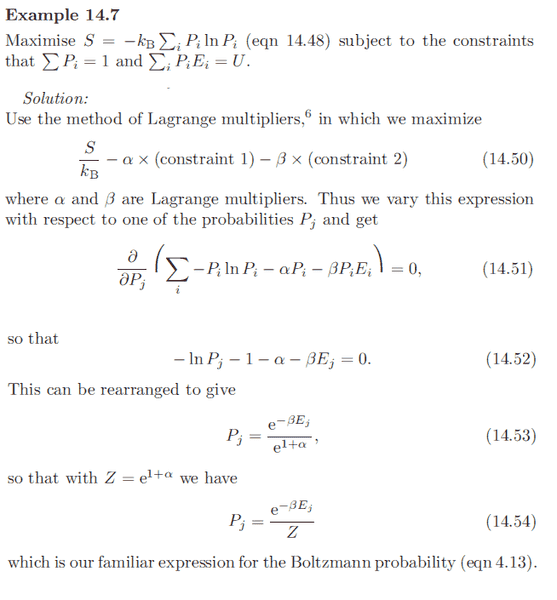
In Blundell's Book, a shorter approach is taken using gibbs' expression for entropy to find the Boltzmann probability:
20jqmtx.png


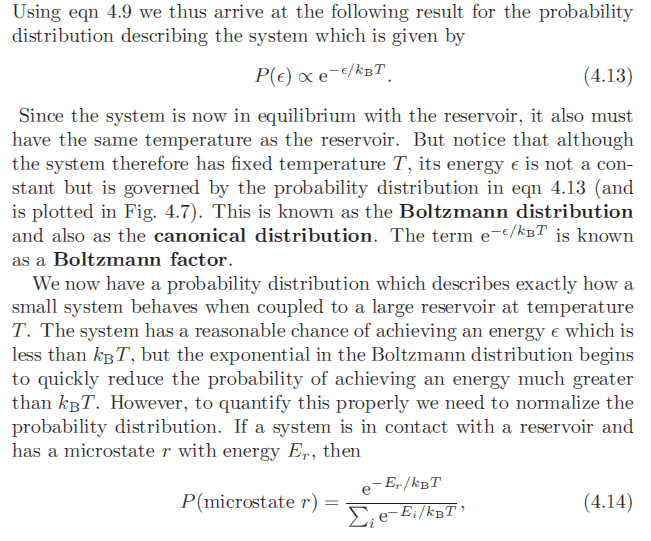
Here's the earlier reference to equation (4.13):
mt5ls7.png
 
Last edited:
  • Like
Likes   Reactions: 1 person
Physics news on Phys.org
Since the momentum p is a continuous quantity, looking for the probability of finding a particle with exactly p is pretty meaningless. One usually says that, if f(p) is the Maxwell-Boltzmann distribution then the probability of find a particle with momentum between p and p+dp is:
$$
P_{[p,p+dp]}=f(p)dp.
$$
For a general interval p\in[p_1,p_2] the probability is simply:
$$
P_{[p_1,p_2]}=\int_{p_1}^{p_2}f(p)dp.
$$
 
Einj said:
Since the momentum p is a continuous quantity, looking for the probability of finding a particle with exactly p is pretty meaningless. One usually says that, if f(p) is the Maxwell-Boltzmann distribution then the probability of find a particle with momentum between p and p+dp is:
$$
P_{[p,p+dp]}=f(p)dp.
$$
For a general interval p\in[p_1,p_2] the probability is simply:
$$
P_{[p_1,p_2]}=\int_{p_1}^{p_2}f(p)dp.
$$

Yes I get all that, but what is ##f_{(p)}## from ##\frac{\overline {n_j}}{g_j} = e^{-\beta \epsilon_j}e^{-\alpha}##?
 
Well, I suppose that \bar{n}_j=\bar{n}(p)dp is the average number of particles with momentum between p and p+dp. As you can see from your expression it is equal to the total number of particles N times something. By definition, that "something" is your distribution f(p).
 
Just divide by N.
f=\frac n N
 
Einj said:
Well, I suppose that \bar{n}_j=\bar{n}(p)dp is the average number of particles with momentum between p and p+dp. As you can see from your expression it is equal to the total number of particles N times something. By definition, that "something" is your distribution f(p).

Ok, so the momentum distribution is:

\overline {n_j} = \overline {n}_{(\vec {p})} d^3p = N \left(\frac{\beta}{2\pi m}\right)^{\frac{3}{2}} e^{\frac{-p^2}{2mkT}} d^3\vec{p}

By changing the dp's to dv's, thus the velocity distribution is:

\overline {n_j} = \overline {n}_{(\vec {v})} d^3v = N \left(\frac{\beta m}{2\pi }\right)^{\frac{3}{2}} e^{\frac{-p^2}{2mkT}} d^3\vec{v}

For a particular direction ##v_x##, simply just take one part of 'dv':

\overline {n_j} = \overline {n}_{(\vec {v_x})} dv_x = N \left(\frac{\beta m}{2\pi }\right)^{\frac{1}{2}} e^{\frac{-p_x^2}{2mkT}} d\vec{v}_x

With ##f_{(\vec{v})} = \frac{n_j}{N} = \left(\frac{\beta m}{2\pi}\right)^{\frac{3}{2}} e^{\frac{-p^2}{2mkT}}## and

##f_{(\vec{v_x})} = \left(\frac{\beta m}{2\pi}\right)^{\frac{1}{2}} e^{\frac{-p_x^2}{2mkT}}##

To change from velocity to speed distribution simply expand the ##d^3\vec{p}## to ##4\pi p^2 dp## or ##d\vec{v_x} = 4\pi v^2_x dv_x##.
 
Last edited:
At a first glance I would say that all the factors are correct. So, yes!
 
  • Like
Likes   Reactions: 1 person

Similar threads

  • · Replies 4 ·
Replies
4
Views
3K
  • · Replies 4 ·
Replies
4
Views
5K
  • · Replies 3 ·
Replies
3
Views
3K
  • · Replies 1 ·
Replies
1
Views
602
  • · Replies 38 ·
2
Replies
38
Views
5K
  • · Replies 5 ·
Replies
5
Views
747
  • · Replies 11 ·
Replies
11
Views
4K
  • · Replies 3 ·
Replies
3
Views
2K
  • · Replies 4 ·
Replies
4
Views
3K
  • · Replies 2 ·
Replies
2
Views
2K