Mean Magnetic Path Length of the Magnetic core of a transformer

Click For Summary
SUMMARY

The discussion centers on calculating the mean magnetic path length of a transformer core, specifically addressing the inclusion of air gap length in the calculation. The mean path length for the left core is stated as 1.11 meters according to the solution manual. Participants clarify that the air gap must be considered in the mean path length calculation to accurately determine reluctance, emphasizing the need for a third region in the magnetic circuit analysis. The discussion also references the Feynman lectures and highlights the importance of integrating magnetic field strengths across different sections of the core and air gaps.

PREREQUISITES
  • Understanding of magnetic circuits and reluctance
  • Familiarity with the Feynman lectures on electromagnetism
  • Knowledge of magnetic field strength (H) and magnetic flux density (B)
  • Basic principles of integral calculus as applied to magnetic fields
NEXT STEPS
  • Study the calculation of reluctance in magnetic circuits
  • Learn about the role of air gaps in transformer design
  • Explore the Feynman lectures on electromagnetism for deeper insights
  • Investigate the application of integral calculus in electromagnetic field analysis
USEFUL FOR

Electrical engineers, physics students, and professionals involved in transformer design and magnetic circuit analysis will benefit from this discussion.

janu203
Messages
35
Reaction score
2
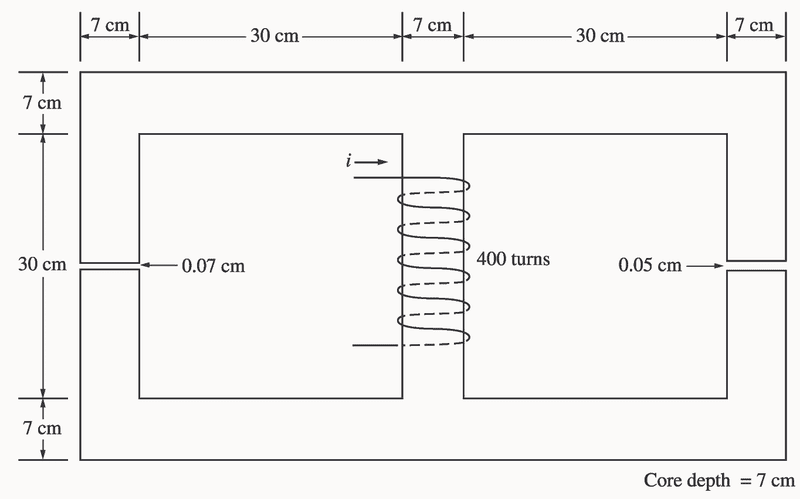
For the Image given, i have to calculate reluctances of air gap and core which depends on respective mean path lengths.
For the left hand core, the mean path length calculated in the solution manual is 1.11 meter . However what I don't understand is that why is the length of the air gap included in calculating mean path length of the core?

Don't we have to subtract the air gap length from the core so that true mean path length of the left core can be calculated?
aPzKq.png
 

Attachments

  • aPzKq.png
    aPzKq.png
    10.3 KB · Views: 2,961
Physics news on Phys.org
A previous homework problem that was posted on Physics Forums along with the discussion might be helpful in answering any questions you might have with the above: https://www.physicsforums.com/threads/absolute-value-of-magnetization.915111/ ## \\ ## Also, in the future please use the homework template for any homework questions. The staff has the option of deleting the thread for not using the homework template.
 
Charles Link said:
A previous homework problem that was posted on Physics Forums along with the discussion might be helpful in answering any questions you might have with the above: https://www.physicsforums.com/threads/absolute-value-of-magnetization.915111/ ## \\ ## Also, in the future please use the homework template for any homework questions. The staff has the option of deleting the thread for not using the homework template.
I will be mindful in future but that thread doesn't answer my question either.
 
And an additional comment: From what I can tell, this method of solution, (see post 2 including the "link" to the Feynman lectures solution), needs an addition which isn't presented in the Feynman lectures, but is necessary when the problem contains a branch like the above. In that case, you need a 3rd region, in the middle section, where ## H_{middle}=H_{left}+H_{right} ##. I think with that addition, the problem should be entirely workable. Also in each of the two gaps, you need ## H_{gap \, left} ##, and ## H_{gap \, right} ##.
 
  • Like
Likes   Reactions: janu203
And to answer your question, in ## \oint H \cdot dl ##, for each section of ## H ##, the integral simply involves the approximate path through the material. It's not high precision. In this case, I believe you actually have two separate sections of the path in the material: ## \int H_{middle} \cdot dl +\int H_{right} \cdot dl +\int H_{right \, gap} \cdot dl=NI ## is what the equation reads for the right loop. Similarly for the left loop. That along with ## H_{middle}=H_{right}+H_{left} ##.(The reason for this is that ## B_{middle}=B_{left}+B_{right} ## because the lines of flux of ## B ## are conserved and continuous). ## \\ ## Also: ## \int H_{middle} \cdot dl=H_{middle} L_{middle} ##, etc. ## \\ ## The Feynman type solution also assumes a continuous ## B ## across the gap so that ## H_{right}=B_{right}/\mu ## and ## H_{right \, gap}=B_{right}/\mu_o ##, etc. with ## B_{right} ## being the same in both expressions.
 
Last edited:
  • Like
Likes   Reactions: janu203
Charles Link said:
And to answer your question, in ## \oint H \cdot dl ##, for each section of ## H ##, the integral simply involves the approximate path through the material. It's not high precision. In this case, I believe you actually have two separate sections of the path in the material: ## \int H_{middle} \cdot dl +\int H_{right} \cdot dl +\int H_{right \, gap} \cdot dl=NI ## is what the equation reads for the right loop. Similarly for the left loop. That along with ## H_{middle}=H_{right}+H_{left} ##.(The reason for this is that ## B_{middle}=B_{left}+B_{right} ## because the lines of flux of ## B ## are conserved and continuous). ## \\ ## Also: ## \int H_{middle} \cdot dl=H_{middle} L_{middle} ##, etc. ## \\ ## The Feynman type solution also assumes a continuous ## B ## across the gap so that ## H_{right}=B_{right}/\mu ## and ## H_{right \, gap}=B_{right}/\mu_o ##, etc. with ## B_{right} ## being the same in both expressions.
yeah now i can get a feel for it
tx a bundle
 
  • Like
Likes   Reactions: Charles Link

Similar threads

Replies
22
Views
2K
  • · Replies 7 ·
Replies
7
Views
4K
  • · Replies 3 ·
Replies
3
Views
1K
  • · Replies 20 ·
Replies
20
Views
3K
  • · Replies 1 ·
Replies
1
Views
3K
  • · Replies 4 ·
Replies
4
Views
3K
  • · Replies 2 ·
Replies
2
Views
2K
  • · Replies 14 ·
Replies
14
Views
3K
  • · Replies 1 ·
Replies
1
Views
4K
  • · Replies 9 ·
Replies
9
Views
3K