Measure with a zero-energy fundamental state

Click For Summary

Homework Help Overview

The discussion revolves around a quantum mechanics problem involving a Hamiltonian and an observable. The original poster is tasked with calculating the probability of measuring values of an observable in the fundamental state, which is identified as the ground state with zero energy.

Discussion Character

  • Exploratory, Conceptual clarification, Mathematical reasoning

Approaches and Questions Raised

  • The original poster attempts to relate the eigenvalues and eigenvectors of the Hamiltonian to the observable, expressing confusion about the significance of the zero energy state and the interpretation of coefficients in the eigenvector expansion.

Discussion Status

Participants are actively engaging in clarifying concepts related to the ground state and the mathematical representation of eigenvectors. Some guidance has been provided regarding the interpretation of the coefficients in the eigenvector and the relevance of the zero energy state.

Contextual Notes

There is an ongoing exploration of the definitions and relationships between the Hamiltonian, the observable, and the corresponding eigenstates. The original poster has indicated a language barrier that contributed to initial misunderstandings.

Keru
Messages
20
Reaction score
1
Homework Statement

Given the following Hamiltonian:
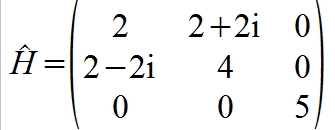
upload_2018-1-2_13-54-42.png

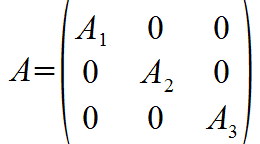
And the observable:
upload_2018-1-2_13-54-57.png


Calculate the probability of measuring any of the possible values of A in the fundamental state.

The attempt at a solution

I have calculated the eigenvectors and eigenvalues of the Hamiltonian, being the eigenvalues {0,5,6}
So the fundamental state have a zero energy. Is this relevant? Or has the same procedure as if the fundamental state was non-zero?
Also, how can I relate A and H? I'm very lost in Matrix Mechanics...
 

Attachments

  • upload_2018-1-2_13-54-42.png
    upload_2018-1-2_13-54-42.png
    2 KB · Views: 830
  • upload_2018-1-2_13-54-57.png
    upload_2018-1-2_13-54-57.png
    1.7 KB · Views: 860
Physics news on Phys.org
I assume that by fundamental state you mean the state of lowest energy or ground state. No, the zero that you get is irrelevant. The reference zero point of energy is arbitrary. Here it happens that one of the states of the system is at zero. For the other question, you have the eigenvector corresponding to the ground state in a form that looks something like |V1> = a1|1> + a2|2> + a3|3>. What is the interpretation of the coefficients ai?
 
  • Like
Likes   Reactions: Keru
kuruman said:
I assume that by fundamental state you mean the state of lowest energy or ground state. No, the zero that you get is irrelevant. The reference zero point of energy is arbitrary. Here it happens that one of the states of the system is at zero. For the other question, you have the eigenvector corresponding to the ground state in a form that looks something like |V1> = a1|1> + a2|2> + a3|3>. What is the interpretation of the coefficients ai?

Yes, i meant ground state. I translated it wrong from Spanish.
I know the chances of getting every possible measure are |ai|2, and that ai = <Vi|V>. But I'm not sure what "V" is. I guess it must be a vector in order to get a scalar from the product, but what i (possibly wrongly) understand, is that V is a matrix containing the three possible eingenvectors... What am i missing?
 
You got three eigenvectors when you diagonalized the Hamiltonian. Of these three choose the one that corresponds to eigenvalue zero. That's vector V.
 
kuruman said:
You got three eigenvectors when you diagonalized the Hamiltonian. Of these three choose the one that corresponds to eigenvalue zero. That's vector V.

Wouldn't that be Vi?
 
No it would not. It would be |V> which is a 3×1 column vector corresponding to eigenvalue zero. Can you show me what eigenvector you got for eigenvalue zero?
 
kuruman said:
No it would not. It would be |V> which is a 3×1 column vector corresponding to eigenvalue zero. Can you show me what eigenvector you got for eigenvalue zero?

Sure.
$$ V_1= \frac {1} {\sqrt{3}} (-1 - i, 1, 0) $$
 
Good. Now think of this as a vector written in unit vector notation as
$$|V_1>= \frac {(-1-i)} {\sqrt{3}}|1> + \frac {1} {\sqrt{3}}|2>+\frac {0} {\sqrt{3}}|3>$$
where ##|1>,~|2>## and ##|3>## are the unit vectors or more correctly the ordered orthonormal basis set. It is the basis in which A is diagonal, that is ##<i|A|j>=A_i \delta_{ij}##. Note that you can also write ##V_1## in general as $$|V_1>= \sum_{k=1}^3a_k|k>$$
where ##a_k=<k|V_1>##. Now go back and read your post #3. Do you see what's going on?
 
  • Like
Likes   Reactions: Keru
Ok, I finally got it. Had a confusion with the basis, but now i know what I was getting wrong. I'm still a newbie at QM, thanks for the patience and for the help, you have my sincere "like" !

(Thread can be closed now i guess)
 
  • #10
Keru said:
(Thread can be closed now i guess)
Actually, no. Others may choose to post their comments. However, as the OP you can click "Mark Solved" (upper right) if you wish.
 

Similar threads

  • · Replies 5 ·
Replies
5
Views
2K
  • · Replies 9 ·
Replies
9
Views
2K
  • · Replies 14 ·
Replies
14
Views
3K
Replies
1
Views
2K
Replies
17
Views
3K
  • · Replies 3 ·
Replies
3
Views
3K
Replies
2
Views
2K
  • · Replies 3 ·
Replies
3
Views
2K
  • · Replies 1 ·
Replies
1
Views
2K
  • · Replies 3 ·
Replies
3
Views
2K