Measuring Steam Condensate from my Steam Cleaner

  • Context: Undergrad 
  • Thread starter Thread starter JoeyF
  • Start date Start date
Click For Summary

Discussion Overview

The discussion revolves around calculating the amount of steam condensate produced by a steam cleaner designed with a through-flow heater and solenoid pump. Participants explore the principles and equations necessary to estimate the condensate volume, considering factors such as steam quality, pressure, and system design. The conversation includes technical details about steam properties and measurements related to the operation of the steam cleaner.

Discussion Character

  • Technical explanation
  • Mathematical reasoning
  • Experimental/applied
  • Debate/contested

Main Points Raised

  • One participant describes the setup of their steam cleaner and the issue of leftover condensate after use, seeking help to calculate the amount of condensate produced.
  • Another participant references steam table properties, including specific enthalpy and specific volume, but expresses uncertainty about how to apply these values.
  • Several participants suggest that the mass of steam can be calculated by dividing the hose volume by the specific volume of steam, equating this to the mass of condensate.
  • One participant notes that their calculations suggest that the excess water may not be primarily from condensate, indicating a need for further experimentation to isolate the tubing and measure condensate directly.
  • Another participant proposes calculating the steam generation capacity of the heater and comparing it to the actual flow rate, emphasizing the importance of water fully contacting the heater for effective heat transfer.
  • One participant shares experimental results, indicating that they collected 1.5 grams of condensate and discusses various definitions of steam quality based on their measurements.
  • Another participant suggests a method for measuring steam quality using a steam separator and outlines a procedure to obtain more accurate measurements of water entering and leaving the steam generator.

Areas of Agreement / Disagreement

Participants express differing views on the interpretation of steam quality and the sources of excess water. While some agree on the need for accurate measurements and calculations, there is no consensus on the definitions of steam quality or the primary source of the excess water observed.

Contextual Notes

Participants acknowledge limitations in their assumptions, such as the need for all water to contact the heater for full heat transfer and the potential impact of steam quality on measurements. There are unresolved mathematical steps and dependencies on specific conditions that affect the calculations.

Who May Find This Useful

This discussion may be useful for individuals interested in steam systems, thermodynamics, and experimental design in engineering contexts, particularly those working with steam generation and measurement techniques.

JoeyF
Messages
13
Reaction score
0
TL;DR
I would like to understand how much water condenses from a fixed volume of steam as a result of cooling the system to ambient. Starting Saturated Steam mixture has a pressure of 18 psi in a volume of 2.46e-5 m^3
I've developed a Steam Cleaner using a through-flow heater (800W) . Solenoid pump is roughly 60 mL/min . Heater Power is limited via Thermostat. The Pump is always running. The Steam Outlet is controlled by a deadman-style valve (normally closed). The Steam outlet is also on a hose that has roughly 6 feet of tubing (I estimate about 2.46 e-5 m^3 of volume containing steam during use). It is a closed system (with a limiting pressure relief valve that wastes water pre-heater when the outlet valve is closed. Works great! However...

Since it is a closed system, after I power down the machine, the leftover steam condenses inside the system. I would like to be able to calculate the amount of Condensate (in grams/mL) that will condense and get leftover in my system. The downside to this is a big slug of water that comes out of the cleaner upon subsequent use. SOME of this liquid is a consequence of the large temperature swings I see in my heater due to the relatively large tolerance on my Thermostat and lack of flowrate controls, but I'm consistently measuring around 16 mL of leftover water during subsequent uses. I want to understand how much liquid water is actually from the Steam condensing. Can anybody help me understand a principle/equation that might get me started?

Some more supporting information: Operating Pressure ~18 psi. After System is turned off, System drops to ~ (-)8 psi.

Thanks!
 
Science news on Phys.org
Based on Steam Table, here are some properties I've started on. Just not entirely sure what to do with them yet.

Saturated Steam Properties:
Gage Pressure = 18 psi
Temp = 124.038 °C
Specific Enthalpy = 2711.7 KJ / kg
Specific Volume of Saturated Steam = 0.7918 m3 / kg [ assuming quality of 1 , 100% steam ]
Total Volume in System = roughly 2.465 m3
Molar Mass of Water = 18.015 g / mol
 
Hose volume in ##m^3## divided by specific volume of steam in ##m^3 / kg## equals kg of steam, which is the same mass of condensate (liquid water). Water has density of 1 kg / liter, so you now have the volume of the water. Convert to ml, and there is your answer.

The pressure drops to negative gauge pressure after shutdown because the steam condenses until the liquid water vapor pressure plus the partial pressure of any air that leaked in is -8 psi, or about 6.7 psi absolute.
 
  • Like
Likes   Reactions: russ_watters
jrmichler said:
Hose volume in ##m^3## divided by specific volume of steam in ##m^3 / kg## equals kg of steam, which is the same mass of condensate (liquid water). Water has density of 1 kg / liter, so you now have the volume of the water. Convert to ml, and there is your answer.

The pressure drops to negative gauge pressure after shutdown because the steam condenses until the liquid water vapor pressure plus the partial pressure of any air that leaked in is -8 psi, or about 6.7 psi absolute.
Ok, Thanks!

Assuming I have 100% Vapor, that would render only 0.03 g/mL of water, i.e., my excess water is not coming from Condensate likely. It takes less than 1% Steam Quality to begin producing larger amounts of Steam/Condensate. By calculation looks like 1% would give me 2.75 g/mL of water. I don't believe I'm much less than 75% steam quality, so this water must be coming from elsewhere. I'm going to perform an experiment where I isolate the tubing and measure the condensate to be 100% sure.

1686072262470.png

1686072357413.png
 
JoeyF said:
I've developed a Steam Cleaner using a through-flow heater (800W) . Solenoid pump is roughly 60 mL/min .
I suggest that you calculate how much steam can be generated from an 800W heater that is running 100%. Then compare to your actual flow rate.

Hint: A practical reality to watch for is that all of the water must fully contact the heater in order to get full heat transfer.

JoeyF said:
that would render only 0.03 g/mL of water
Check your units. ALWAYS check your units. Because these units are a density, not an amount.
 
  • Like
Likes   Reactions: russ_watters
jrmichler said:
I suggest that you calculate how much steam can be generated from an 800W heater that is running 100%. Then compare to your actual flow rate.

Hint: A practical reality to watch for is that all of the water must fully contact the heater in order to get full heat transfer. Check your units. ALWAYS check your units. Because these units are a density, not an amount.
poor nomenclature on my end. I meant 0.03 g , alternatively 0.03 mL , (g=mL)
 
Update with some comparative data.

I was able to isolate and collect the condensate in my "Hose". What I collected was on average 1.5 grams.

By a 'Theoretical Definition', I could map out Steam Quality for Saturated Steam Mixture at 18 psi (shown below), and match the mass of Water (which equates to mass of Steam and eventual mass of Steam Condensate at Room Temp), and back out a Steam Quality. 1.5 gram of Steam, yields a quality of 1% based on my 'Hose Volume' (1.36e^-5 m^3).

This is inaccurate and not representative of my actual Steam Quality obviously. The main incorrect assumption may be what @jrmichler , pointed out - All water would have to come in contact with the heater for full heat transfer / conversion to Steam. It is evident visually and by some more data that I've taken that liquid water is making it's way past the heater in my system. So I think that's most of where this 1.5 grams is coming from.

Question 1) Is the above accurate?

1686775697645.png
Now for a more practical estimation of Steam Quality. Maybe somebody can help me understand if I'm interpreting this correctly.

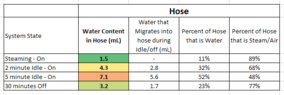
By a 'Instantaneous Definition' of Steam Quality, I would take the Total volume of the Hose, subtract the volume of Steam Condensate collected, and divide by the Total volume of the System. If I do this, I end up with 89% [ (13.65 - 1.5)/13.65 ]. This seems pretty accurate based on how my steam looks and feels - i.e. 89% vapor, 9% liquid.

I have pause calling this Steam Quality though because it's more describing the mix of Wet Steam + the Water that escapes past the heater, but maybe it truly is Steam Quality?

By an 'Averaged Definition' of Steam Quality, I would make this calculation over a longer period of time. Taking the Total Volume that I feed the heater, subtracting the Steam Condensate that I collect (via spraying steam over a large pan and letting water droplets fall out of suspension), and dividing by Total Volume fed. For example (hypothetical numbers), running 10 minutes at 70 mL/min would mean 700 mL of water. If I collect 50 mL, that would result in 93% [ (700-50) / 700 ].

Question 2) For anybody well versed in the Steam Industry, can I get away with calling either of my estimations above, 'Instantaneous' or 'Averaged', as an actual representation of Steam Quality?

...

Bonus for anybody interested: Here is where I netted out with water collected in different areas and different conditions.

1686838042127.png
 

Attachments

  • 1686775500082.png
    1686775500082.png
    4.8 KB · Views: 140
There is a better way to measure steam quality from your setup. Try this procedure:
1) Assume 60 ml/min, 100% heat transfer, and 800 watts. Calculate the amount of steam and steam quality.

2) Connect the output of your steam generator to a steam separator. The steam separator is a T-shaped insulated piece of pipe as in the rough sketch below:
Steam separator.jpg

The steam enters from the left, presumably at a velocity that mixes the water with steam. It enters the larger horizontal pipe and slows to a velocity slow enough that the water drops out. Using the steam quantity from (1) above and atmospheric pressure, calculate the pipe diameter that allows this to happen. I would guess that a steam velocity of about 3 m/sec would work.

3) Run the system with the drain valve open until it is fully heated up and you have stable operation. Then close the drain valve and start your stopwatch.

4) After an appropriate time interval, disconnect the supply line, stop the stopwatch, and measure the amount of water in the steam separator. You now have a reasonably accurate measurement of the amount of water entering the steam generator, and the amount of liquid water leaving the steam generator. The difference between those two is the amount of steam that exited through the top vent.

JoeyF said:
large temperature swings I see in my heater due to the relatively large tolerance on my Thermostat and lack of flowrate controls,
This implies that the heater is switching on and off because there is insufficient heat transfer to the water. That's why you did the calculation in Step 1. If that calculation shows that 800W is enough to evaporate only a portion of the water, and the thermostat is cycling the heater, then you have poor heat transfer from the heater to the water.
 
Thanks a lot @jrmichler for the suggestions.
jrmichler said:
This implies that the heater is switching on and off because there is insufficient heat transfer to the water.
That would be true if I was feeding water 100% of the time. My system only flows when user opens valve, so you get on and off cooling and thus off and on TSTAT.

I also do want some water to get through because it "looks" better than pure invisible steam - my goal isn't to have 100% Steam Quality.

@jrmichler, Any chance you can confirm my definitions of Steam Quality described above, or the only reasonable way, the method you describe?
 

Similar threads

  • · Replies 8 ·
Replies
8
Views
2K
  • · Replies 4 ·
Replies
4
Views
2K
  • · Replies 26 ·
Replies
26
Views
4K
  • · Replies 9 ·
Replies
9
Views
2K
  • · Replies 14 ·
Replies
14
Views
3K
  • · Replies 3 ·
Replies
3
Views
2K
  • · Replies 6 ·
Replies
6
Views
4K
  • · Replies 6 ·
Replies
6
Views
12K
  • · Replies 2 ·
Replies
2
Views
2K
  • · Replies 9 ·
Replies
9
Views
2K