High School Measuring the speed of light from moving source of light

Click For Summary
SUMMARY

The discussion centers on the measurement of the speed of light from a moving source, highlighting the challenges and methodologies involved. It emphasizes that while the speed of light can be indirectly measured through frequency and wavelength, this approach is not straightforward due to the reliance on current standards that define light speed as a constant. The conversation references various experiments, including cosmological tests that compare light from moving and stationary sources, and points out the circularity of using modern standards to measure light speed. The need for alternative standards, such as the old prototype meter bar, is also discussed.

PREREQUISITES
  • Understanding of the principles of special relativity
  • Familiarity with frequency and wavelength measurement techniques
  • Knowledge of national standards laboratories, specifically NIST
  • Basic concepts of differential measurement in physics
NEXT STEPS
  • Research the methodology of measuring frequency and wavelength in optical physics
  • Explore the implications of using historical standards for measuring the speed of light
  • Investigate cosmological tests comparing light from moving and stationary sources
  • Review literature on the calibration of atomic clocks and their relation to light speed measurements
USEFUL FOR

Physicists, researchers in optics, and anyone interested in the experimental measurement of light speed and its implications in modern physics.

Rozman
Messages
9
Reaction score
0
The speed of light from a moving source of light is usually recognized indirectly, based on various explanations of phenomena. The speed of light is fairly simple directly measurable on the basis of autonomous and separate measurements of the frequency and wavelength of the light.
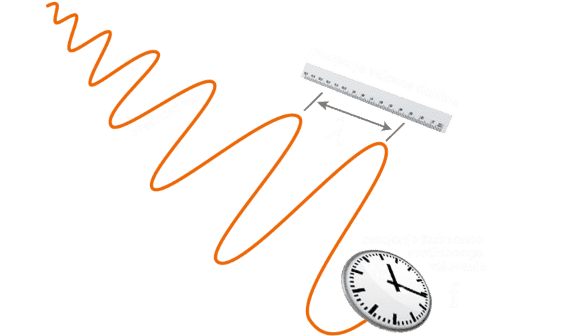
metitev%20hitrosti%20svetlobe.png

Is a similar measurement of the speed of light from the moving light source already performed and described in articles? Which direct and therefore undoubtedly measurement of the speed of light from a moving light source is most convincing?
 

Attachments

  • metitev%20hitrosti%20svetlobe.png
    metitev%20hitrosti%20svetlobe.png
    14.3 KB · Views: 741
Physics news on Phys.org
Rozman said:
The speed of light is fairly simple directly measurable on the basis of autonomous and separate measurements of the frequency
Really? Can you cite any references showing this? In particular the accuracy to which frequency and wavelength measurements can be made in the optical range?

I would call this an indirect measure of the speed. Instead of directly measuring speed you are directly measuring frequency and wavelength and then calculating speed. That is much more indirect than simply directly measuring the speed to begin with.

But whether you call it direct or indirect, such a measurement does not seem simple to me. At least not to the level of precision available with standard measurements.
 
  • Like
Likes russ_watters
There's another problem that I think needs to be addressed. The speed of light is defined as a constant nowadays, so it's not something that can be measured with current time and distance standards. One would be in the position of using a standard that was calibrated by the appropriate national standards laboratory (NIST in the United States) based on the current standards which assume that the speed of light is a constant to measure the speed of light. This is highly circular.

One way of addressing the issue would be by acquiring some old "retro" standards of the meter that are not based on the current SI definition of the meter. This means that the aspiring experimenter may not be able go to their local national institute of standards to calibrate their standards used to measure distance (whether it be flight distance or wavelength) for such an experiment. They would need to use a different standard (I would assume they would use the old standard based on the prototype meter bar standard, but I'm not the one interested in doing such an experiment). More importantly, beside using such a standard, they'd need to describe what standard they were using in some detail.

If they only wants to compare the speed of light from a moving source to a speed of light from a stationary source in a differential measurement, this obstacle may be avoidable. Such experiments have been done, some of the cosmological tests described in http://math.ucr.edu/home/baez/physics/Relativity/SR/experiments.html#moving-source_tests for instance. The cosmological tests are well known and inherently use such a differential measurement technique to compare the speed of light from a binary source (such as binary star) moving away from us to the speed of light from the star moving towards us. The effect on the image of any change in the speed of light based on source velocity is discussed in many textbooks as well as in the papers referenced in the above link (though I don't recall the details of exactly which textbooks). I'm not familiar with the details of the terrestial experimetns described in the above references, they may not be described in textbooks either, which means one likely has to read the papers for details.

The fact that our primary standards have been calibrated from atomic clocks and the speed of light for quite some time should be a big clue that such an experiment is not likely to yield any unexpected results, given the number of highly precise experiments which have been carried out successfully using references traceable to the NIST standards, said standards being based on the constancy of the speed of light.

It could be interesting to find the meeting notes of the professional body, the BIPM I believe, where the change in standard was discussed before being adopted. I'm sure I've read something about this once upon a time, but I don't recall the details.
 
Last edited:
  • Like
Likes Ibix and Dale
Dale said:
Really? Can you cite any references showing this?
I described the method of separate frequency and the wavelength measurement of light in the article: <Personal unpublished link deleted> I'm looking forward to some response to the article.
 
Last edited by a moderator:
Rozman said:
I described the method of separate frequency and the wavelength measurement of light in the article: <Personal unpublished link deleted> I'm looking forward to some response to the article.
We do not provide review or editing of personal research prior to publication in the professional scientific literature.
 
  • Like
Likes Sorcerer
In an inertial frame of reference (IFR), there are two fixed points, A and B, which share an entangled state $$ \frac{1}{\sqrt{2}}(|0>_A|1>_B+|1>_A|0>_B) $$ At point A, a measurement is made. The state then collapses to $$ |a>_A|b>_B, \{a,b\}=\{0,1\} $$ We assume that A has the state ##|a>_A## and B has ##|b>_B## simultaneously, i.e., when their synchronized clocks both read time T However, in other inertial frames, due to the relativity of simultaneity, the moment when B has ##|b>_B##...

Similar threads

  • · Replies 13 ·
Replies
13
Views
2K
  • · Replies 19 ·
Replies
19
Views
1K
  • · Replies 42 ·
2
Replies
42
Views
3K
  • · Replies 33 ·
2
Replies
33
Views
4K
  • · Replies 53 ·
2
Replies
53
Views
6K
  • · Replies 45 ·
2
Replies
45
Views
6K
  • · Replies 25 ·
Replies
25
Views
5K
  • · Replies 146 ·
5
Replies
146
Views
10K
  • · Replies 13 ·
Replies
13
Views
3K
  • · Replies 15 ·
Replies
15
Views
2K