Mechanical Principles Dynamics of Rotating Systems

Click For Summary
SUMMARY

The discussion focuses on the mechanical principles governing the dynamics of rotating systems, specifically analyzing a piston mechanism at an angle θ = 45°. Key calculations include determining the velocity of the piston relative to a fixed point O (VBO), the angular velocity of link AB about point A (ωAB), and the acceleration of point B relative to A (aBA). The velocity triangle is utilized to derive VBO, which is calculated as 1.1107 m/s. Additionally, the discussion addresses conditions for zero velocity at point B and the maximum angular velocity of link AB.

PREREQUISITES
  • Understanding of mechanical dynamics and kinematics
  • Familiarity with angular velocity and linear velocity concepts
  • Knowledge of vector resolution in physics
  • Proficiency in using trigonometric functions in mechanical calculations
NEXT STEPS
  • Study the principles of rotational dynamics in mechanical systems
  • Learn about velocity triangles and their applications in kinematics
  • Explore the calculation of angular acceleration in rotating systems
  • Investigate the effects of varying angles on the dynamics of pistons
USEFUL FOR

Mechanical engineers, physics students, and anyone involved in the design and analysis of rotating systems will benefit from this discussion.

mally baringon
Messages
2
Reaction score
0
1. For the mechanism shown in FIGURE 1 determine for the angle
θ = 45°:

(i) the velocity of the piston relative to the fixed point O (VBO)
(ii) the angular velocity of AB about point A (i.e. ωAB)
(iii) the acceleration of point B relative to A (aBA).

(b) Determine the value of the angle θ (measured from vertical) when:
(i) the velocity of point B = 0
(ii) the angular velocity of link AB a maximum.

(c) What is the maximum angular velocity of link AB?
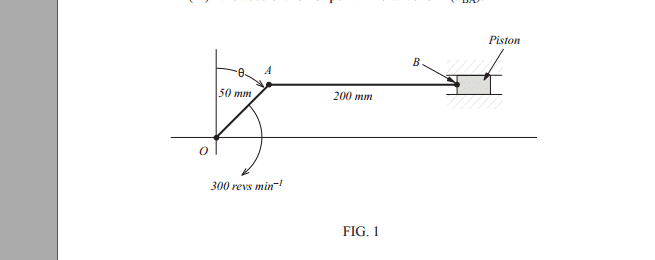
upload_2017-5-31_15-50-21.png

Homework Equations


Vao = Loa x ωoa

The Attempt at a Solution


Vao = Loa x ωoa = 0.005 x 10pi 0.1570

velocity triangle cosθ = Vbo/Vao

VBo =cos45 x Nao = 0.707 x 1.5708 = 1.1107 m/s^-1


I just have no idea where to start or what numbers to use where
 

Attachments

  • upload_2017-5-31_15-50-2.png
    upload_2017-5-31_15-50-2.png
    3.6 KB · Views: 592
Physics news on Phys.org
Try to define de displacement of point B as a function of de alngle theta. You can define vectors from origin O to help you.
 
  • Like
Likes   Reactions: berkeman
Diegor said:
Try to define de displacement of point B as a function of de alngle theta. You can define vectors from origin O to help you.
That would certainly work, but is unnecessarily complicated for the specific questions asked.
@mally baringon, if you resolve the instantaneous velocities of A and B into components along the rod and normal to the rod, what relationship must exist between them?
 

Similar threads

  • · Replies 12 ·
Replies
12
Views
5K
  • · Replies 8 ·
Replies
8
Views
2K
  • · Replies 5 ·
Replies
5
Views
4K
Replies
13
Views
11K
  • · Replies 18 ·
Replies
18
Views
5K
  • · Replies 3 ·
Replies
3
Views
3K
  • · Replies 19 ·
Replies
19
Views
4K
  • · Replies 6 ·
Replies
6
Views
3K
  • · Replies 10 ·
Replies
10
Views
3K
  • · Replies 26 ·
Replies
26
Views
9K