Microscope Optics: questions and calculations

Click For Summary
SUMMARY

This discussion focuses on the calculations involved in microscope optics, specifically using a 150 mm and 75 mm convex lens setup. Key distances include the object distance (dO = 10.6 cm) and the distance between the objective and eyepiece (D = 34 cm). The first image distance (dI = 26 cm) results in a magnification (M1 = -2.4), indicating an inverted and real image. The second image distance (dI' = 35 cm) leads to a total magnification of -5.8, confirming the final image is enlarged and inverted.

PREREQUISITES
  • Understanding of the thin lens formula: 1/dO + 1/dI = 1/f
  • Familiarity with magnification calculations: M = -dO/dI
  • Knowledge of real and virtual images in optics
  • Basic principles of microscope construction and operation
NEXT STEPS
  • Study the application of the thin lens formula in complex optical systems
  • Explore the concept of virtual images and their significance in microscopy
  • Research advanced magnification techniques in optical instruments
  • Learn about the impact of lens quality and alignment on image clarity
USEFUL FOR

Students and professionals in optics, physics educators, and anyone involved in the design and analysis of optical instruments, particularly microscopes.

member 731016
Homework Statement
Please see below
Relevant Equations
Please see below
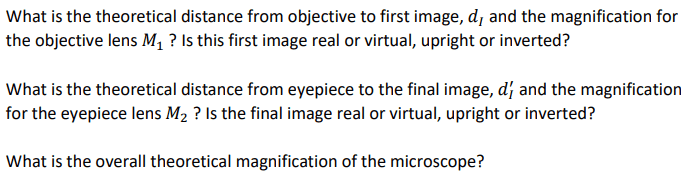
For this problem,

Distance from objective to object ##š‘‘š‘‚ = 10.6cm##
Distance between the objective and eyepiece ##š· = 34cm##

1683350352608.png


For (b) I got ##d_I = 26 cm## and ##M_1 = -2.4## which means that firsts image is inverted and real

For (c) I got ##dI' = 35 cm## and ##M_2 = -1.3##. However, I thought ##dI' < 0## since the second image is virtual and inverted from a ray diagram.

For (d)

I got ##M = M_1M_2 = 3.2## which is interesting since the finial image is inverted

Can someone please tell me whether I am correct and how to tell the second image is virtual without drawing a ray diagram?

Many thanks!
 
Last edited by a moderator:
Physics news on Phys.org
Hi, seems to me there is a lot missing:
Given information?
Relevant equations?
 
  • Like
Likes   Reactions: member 731016
BvU said:
Hi, seems to me there is a lot missing:
Given information?
Relevant equations?
Thank you for your reply @BvU!

Distance from objective to object ## d_O = 10.6cm##
Distance between the objective and eyepiece ##D = 34cm##

Is the given information (the data collected from the experiment)

Relevant equation:
- thin lens formula ##\frac{1}{d_O} + \frac{1}{d_I} = \frac{1}{f}##
- Magnification formula ##M = -\frac{d_{O}}{d_I}##

Many thanks!
 
Never saw a microscope do anything sensible at 10.6 cm from the object....
 
  • Like
Likes   Reactions: member 731016 and berkeman
BvU said:
Never saw a microscope do anything sensible at 10.6 cm from the object....
Thank you for your reply @BvU!

Well it did in the labs! We used a 150 mm and 75 mm convex lens to make a microscope and adjusted the distances accordingly to get a clear image.

Many thanks!
 
ChiralSuperfields said:
Well it did in the labs! We used a 150 mm and 75 mm convex lens to make a microscope and adjusted the distances accordingly to get a clear image
Do you realize there is some very useful information there?
BvU said:
Never saw a microscope do anything sensible at 10.6 cm from the object....
So this isn't some biologist's microscope, but a lab exercise to work out the principles. OK!

And now we have some input for the relevant equations !

Now we can gamble safely that the objective lens is the 75 mm one ( but it would have been much better if you had offered that voluntarily in the problem description :wink:).

Then I can understand your answer to the (b) (?) part.

But not what you do for (c). What is your ##d_{O'}## ?
(Or better: post your work, clearly, step by step :smile:)

##\ ##
 
  • Like
Likes   Reactions: SammyS and member 731016
BvU said:
Do you realize there is some very useful information there?

So this isn't some biologist's microscope, but a lab exercise to work out the principles. OK!

And now we have some input for the relevant equations !

Now we can gamble safely that the objective lens is the 75 mm one ( but it would have been much better if you had offered that voluntarily in the problem description :wink:).

Then I can understand your answer to the (b) (?) part.

But not what you do for (c). What is your ##d_{O'}## ?
(Or better: post your work, clearly, step by step :smile:)

##\ ##
Thank you for your reply @BvU!

My ##d_{O'}## for is the real image formed by objective lens. I use that virtual object for the eyepiece.

##\frac{1}{26} + \frac{1}{dI'} = \frac{1}{15}##
##d_{I'} = 35 cm##

Many thanks!
 
ChiralSuperfields said:
My ##d_{O'}## for is the real image formed by objective lens. I use that virtual object for the eyepiece.

##\frac{1}{26} + \frac{1}{dI'} = \frac{1}{15}##
##d_{I'} = 35 cm##
How come you think this image is formed at a distance of 26 cm from the eyepiece ?

##\ ##
 
  • Like
Likes   Reactions: member 731016
BvU said:
How come you think this image is formed at a distance of 26 cm from the eyepiece ?

##\ ##
Thank you for your reply @BvU!

True, that might be a mistake. I guess 26 cm is the distance from the real image from the objective lens not the eyepiece so I guess the distance to the real image from the eyepiece should be ##34 - 26 = 8 cm## this gives
the finial image to be - 17 cm from the objective lens.

Many thanks!
 
  • #10
We are getting there, step by step :smile:

A remark about accuracy: you have input with 2 to 2½ digit accuracy. You want to do your calculations with at least that and only round off properly at the end. So NOT ##d_{O'} = 8 ## cm but 8.355 and then ##d_{I'} = -18.86 ## cm, so you get -18.9 cm, not -17 !

So: what's the performance of your 'microscope' ?

##\ ##
 
Last edited:
  • Like
Likes   Reactions: member 731016 and SammyS
  • #11
BvU said:
We are getting there, step by step :smile:

A remark about accuracy: you have input with 2 to 2½ digit accuracy. You want to do your calculations with at least that and only round off properly at the end. So NOT ##d_{O'} = 8 ## cm but 8.355 and then ##d_{I'} = -18.86 ## cm, so you get -18.9 cm, not -17 !

So: what's the performance of your 'microscope' ?

##\ ##
Thank you for your help @BvU!

Sorry, what do you mean by performance of the microscope?

Many thanks!
 
  • #12
Magnification :smile:
 
  • Like
Likes   Reactions: member 731016
  • #13
BvU said:
Magnification :smile:
Thank you for your help @BvU!
For the total magnification I get ##-2.4 \times 2.4 = -5.8## which means that it must be an enlarged and inverted image

Many thanks!
 

Similar threads

  • Ā· Replies 7 Ā·
Replies
7
Views
2K
  • Ā· Replies 12 Ā·
Replies
12
Views
3K
  • Ā· Replies 1 Ā·
Replies
1
Views
3K
  • Ā· Replies 4 Ā·
Replies
4
Views
2K
  • Ā· Replies 7 Ā·
Replies
7
Views
3K
Replies
5
Views
2K
Replies
1
Views
2K
  • Ā· Replies 1 Ā·
Replies
1
Views
3K
  • Ā· Replies 4 Ā·
Replies
4
Views
2K
  • Ā· Replies 2 Ā·
Replies
2
Views
2K