Microscope Optics: questions and calculations

Join the discussion
Ask a follow-up here, or get your own question answered by working scientists, mathematicians and engineers — people, not an autocomplete.
Real named experts · corrections over time · the nuance an AI answer skips
12 replies · 2K views
member 731016
Homework Statement
Please see below
Relevant Equations
Please see below
For this problem,

Distance from objective to object ##𝑑𝑂 = 10.6cm##
Distance between the objective and eyepiece ##𝐷 = 34cm##
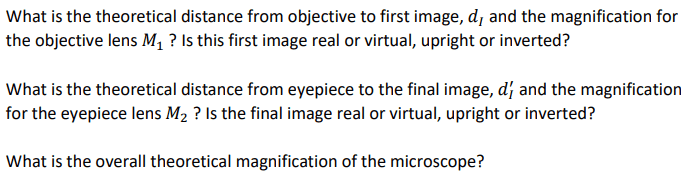
1683350352608.png


For (b) I got ##d_I = 26 cm## and ##M_1 = -2.4## which means that firsts image is inverted and real

For (c) I got ##dI' = 35 cm## and ##M_2 = -1.3##. However, I thought ##dI' < 0## since the second image is virtual and inverted from a ray diagram.

For (d)

I got ##M = M_1M_2 = 3.2## which is interesting since the finial image is inverted

Can someone please tell me whether I am correct and how to tell the second image is virtual without drawing a ray diagram?

Many thanks!
 
Last edited by a moderator:
Physics news on Phys.org
BvU said:
Hi, seems to me there is a lot missing:
Given information?
Relevant equations?
Thank you for your reply @BvU!

Distance from objective to object ## d_O = 10.6cm##
Distance between the objective and eyepiece ##D = 34cm##

Is the given information (the data collected from the experiment)

Relevant equation:
- thin lens formula ##\frac{1}{d_O} + \frac{1}{d_I} = \frac{1}{f}##
- Magnification formula ##M = -\frac{d_{O}}{d_I}##

Many thanks!
 
BvU said:
Never saw a microscope do anything sensible at 10.6 cm from the object....
Thank you for your reply @BvU!

Well it did in the labs! We used a 150 mm and 75 mm convex lens to make a microscope and adjusted the distances accordingly to get a clear image.

Many thanks!
 
ChiralSuperfields said:
Well it did in the labs! We used a 150 mm and 75 mm convex lens to make a microscope and adjusted the distances accordingly to get a clear image
Do you realize there is some very useful information there?
BvU said:
Never saw a microscope do anything sensible at 10.6 cm from the object....
So this isn't some biologist's microscope, but a lab exercise to work out the principles. OK!

And now we have some input for the relevant equations !

Now we can gamble safely that the objective lens is the 75 mm one ( but it would have been much better if you had offered that voluntarily in the problem description :wink:).

Then I can understand your answer to the (b) (?) part.

But not what you do for (c). What is your ##d_{O'}## ?
(Or better: post your work, clearly, step by step :smile:)

##\ ##
 
Reply
  • Like
Likes   Reactions: SammyS and member 731016
BvU said:
Do you realize there is some very useful information there?

So this isn't some biologist's microscope, but a lab exercise to work out the principles. OK!

And now we have some input for the relevant equations !

Now we can gamble safely that the objective lens is the 75 mm one ( but it would have been much better if you had offered that voluntarily in the problem description :wink:).

Then I can understand your answer to the (b) (?) part.

But not what you do for (c). What is your ##d_{O'}## ?
(Or better: post your work, clearly, step by step :smile:)

##\ ##
Thank you for your reply @BvU!

My ##d_{O'}## for is the real image formed by objective lens. I use that virtual object for the eyepiece.

##\frac{1}{26} + \frac{1}{dI'} = \frac{1}{15}##
##d_{I'} = 35 cm##

Many thanks!
 
ChiralSuperfields said:
My ##d_{O'}## for is the real image formed by objective lens. I use that virtual object for the eyepiece.

##\frac{1}{26} + \frac{1}{dI'} = \frac{1}{15}##
##d_{I'} = 35 cm##
How come you think this image is formed at a distance of 26 cm from the eyepiece ?

##\ ##
 
Reply
  • Like
Likes   Reactions: member 731016
BvU said:
How come you think this image is formed at a distance of 26 cm from the eyepiece ?

##\ ##
Thank you for your reply @BvU!

True, that might be a mistake. I guess 26 cm is the distance from the real image from the objective lens not the eyepiece so I guess the distance to the real image from the eyepiece should be ##34 - 26 = 8 cm## this gives
the finial image to be - 17 cm from the objective lens.

Many thanks!
 
We are getting there, step by step :smile:

A remark about accuracy: you have input with 2 to 2½ digit accuracy. You want to do your calculations with at least that and only round off properly at the end. So NOT ##d_{O'} = 8 ## cm but 8.355 and then ##d_{I'} = -18.86 ## cm, so you get -18.9 cm, not -17 !

So: what's the performance of your 'microscope' ?

##\ ##
 
Last edited:
Reply
  • Like
Likes   Reactions: member 731016 and SammyS
BvU said:
We are getting there, step by step :smile:

A remark about accuracy: you have input with 2 to 2½ digit accuracy. You want to do your calculations with at least that and only round off properly at the end. So NOT ##d_{O'} = 8 ## cm but 8.355 and then ##d_{I'} = -18.86 ## cm, so you get -18.9 cm, not -17 !

So: what's the performance of your 'microscope' ?

##\ ##
Thank you for your help @BvU!

Sorry, what do you mean by performance of the microscope?

Many thanks!
 
BvU said:
Magnification :smile:
Thank you for your help @BvU!
For the total magnification I get ##-2.4 \times 2.4 = -5.8## which means that it must be an enlarged and inverted image

Many thanks!