Mind boggling attempt to apply Newton's 3rd law

  • Context: Graduate 
  • Thread starter Thread starter PhiowPhi
  • Start date Start date
  • Tags Tags
    Apply Law Mind
Click For Summary
SUMMARY

This discussion focuses on the application of Newton's 3rd law in electrodynamics, particularly in scenarios involving Lorentz forces. The participants explore examples such as a conductor in a magnetic field and interactions between two current-carrying wires. It is established that while Newton's 3rd law generally applies in static situations, it may not hold in dynamic contexts where electromagnetic fields carry momentum. The conversation emphasizes that the labels of "action" and "reaction" are arbitrary, and the key takeaway is the existence of equal and opposite forces in these systems.

PREREQUISITES
  • Understanding of Newton's 3rd law of motion
  • Familiarity with Lorentz force and its implications
  • Basic knowledge of electromagnetic fields and their properties
  • Concept of momentum conservation in physics
NEXT STEPS
  • Study the implications of Lorentz force in various electromagnetic scenarios
  • Research the relationship between electromagnetic fields and momentum conservation
  • Explore the differences between static and dynamic applications of Newton's laws
  • Investigate the role of electromagnetic fields in energy transfer
USEFUL FOR

Physics students, educators, and professionals in engineering or applied physics who are interested in the nuances of classical mechanics and electrodynamics.

PhiowPhi
Messages
203
Reaction score
8
In classical mechanics, it's pretty straight forward for me to apply it(sometimes...), and really intuitive to picture it. However, when I kick it up a notch... to apply Newton's 3rd law in electrodynamics, my brain malfunctions...

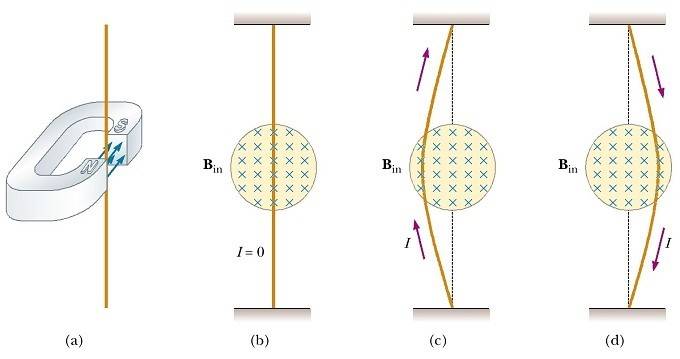
Simplest example I can think of, a conductor carrying a wire placed inside a magnetic field like so:
d1boi0Y.jpg

This diagram shows it all, when current flows in the conductor perpendicular to the magnetic field of the magnet, there is a Lorentz force created. What is the action? The Lorentz force? What is the reaction then... a magnetic force acting on the magnet :confused:?

Another example, instead of using a permanent magnet which has a complexity of it's own(with magnetic moment) let's use two wires like so:
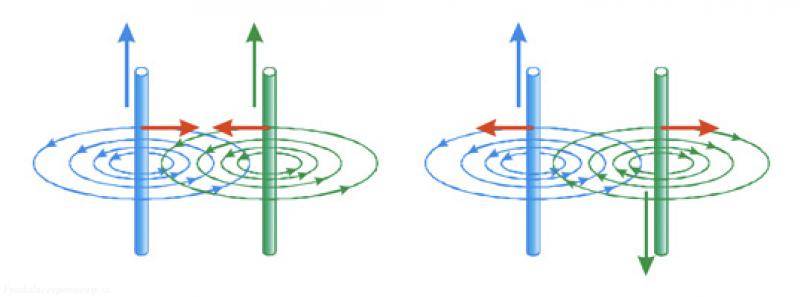
foto-E128_SKETCH-F.JPE

This example I think is easier for me to apply Newton's 3rd law, due to the current flow of each wire and their magnetic fields they both have equal and opposing forces acting on one another? I mean, if the blue wire attracts the green wire, likewise the green wire will attract the blue wire and vice versa in the case of repulsion due to the opposite current flows. So, the Lorentz force is the action and reaction force in such systems?

I've read other thread related to this topic, some members related momentum to this, and how it will be conserved can someone please explain that point too?
 
Physics news on Phys.org
If the magnet is held in place then the force on the wire will make the wire move, if the wire is a rigid bar (of copper) and the magnet is free to move then the magnet will move due to the force.
 
lychette said:
If the magnet is held in place then the force on the wire will make the wire move, if the wire is a rigid bar (of copper) and the magnet is free to move then the magnet will move due to the force.

What is the specific reaction force acting on the magnet. Is it a repulsive magnetic force due to the conductor's magnetic field(N/S)?
 
PhiowPhi said:
to apply Newton's 3rd law in electrodynamics
Newton's 3rd law doesn't always apply in electrodynamics. Newton's 3rd law is a statement about the conservation of momentum, but the EM field also carries momentum. So you can get situations where mechanical momentum is not conserved because momentum is being transferred from the matter to the fields.

However, if you are in a static situation then Newton's 3rd law will apply because the momentum of the field will be constant.

PhiowPhi said:
there is a Lorentz force created. What is the action? The Lorentz force? What is the reaction then... a magnetic force acting on the magnet :confused:?
Yes.

PhiowPhi said:
So, the Lorentz force is the action and reaction force in such systems?
Yes.

You may be getting worried about the "action" and "reaction" labels. Those are completely arbitrary. The point is that there is a pair of forces which are equal and opposite. Which one you choose to label as the "action" and the one you choose to label as the "reaction" is a matter of personal taste, not physics.
 
  • Like
Likes   Reactions: PhiowPhi
DaleSpam said:
Newton's 3rd law doesn't always apply in electrodynamics. Newton's 3rd law is a statement about the conservation of momentum, but the EM field also carries momentum. So you can get situations where mechanical momentum is not conserved because momentum is being transferred from the matter to the fields.

That makes sense, because EM fields can carry energy too.
 

Similar threads

Replies
5
Views
2K
  • · Replies 14 ·
Replies
14
Views
2K
  • · Replies 24 ·
Replies
24
Views
2K
  • · Replies 41 ·
2
Replies
41
Views
2K
  • · Replies 9 ·
Replies
9
Views
2K
  • · Replies 31 ·
2
Replies
31
Views
3K
  • · Replies 14 ·
Replies
14
Views
1K
  • · Replies 22 ·
Replies
22
Views
3K
  • · Replies 20 ·
Replies
20
Views
2K
  • · Replies 14 ·
Replies
14
Views
2K