Minimum work required to move a point charge

Click For Summary

Homework Help Overview

The discussion revolves around calculating the minimum work required to move a point charge (q1) to infinity in a system of three point charges arranged at the corners of a rectangle. The problem involves concepts from electrostatics, specifically electric potential energy (EPE) and work-energy principles.

Discussion Character

  • Exploratory, Conceptual clarification, Mathematical reasoning

Approaches and Questions Raised

  • Participants discuss the initial and final electric potential energy of the system and how to apply the work-energy principle. Questions arise regarding the conditions for minimum work and the relationship between kinetic energy and potential energy during the charge's movement.

Discussion Status

Participants are exploring the implications of minimizing work and its relationship to kinetic energy. Some have provided insights into the equations governing the problem, while others express uncertainty about the conditions necessary for achieving minimum work.

Contextual Notes

There is a lack of information regarding the direction of movement and the displacement of the charge, which complicates the discussion on work done. Participants are also navigating the assumptions about kinetic energy at the start and end of the movement.

kno
Messages
3
Reaction score
0
Homework Statement
Three point-like charges are placed at the corners of a rectangle as shown in the figure, a = 22.0 cm and b = 54.0 cm. Find the minimum amount of work required by an external force to move the charge q1 to infinity. Let q1= +3.00 µC, q2= −3.30 µC, q3= −3.60 µC.
Relevant Equations
W = -(EPE final - EPE initial)
W = -q * (V final - V initial)
This is the figure for the problem:
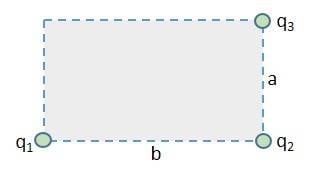
19-74.jpg
1.) Solved for initial total EPE of the system

EPE system = (kq2q3/a) + (kq2q1/b) + (kq1q3/√a^2 + b^2)

2.) Solved for final EPE of the system negating q1 as if it were off to infinity

EPE system final = (kq2q3/a)

3.) Plugged values into equation

W = -(EPE final - EPE intial)

I wasn't sure how to figure out the minimum work required, I think I am missing a step or two.
 
Physics news on Phys.org
kno said:
Homework Statement: Three point-like charges are placed at the corners of a rectangle as shown in the figure, a = 22.0 cm and b = 54.0 cm. Find the minimum amount of work required by an external force to move the charge q1 to infinity. Let q1= +3.00 µC, q2= −3.30 µC, q3= −3.60 µC.
Homework Equations: W = -(EPE final - EPE initial)
W = -q * (V final - V initial)

This is the figure for the problem:
View attachment 2498341.) Solved for initial total EPE of the system

EPE system = (kq2q3/a) + (kq2q1/b) + (kq1q3/√a^2 + b^2)

2.) Solved for final EPE of the system negating q1 as if it were off to infinity

EPE system final = (kq2q3/a)

3.) Plugged values into equation

W = -(EPE final - EPE intial)

I wasn't sure how to figure out the minimum work required, I think I am missing a step or two.
The work of an external force can change both the kinetic energy and potential energy of a particle. When is the work minimum when moving q1 to infinity ?
 
I know net work = change in KE. So by that equation work would be closest to zero when there is the smallest change in KE. Since the point charge starts at rest (I'm assuming) then the KE is zero. However I don't see how the kinetic energy can be zero in its final state to produce the smallest amount of work required. I was also unsure how to calculate KE in the first place since I am not given mass or velocity once the point is moved.

In short, is the answer to your question that work would be smallest when KE is largest? AKA KE final will equal EPE initial?
 
kno said:
net work = change in KE
That is the net work done on a body. That is different from the net work done by a force.
Your original work on that is correct. You just seem to be confused about the significance of the "minimum" condition.
There is no requirement given for the charged particle to have any final KE, so what will be its final KE if the work done by the force is minimised?
 
So when the work done is minimized the KE = 0? I thought I solved the problem that way initially by negating the KE in the W = -(EPE final - EPE initial) equation. The only other equation I know for work is W=FdcosΘ however I am not given the direction that the particle moves or its displacement. The last idea I had was the conservation of energy equation where KE initial + PE initial = KE final + PE final. If I use this and assume KE is zero in both cases then I'm left with PE initial = PE final. So, should my final PE be equal to my initial and use this value in the work equation?
 
kno said:
So when the work done is minimized the KE = 0? I thought I solved the problem that way initially by negating the KE in the W = -(EPE final - EPE initial) equation.
Indeed you did, and as I wrote in post #4, that was correct. But you seemed puzzled by the requirement for the work done to be minimised. All it means is, no residual KE.
 

Similar threads

  • · Replies 8 ·
Replies
8
Views
2K
  • · Replies 1 ·
Replies
1
Views
2K
Replies
1
Views
5K
  • · Replies 2 ·
Replies
2
Views
1K
  • · Replies 4 ·
Replies
4
Views
6K
Replies
2
Views
3K
  • · Replies 1 ·
Replies
1
Views
3K
  • · Replies 15 ·
Replies
15
Views
2K
  • · Replies 7 ·
Replies
7
Views
5K
Replies
14
Views
2K