Mirrors, Polaroid Films, Light/Wavelength help needed

  • Thread starter Thread starter riseofphoenix
  • Start date Start date
  • Tags Tags
    Mirrors Polaroid
Click For Summary

Homework Help Overview

The discussion revolves around concepts related to mirrors, light polarization, and image formation in optics. Participants are exploring questions related to the behavior of light through polarizers and the characteristics of images formed by convex mirrors.

Discussion Character

  • Mixed

Approaches and Questions Raised

  • Participants discuss the implications of using angles in polarization, questioning the validity of multiplying angles to determine outcomes. There are attempts to clarify the relationships between object distance, image distance, and magnification in mirror equations. Some participants express uncertainty about their calculations and the correctness of their answers.

Discussion Status

There is ongoing exploration of various interpretations of the problems presented. Some participants have offered corrections to calculations and suggested reconsidering assumptions about image characteristics and distances. The discussion reflects a mix of attempts to verify answers and seek further clarification on specific questions.

Contextual Notes

Participants are working under the constraints of homework assignments, which may limit their ability to change answers once submitted. There is also mention of confusion regarding the application of concepts learned in previous educational settings.

riseofphoenix
Messages
294
Reaction score
2
:(:(:( Please ease my aching soul by helping me with this...
I submitted this assignment online and I don't know the answers yet or however many I got wrong.
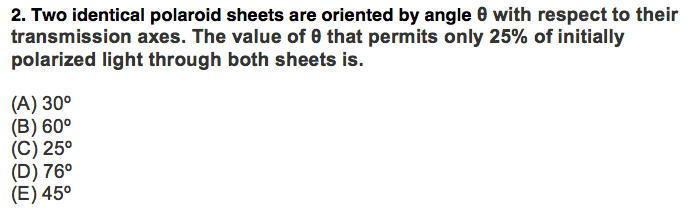
Number2-2_zps32ccd6b8.png


I chose 45 because I know unpolarized light becomes this after going through a polarizer:
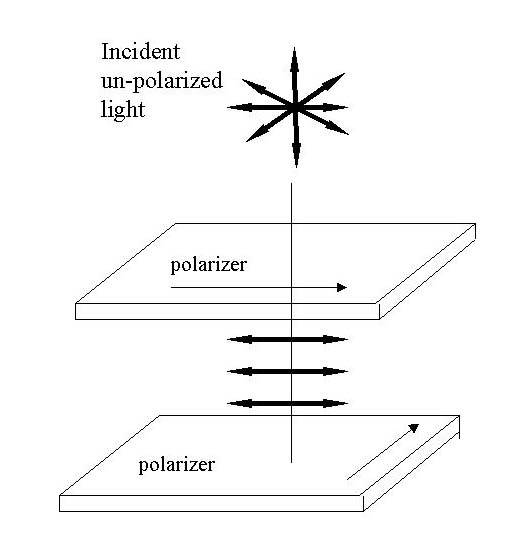
LCfig1.jpg


That single line is 180º, so I did 0.25 x 180º = 45º.
Is E the right answer?
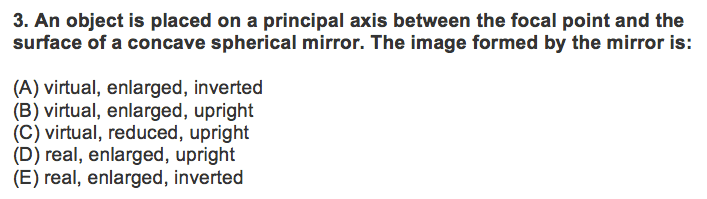
Number3-4_zps647d385c.png


I chose E…but after seeing this diagram below just now, I think I got the answer wrong and that it's supposed to be B… Is E not the answer?
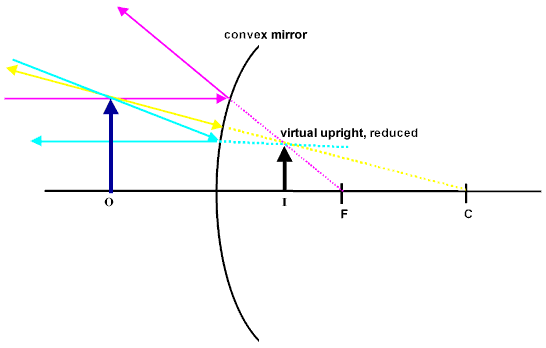
2fa55e0b-7598-4903-95f6-b3406b83c9d5.gif


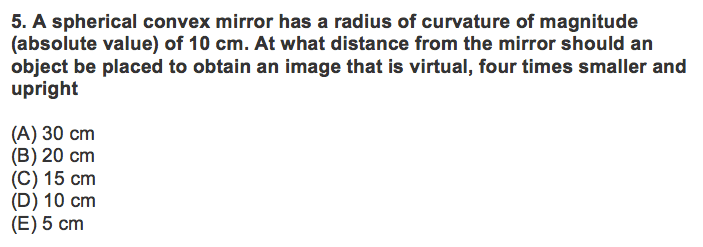
Number5-1_zpsce573a17.png


I chose D…but I don't think it's right…
I did this:

Given:
R = 10 cm
f = -R/2 (since it's convex) = -10/2 = -5
do = ?
M = +4 x (image is upright)
di = -? (image is virtual)

M = -di/do
4 = -di/do
di = -4do

1/f = 1/do + 1/di
1/(-5) = 1/do + 1/(-4do)
-0.2 = 1/do - 1/4do
-0.2 = (4/4)1/do - (1/1)1/4do
-0.2 = (4 - 1)/4do
-0.2 = 3/4do
4do = 3/(-0.2)
4do = -0.6
do = -0.6/4
do = -0.15

Is the answer C? (I chose D originally and I can't change my answer….but now that I've worked it out step by step i think the answer is C)
 
Physics news on Phys.org
riseofphoenix said:
That single line is 180º, so I did 0.25 x 180º = 45º.
Is E the right answer?
It is not, and there is no reason to multiply 180° by anything. Using the same argument, 90° would let 50% pass through, which is obviously wrong.

You can analyze this with polarization vectors and projetions on the polarization axis, or with existing formulas (Wikipedia, book, ...).

I did this:
Your result is very small (0.15 cm), there has to be some error in the calculation. I found one here:
4do = 3/(-0.2)
4do = -0.6
 
mfb said:
It is not, and there is no reason to multiply 180° by anything. Using the same argument, 90° would let 50% pass through, which is obviously wrong.

You can analyze this with polarization vectors and projetions on the polarization axis, or with existing formulas (Wikipedia, book, ...).


Your result is very small (0.15 cm), there has to be some error in the calculation. I found one here:

So basically all three of them are wrong?
 
mfb said:
It is not, and there is no reason to multiply 180° by anything. Using the same argument, 90° would let 50% pass through, which is obviously wrong.

You can analyze this with polarization vectors and projetions on the polarization axis, or with existing formulas (Wikipedia, book, ...).


Your result is very small (0.15 cm), there has to be some error in the calculation. I found one here:

Also, what about question number 3?
 
:( :(
 
riseofphoenix said:
Also, what about question number 3?
Take a spoon and test it.
The graph below is not a concave mirror.
 
mfb said:
Take a spoon and test it.
The graph below is not a concave mirror.

Ok but my answer is still wrong though...
The answer for 3 would have to be D.
 
Did you take the right ("inner") side of the spoon?
 
riseofphoenix said:
Also, what about question number 3?

Think about which side of the concave surface the image lies in.

If it lies on the left (the same side as where the object resides), it is real. If on the right, then the image is virtual. The focal equation is based on the reference of the surface of the mirror. Positive distance means real and negative distance means virtual.
 
  • #10
mfb said:
Did you take the right ("inner") side of the spoon?

What do you mean?
 
  • #11
I don't know what is unclear about that question.
Like this, but with an object closer to the mirror.
 
  • #12
mfb said:
I don't know what is unclear about that question.
Like this, but with an object closer to the mirror.

So the answer IS E.
real (image on front), enlarged, inverted.
 
  • #13
riseofphoenix said:
So the answer IS E.
real (image on front), enlarged, inverted.

Not for an object lying inside of the focal point.

Why don't you try drawing out a a simple ray diagram?
 
  • #14
I did not find an image of an object closer to the focal point. The inversion is not there in your problem.
 
  • #15
TerraForce469 said:
Not for an object lying inside of the focal point.

Why don't you try drawing out a a simple ray diagram?

I forgot how to because I did this back in high school and my teacher (in college) just gave us a simple chart to follow and didn't emphasize the fact that we had to draw a ray diagram. :(
 
Last edited:
  • #16
mfb said:
I did not find an image of an object closer to the focal point. The inversion is not there in your problem.

The answer has to be B then...

Ok well since I know I got those top 3 questions wrong...I wouldn't mind moving on to the other questions I wouldn't mind you guys checking for me...

Number5-1_zpsce573a17.png


I chose D…but I don't think it's right…
I did this:

Given:
R = 10 cm
f = -R/2 (since it's convex) = -10/2 = -5
do = ?
M = +4 x (image is upright)
di = -? (image is virtual)

____________________________

M = -di/do
4 = -di/do
di = -4do

____________________________

1/f = 1/do + 1/di
1/(-5) = 1/do + 1/(-4do)
-0.2 = 1/do - 1/4do
-0.2 = (4/4)1/do - (1/1)1/4do
-0.2 = (4 - 1)/4do
-0.2 = 3/4do
4do = 3/(-0.2)
4do = -0.6
do = -0.6/4
do = -0.15

Is the answer C? (I chose D originally and I can't change my answer….but now that I've worked it out step by step i think the answer is C)
 
  • #17
riseofphoenix said:
The answer has to be B then...

Ok well since I know I got those top 3 questions wrong...I wouldn't mind moving on to the other questions I wouldn't mind you guys checking for me...

Number5-1_zpsce573a17.png


I chose D…but I don't think it's right…
I did this:

Given:
R = 10 cm
f = -R/2 (since it's convex) = -10/2 = -5
do = ?
M = +4 x (image is upright)
di = -? (image is virtual)

____________________________

M = -di/do
4 = -di/do
di = -4do

____________________________

1/f = 1/do + 1/di
1/(-5) = 1/do + 1/(-4do)
-0.2 = 1/do - 1/4do
-0.2 = (4/4)1/do - (1/1)1/4do
-0.2 = (4 - 1)/4do
-0.2 = 3/4do
4do = 3/(-0.2)
4do = -0.6
do = -0.6/4
do = -0.15

Is the answer C? (I chose D originally and I can't change my answer….but now that I've worked it out step by step i think the answer is C)

Your magnification is wrong. It's 4x smaller, which means ##\frac{d_i}{d_o}## should be less than one since ##\frac{h_i}{h_o}## is reduced.
 
  • #18
TerraForce469 said:
Your magnification is wrong. It's 4x smaller, which means ##\frac{d_i}{d_o}## should be less than one since ##\frac{h_i}{h_o}## is reduced.

Oh goodness...
So what should M equal?
 
  • #19
riseofphoenix said:
Oh goodness...
So what should M equal?

Well, it's 4x smaller so what do you think?

I'm sure you can figure this out. Other than that there seems to be nothing else wrong with your calculations.
 
  • #20
TerraForce469 said:
Other than that there seems to be nothing else wrong with your calculations.
Well, there is a calculation error in the first post, I mentioned it in post 2:
mfb said:
Your result is very small (0.15 cm), there has to be some error in the calculation. I found one here:
4d0 = 3/(-0.2)
4d0 = -0.6
 

Similar threads

  • · Replies 5 ·
Replies
5
Views
2K
  • · Replies 1 ·
Replies
1
Views
6K
Replies
4
Views
2K
  • · Replies 16 ·
Replies
16
Views
2K
  • · Replies 1 ·
Replies
1
Views
3K
Replies
3
Views
5K
Replies
9
Views
2K
  • · Replies 2 ·
Replies
2
Views
3K
  • · Replies 1 ·
Replies
1
Views
2K
Replies
13
Views
4K