Modal frequencies of a vibrating circular membrane? (DRUM)

Click For Summary
SUMMARY

This discussion focuses on calculating modal frequencies for a vibrating circular membrane, specifically for developing a modal drum synth. The key formula involves using the zeros of Bessel functions, denoted as ##x_{mn}##, which can be computed using online calculators or programming libraries. The Casio Bessel calculator and Python's MPMath library are highlighted as effective tools for obtaining these values. The conversation emphasizes the simplicity of using the Casio calculator for practical applications.

PREREQUISITES
  • Understanding of modal frequencies in vibrating systems
  • Familiarity with Bessel functions and their applications
  • Basic knowledge of programming in Python or C++ (optional)
  • Experience with digital audio synthesis tools like Reaktor
NEXT STEPS
  • Research how to use the Casio Bessel calculator for modal frequency calculations
  • Explore the Boost library for C++ to compute Bessel function zeros
  • Learn how to implement MPMath in Python for calculating Bessel function values
  • Study the mathematical principles behind Bessel functions and their significance in acoustics
USEFUL FOR

Sound designers, audio engineers, and developers interested in synthesizing drum sounds using modal frequencies and Bessel functions.

mikejm
Messages
40
Reaction score
2
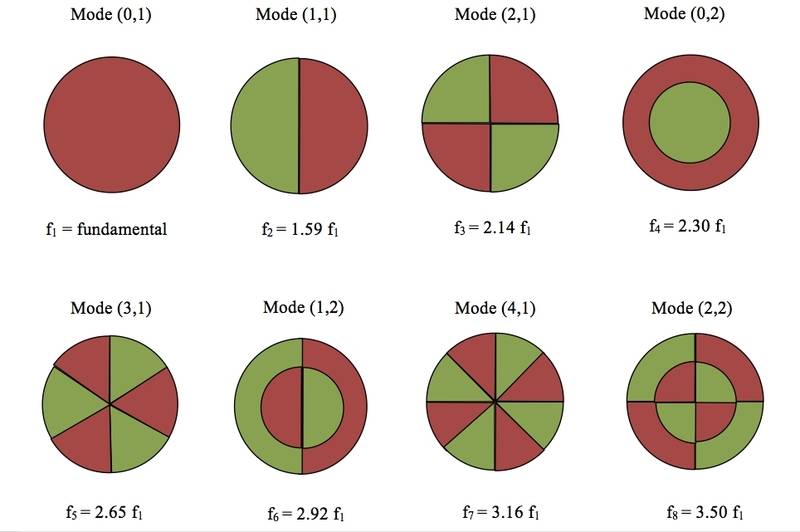
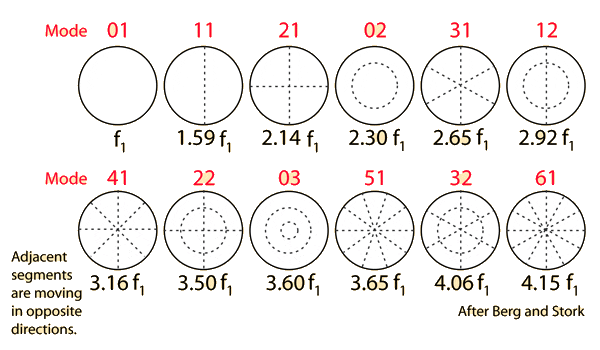
I am in the process of trying to develop a modal drum synth. I have the following graphics as references for the frequencies of some of the first modes relative to the fundamental:
drummodes.jpg


mem.gif


This is a good start. But I want to be able to model more modes than just that.

What is the formula required to calculate any mode as a multiplier of "f1" like above?

Eg. If I am wondering what the (7,1) mode is, how would I calculate that?

This article gets into it from what I can tell, but it's way over my head mathematically:
https://courses.physics.illinois.edu/phys406/lecture_notes/p406pom_lecture_notes/p406pom_lect4_part2.pdf

Ideally I'd like a formula I can punch (2,1) into and get 2.14 (for example).

Any help? Very appreciated if so.

Thanks,
Mike
 
Physics news on Phys.org
Here is the excerpt from that Physics 400 level course that I think summarizes the equations that are needed:

bessel.png


I never went past first year physics (biology & medicine guy) so I don't understand how to use these.

Any help?

If anyone has any medical questions I'm happy to answer those in return. :biggrin:
 
Your issue is how to compute ##x_{mn}##, which is the n-th zero of the m-th order Bessel function. There is no simple formula to do this, however there are many resources that will do the dirty work for you. A Bessel function of the first kind, ##J_m\left (x\right )##, looks kind of like a periodic function but whose y values cross the x-axis at non-periodic x values. You don't need to know all about Bessel functions to solve your problem. There are online calculators that input m-n and spit back ##x_{mn}##. Google "zeros of Bessel functions".
If you know how to program c++, the boost library has a function that does this as well.
 
Wow. This is way harder to do than I thought it would be. Okay. Thanks.

So I've looked into what you're describing a bit, and I can find three approaches to getting it done (none of which I actually understand o_O?:)). I can't code anything except HTML lol.

(If you're wondering how I'm building a drum synth without knowing how to code, it's because I'm doing it in Reaktor which doesn't require coding so much as linking modules in a logical fashion to get the signal you want.)

Anyway, here is what I've found:

1) Calculators
I found two Bessel calculators:
http://keisan.casio.com/exec/system/1180573472
http://www.mhtl.uwaterloo.ca/old/courses/me3532/js/bessel.html

The Casio one says it's for calculating zeros, but I don't know what to put in there to get what I want (or if it can give me what I want).

2) C++ with Boost
As you suggested, Fred, I found this page which seems to summarize a lot about Bessel functions and C+:
http://www.boost.org/doc/libs/1_62_0/libs/math/doc/html/math_toolkit/bessel/bessel_root.html

Is there a simple bit of code of command I could just plug into get what I want?

3) Python with MPMath
I found this seemingly simple technique using "MPMath" for Python:
http://fredrik-j.blogspot.ca/2010/07/sage-days-23-and-bessel-function-zeros.html

He gives the following example of its utility:

>>> besseljzero(1,100)
314.9434728377671624580656

Is that what I want? Or would it get me what I want?

Which of those would likely be the easiest way to get what I want? Thanks again. Any further help would be appreciated. I feel like a toddler.
 
I think the easiest implementation for you is to go with the Casio calculator. In order to work that calculator enter m in the box that says "order ##\nu##" and n in the box that says "ordinal number s", then press the "execute" button. Divide your answer by 2.4. Give it a go and compare with the ##f_{mn}## you already have.
Edit: The answer is by the red dot.
 
Last edited:
Ha!

Well that is super easy. You just made my day Fred. That was a million times simpler than I was preparing for.

Thanks. Have a good one. :smile:
 

Similar threads

  • · Replies 12 ·
Replies
12
Views
4K
  • · Replies 1 ·
Replies
1
Views
2K
  • · Replies 1 ·
Replies
1
Views
2K
  • · Replies 1 ·
Replies
1
Views
3K
  • · Replies 5 ·
Replies
5
Views
5K
  • · Replies 1 ·
Replies
1
Views
3K
  • · Replies 3 ·
Replies
3
Views
3K
  • · Replies 3 ·
Replies
3
Views
4K
  • · Replies 10 ·
Replies
10
Views
4K
  • · Replies 3 ·
Replies
3
Views
3K