Modeling a peristaltic roller pump

  • Context: Undergrad 
  • Thread starter Thread starter Oppogo
  • Start date Start date
  • Tags Tags
    Modeling Pump Roller
Click For Summary
SUMMARY

This discussion centers on the mathematical modeling of a peristaltic roller pump, specifically for blood infusion applications. Key parameters for optimization include roller diameter, tube diameter, and roller placement, with the formula Q=π*r²*l*rpm being introduced to calculate flow. The conversation highlights the importance of achieving constant output pressure while considering the effects of semi-occlusion on flow rates. Participants emphasize the necessity of full occlusion for effective metering in medical applications and suggest further exploration of input and output pressure dynamics.

PREREQUISITES
  • Understanding of peristaltic pump mechanics
  • Familiarity with fluid dynamics principles
  • Knowledge of mathematical modeling techniques
  • Experience with IV infusion systems and their requirements
NEXT STEPS
  • Research the effects of roller diameter on flow rates in peristaltic pumps
  • Explore the relationship between tube diameter and flow in IV infusion systems
  • Investigate formulas for flow behavior in semi-occluded states
  • Learn about pressure dynamics in peristaltic pumps and their impact on output
USEFUL FOR

Engineers, biomedical professionals, and students involved in the design and optimization of medical infusion systems, particularly those focusing on peristaltic pump applications.

Oppogo
Messages
8
Reaction score
0
Hello!
We were recently introduced to mathematical modeling.
I would want to model a blood roller pump - a simple peristaltic pump. I was wondering, what kind of formulas there are that I can use to model a pump which optimizes the number of rollers, roller diameter, tube diameter etc. Naturally I would have to constrain these parameters, the problem is I don't know what kind of formulas I would use. Any help behind the physics of a blood roller pump would be appreciated!
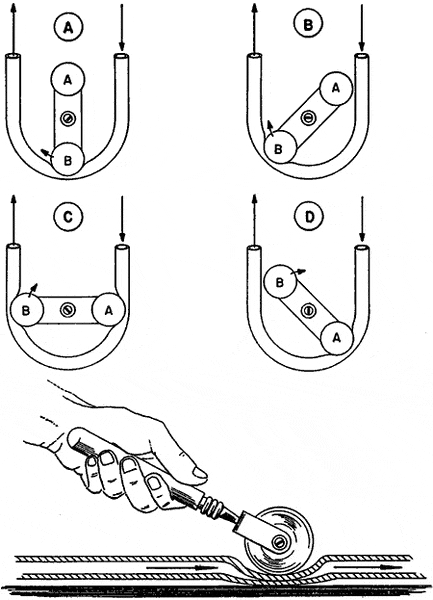
he019g02.gif
 
Physics news on Phys.org
Oppogo said:
Hello!
We were recently introduced to mathematical modeling.
I would want to model a blood roller pump - a simple peristaltic pump. I was wondering, what kind of formulas there are that I can use to model a pump which optimizes the number of rollers, roller diameter, tube diameter etc. Naturally I would have to constrain these parameters, the problem is I don't know what kind of formulas I would use. Any help behind the physics of a blood roller pump would be appreciated!

View attachment 116889
Welcome to the PF.

What have you found in your reading about this so far? I can think of at least s few parameters that would go into optimizing a peristaltic pump like this. Can you tell us a few that you have been considering so far?
 
Also, a nice feature of some peristaltic pumps for IVs and blood transport have built-in bubble detection. Have you seen how those typically work? :smile:
 
berkeman said:
Welcome to the PF.

What have you found in your reading about this so far? I can think of at least s few parameters that would go into optimizing a peristaltic pump like this. Can you tell us a few that you have been considering so far?

I wasn't thinking anything too complicated.
What I want to test is how to optimize the flow (I would want to achieve the highest flow while retaining constant output pressure)
Taken that I place my 'rollers' a certain distance from the center of roller head and the tube I would like to examine how by changing roller diameter the flow would change. I expect the flow to be the best when the tube gets completely occluded but I would also love to see how it behaves in semi-occluded states. Same would be for the tube diameter. If the length of the tube would remain constant, the higher the inner diameter - the higher the flow. These parameters (roller, tube diameter, rpm etc. in can create different combinations but I want to find out formulas to from which to derive the connection between these parameters).

The formula I have so far is Q=π*r2*l*rpm
where Q would be flow, r - inner diameter of the tube, l - contact length with the rollers (half of a circle)
What this formula doesn't give me is how flow would behave in semioccluded state. How would i go to find this?
 
Oppogo said:
I wasn't thinking anything too complicated.
What I want to test is how to optimize the flow (I would want to achieve the highest flow while retaining constant output pressure)
Taken that I place my 'rollers' a certain distance from the center of roller head and the tube I would like to examine how by changing roller diameter the flow would change. I expect the flow to be the best when the tube gets completely occluded but I would also love to see how it behaves in semi-occluded states. Same would be for the tube diameter. If the length of the tube would remain constant, the higher the inner diameter - the higher the flow. These parameters (roller, tube diameter, rpm etc. in can create different combinations but I want to find out formulas to from which to derive the connection between these parameters).

The formula I have so far is Q=π*r2*l*rpm
where Q would be flow, r - inner diameter of the tube, l - contact length with the rollers (half of a circle)
What this formula doesn't give me is how flow would behave in semioccluded state. How would i go to find this?
For semi-occluded, you would need to factor in the input pressure and output pressure, I believe. But AFAIK, all medical peristaltic pumps rely on full occlusion. Otherwise their metering function would not work, and that is extremely important in medical applications. Also, the design of a high-flow pump for cardiac bypass operations will likely be different from what you use for IV infusions, right? Are you modeling both of those applications?
 
berkeman said:
For semi-occluded, you would need to factor in the input pressure and output pressure, I believe. But AFAIK, all medical peristaltic pumps rely on full occlusion. Otherwise their metering function would not work, and that is extremely important in medical applications. Also, the design of a high-flow pump for cardiac bypass operations will likely be different from what you use for IV infusions, right? Are you modeling both of those applications?

I was thinking of doing IV infusions. We are expected to model the process and calculate for the optimal solutions. That is exactly why I need to figure out or find a formula for semi-occluded tubes as well (to visualize in graphs that semi-occluding a tube isn't the most optima route) however I can not find the formulas I'm looking for anywhere.

Edit: Could also simplify, not accounting for input pressure, only trying to maintain a constant exit by changing required variables
 
Oppogo said:
I was thinking of doing IV infusions. We are expected to model the process and calculate for the optimal solutions. That is exactly why I need to figure out or find a formula for semi-occluded tubes as well (to visualize in graphs that semi-occluding a tube isn't the most optima route) however I can not find the formulas I'm looking for anywhere.

Edit: Could also simplify, not accounting for input pressure, only trying to maintain a constant exit by changing required variables
A semi-occluded tube in an IV infusion pump would be disaster. You need to be able to precisely meter the flow. The pressure can vary slightly as each roller let's go at the output side of the pump -- that's no big deal medically.
 
berkeman said:
A semi-occluded tube in an IV infusion pump would be disaster. You need to be able to precisely meter the flow. The pressure can vary slightly as each roller let's go at the output side of the pump -- that's no big deal medically.

Isn't the flow calculable from formulas though? If not looking at the IV example, If I would want the best flow with almost constant exit pressure, could that be described with a formula for a semi-occluded state? Hemodialysis as an example?
I may be mixing flow and pressure up.
But the assignment is to model constant output pressure. If I constraint the maximum flow (some naturally occurring value), I need to know the best variables to achieve this flow. Semi-constrained will obviously not be the best, however I need to look into it regardless.

redypump01_24.jpg
 
Oppogo said:
Isn't the flow calculable from formulas though?
I don't think so. It would depend on how high the IV pole is set (with the IV bag hung from the top as usual), and the height of the patient with respect to the IV bag and the pump. And it would depend on how full the IV bag was (and thus the height of the surface of the IV fluid in the bag).
Oppogo said:
But the assignment is to model constant output pressure.
To get almost constant pressure out of a peristaltic pump, you will need to use other than a constant angular velocity for the pump shaft. Can you say what you may have to do to mitigate the slight pulsing that you get at the output of a traditional peristaltic pump that uses a constant shaft rotation speed?

You might also clarify this with your instructor. AFAIK, normal medical peristaltic pumps use a constant output shaft rotation rate, set by the IV flow rate. They probably use microstepper motors anyway, so you will always get small pulses as a result of each microstep.
 

Similar threads

Replies
9
Views
3K
  • · Replies 6 ·
Replies
6
Views
3K
  • · Replies 24 ·
Replies
24
Views
4K
  • · Replies 3 ·
Replies
3
Views
2K
  • · Replies 26 ·
Replies
26
Views
6K
  • · Replies 0 ·
Replies
0
Views
3K
  • · Replies 15 ·
Replies
15
Views
4K
  • · Replies 9 ·
Replies
9
Views
5K
  • · Replies 6 ·
Replies
6
Views
3K
  • · Replies 3 ·
Replies
3
Views
4K