Molecular speed distribution - most probable speed V

Click For Summary
SUMMARY

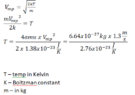
The discussion focuses on calculating the temperature (T) of helium gas using the most probable speed formula, T = (V^2) m/(2k). The user initially miscalculates the mass (m) of helium atoms, mistakenly using the total number of atoms instead of the mass of a single atom. The correct approach involves using the atomic mass of helium (4 amu) converted to kilograms (1.66 x 10^-27 kg/amu) and squaring the most probable speed (Vmp = 1.5 x 10^3 m/s) to find T in Kelvin. The importance of unit consistency and the ideal gas law (PV = nRT) for calculating pressure is also emphasized.

PREREQUISITES
  • Understanding of the ideal gas law (PV = nRT)
  • Knowledge of atomic mass units (amu) and their conversion to kilograms
  • Familiarity with the concept of most probable speed in kinetic theory
  • Basic grasp of unit consistency in physics calculations
NEXT STEPS
  • Learn about the kinetic theory of gases and its applications
  • Study the conversion of atomic mass units to kilograms in detail
  • Explore the derivation and application of the ideal gas law
  • Investigate the significance of unit consistency in scientific calculations
USEFUL FOR

Students studying thermodynamics, physicists working with gas laws, and anyone involved in calculations related to the behavior of gases at the atomic level.

greg997
Messages
105
Reaction score
2
Homework Statement
Finding Temperatur T and Pressure of gas in container given N= number of atoms of hellium and distribution V most probable.
Relevant Equations
Vmp= sqrt(2kT/m)
Can someone explain to me what I am doing wrong? Trying to calculate the Temperature T using this formula

I am trying to find T using most probable speed of atoms formula.
T = (V^2) m/( 2k) I am getting riduculous T like 20x10^27. Why?

If number of atoms N= 2x10^24 how do i get mass m? each hellium atom has 4 amu.
What i get is this : 2x10^24 x 4 = 8x10^24 amu
then 8x10^24 x 1.66x 10^-27 = 13.28x10^-3= m
is that correct?
 
Physics news on Phys.org
It is unclear to me hiw you are computing T as you have not provided details here. Regarding your mass computation, please make sure to quote the appropriate units everywhere. You are probably using units of kg, but it is not very clear (and technically incorrect) to not quote the units.

Edit: Are you using the mass of the entire helium gas when computing T? The mass that goes into the formula is the atomic mass, not the mass of the entire gas.
 
Hello,
1711198057549.png
 
No. See the edit of #2.
 
Hmm... so what do i do with N- number of atoms? Yes, that was my intention. total mass of gas.
Should I just then make m=4 to find T since helium is 4 amu?
 
You cannot use the number of atoms to find the mass of one atom. You are not given the total mass of the gas, are you? You are told that the gas is helium and this is how you find the molar mass or the mass of an atom, whicever you want to use.
But you will need the volume of the gas in order to find the pressure. Is the text in the OP the full text of the problem?
 
greg997 said:
Should I just then make m=4 to find T since helium is 4 amu?
m = 4 amu

Remember, units are important!
 
So the formula for that T, m is just mass of one atom? For helium 4 amu? Not total mass?
If that is the case , can i get correct pressure P from ideal gas formula? PV= nRT? I am given Volume, so I need to calculate n- number of moles. Is that correct?
 
@greg997, to add to what's already been said...

##m## is the mass of a single helium atom (in kg if you're working in SI units).

You don't need the total number of atoms, N, to find the temperature. But you will need it to find the pressure.

You haven't given the values of the most probable velocity and the volume. The guidelines here say you should 'Reproduce the problem statement accurately'. That means the complete problem, word-for-word. It makes the whole process much simpler/smooother. See https://www.physicsforums.com/threads/homework-help-guidelines-for-students-and-helpers.686781/
 
  • Like
Likes   Reactions: Orodruin
  • #10
1711208639566.png


Apologies. I am given Volume V= 0. 707m^3

Is may calculation correct? How do i get Temp T in kelvin? I multipled 4 amu by 1.66x10^-27. Is that correct?
 
  • #11
greg997 said:
Apologies. I am given Volume V= 0. 707m^3
You still haven't told us the given value for the most probable speed (I.e. you still haven't provided the complete question!!!)

greg997 said:
Is may calculation correct? How do i get Temp T in kelvin? I multipled 4 amu by 1.66x10^-27. Is that correct?
You have a volume of ##0.5m^3## in your formula. Where is that from?
The most probable speed should appear in your formula - it doesn't.
So I would say the formula is incorrect.

To convert 4amu to kg you multiply it by ##1.66 \times 10^{-27}## kg/amu. So yes, that part is correct.

Edit: Note that 'amu' is old-fashioned. You should really use 'u' or 'Da' (dalton).
Edit 2: typo's
 
Last edited:
  • #12
Apologies. I messed up with the formula above.
The Volume V = 0.5 m^3
And the most probable speed Vmp = 1.5x10^3m/s.
So how to I get T in Kelvin? None of the units cancel so whatever is left we call it Kelvin then?
Once i got T I should use ideal gas formula to find pressure P?
1711211461574.png
 

Attachments

  • 1711211336356.png
    1711211336356.png
    5.4 KB · Views: 90
  • #13
greg997 said:
Apologies. I messed up with the formula above.
The Volume V = 0.5 m^3
And the most probable speed Vmp = 1.5x10^3m/s.
So how to I get T in Kelvin? None of the units cancel so whatever is left we call it Kelvin then?
Once i got T I should use ideal gas formula to find pressure P?
View attachment 342219
You have forgotten to square the most probable speed.

All your quantities are SI. So if you do the calculation (with correct values!) the answer will automatically be in kelvin (upper-case 'K' for the symbol, lower-case 'kelvin' for the full name).

If you want to confirm that you have the units correct, you can express a joule in terms of kg, m and s. A joule is a derived unit (a combination of base units).
 
  • #14
fantastic. Thank you for your explanation and support
 
  • Like
Likes   Reactions: Steve4Physics

Similar threads

  • · Replies 10 ·
Replies
10
Views
5K
  • · Replies 5 ·
Replies
5
Views
713
  • · Replies 9 ·
Replies
9
Views
2K
  • · Replies 21 ·
Replies
21
Views
2K
  • · Replies 1 ·
Replies
1
Views
2K
  • · Replies 5 ·
Replies
5
Views
3K
  • · Replies 6 ·
Replies
6
Views
3K
  • · Replies 7 ·
Replies
7
Views
2K
  • · Replies 46 ·
2
Replies
46
Views
4K
  • · Replies 11 ·
Replies
11
Views
2K