Molecular symmetry group of non-rigid molecules

Click For Summary

Discussion Overview

The discussion revolves around the determination of the Molecular Symmetry group (MS) for non-rigid molecules, particularly focusing on cases like butane that exhibit non-equivalent equilibrium versions. Participants explore the implications of these characteristics for spectroscopy and the construction of character tables.

Discussion Character

  • Exploratory
  • Technical explanation
  • Debate/contested
  • Mathematical reasoning

Main Points Raised

  • One participant describes their understanding of the MS group based on "feasible" operations from the Complete Nuclear Permutation Inversion (CNPI) group and raises a question about defining the MS group for non-rigid molecules with non-equivalent equilibrium versions.
  • Another participant suggests that if the goal is spectroscopy, the spectrum will reflect characteristics of both stable conformers.
  • A follow-up inquiry seeks clarification on whether both stable conformers should be treated as independent molecules for constructing the character table of the MS group and deriving selection rules.
  • Some participants assert that there are no elements of the CNPI that would connect energetically different minima of the potential energy surface.
  • A later reply questions the possibility of formally characterizing the eigenstates of such a molecule without necessarily solving the Schrödinger equation, while still obtaining selection rules.

Areas of Agreement / Disagreement

Participants express differing views on how to approach the characterization of the MS group for non-rigid molecules, particularly regarding the treatment of stable conformers and the implications for spectroscopy. The discussion remains unresolved with multiple competing perspectives.

Contextual Notes

There are limitations regarding the assumptions made about the interconversion between non-equivalent equilibrium versions and the dependence on the definitions of the CNPI and MS group in this context.

Konte
Messages
90
Reaction score
1
Hello everybody,

I have read some very interesting book (Molecular symmetry and Spectroscopy - Bunker and Jensen) that talk about how to find the Molecular Symmetry group (MS) of a molecule by using the concept of "feasible" operation from the Complete Nuclear Permutation Inversion (CNPI) group.
Following the explanation given by the authors, "feasible" operation is that can interconverts a numbered and equivalent equilibrium versions of the molecule (rigid or non-rigid).

Confident of this understanding, I tried and success on finding MS of some famous non-rigid molecule until I met certain hard case as of the butane molecule which have non equivalent equilibrium versions!

So, my question is :

How to define the MS group of such a non-rigid molecule that have non equivalent equilibrium versions, knowing that between theses non equivalent equilibrium versions, potential barrier is not too high and allow some interconversion between the different versions of the same molecule?

I attached here the potential energy of butane as an example of those molecule which have more than one equilibrium versions:
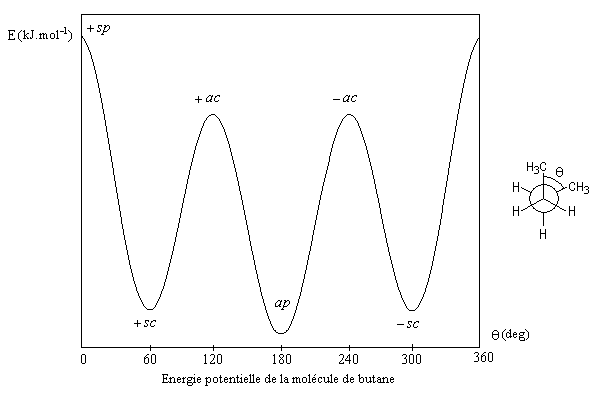
butane-config.png


Thank you very much everybody.

Konte.
 
Chemistry news on Phys.org
What's the ultimate goal? If it is spectroscopy, then the answer would be that you will find that the spectrum shows characteristics of both stable conformers.
 
DrClaude said:
What's the ultimate goal? If it is spectroscopy, then the answer would be that you will find that the spectrum shows characteristics of both stable conformers.

My goal is to construct the character table of the MS group and from that be able to find selection rules.
Your answer suggest that I have to consider both stable conformers as an independent (different) molecules?

Thanks .

Konte
 
There are no elements of the CNPI which would link energetically different minima of the potential energy surface.
 
  • Like
Likes   Reactions: Konte
DrDu said:
There are no elements of the CNPI which would link energetically different minima of the potential energy surface.

Ok. Is there a formal way which permit me to characterize the eigenstates (with or without solving the Schrödinger equation) of such a molecule and having some selection rules?

Thanks.

Konte.
 

Similar threads

  • · Replies 2 ·
Replies
2
Views
2K
  • · Replies 4 ·
Replies
4
Views
1K
Replies
5
Views
1K
  • · Replies 6 ·
Replies
6
Views
2K
  • · Replies 23 ·
Replies
23
Views
3K
  • · Replies 11 ·
Replies
11
Views
2K
  • · Replies 10 ·
Replies
10
Views
5K
  • · Replies 6 ·
Replies
6
Views
6K
Replies
24
Views
8K
  • · Replies 13 ·
Replies
13
Views
4K