Moment of inertia avoid double integral?

Click For Summary
SUMMARY

The discussion focuses on calculating the moment of inertia of a shaded area about the x-axis using the equation I(x) = y²dA. The participants explore the integration process, highlighting the challenges of handling complex integrals and the importance of careful algebraic manipulation. A specific integral involving arcsin and arctan identities is discussed, revealing that a small error, such as a misplaced parenthesis, can lead to significant discrepancies in results. Ultimately, the correct approach involves detailed verification of each step in the integration process to avoid mistakes.

PREREQUISITES
  • Understanding of moment of inertia concepts
  • Familiarity with double integrals and their applications
  • Knowledge of trigonometric identities, particularly arcsin and arctan
  • Proficiency in algebraic manipulation and simplification techniques
NEXT STEPS
  • Study the derivation of the moment of inertia for various shapes
  • Learn advanced integration techniques, including integration by parts and substitution
  • Explore the use of computational tools like Wolfram Alpha for integral verification
  • Practice solving complex integrals involving trigonometric functions and their identities
USEFUL FOR

Students and professionals in engineering, physics, and mathematics who are involved in mechanics and structural analysis, particularly those focusing on calculating moments of inertia and mastering integration techniques.

Pascal1p
Messages
28
Reaction score
0

Homework Statement


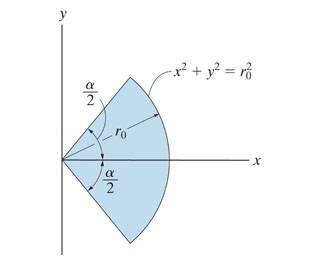
proxy.php?image=http%3A%2F%2Fi.stack.imgur.com%2FsqZ9I.jpg

Determine the moment of inertia of the shaded area about the x-axis.

Homework Equations


I(x)= y^2dA

The Attempt at a Solution


In order to determine the moment of inertia of the shaded area about the x-axis I first looked at the portion above the x-axis, integrate it with a small rectangular element and then because of the symmetry I would multiply it with 2. So:
3x8ze.png
mFGRzXL.png


Yet if I integrate that with those limits and then multiply it with 2 and insert B= a/2
I do not get (a-sin (a))(r^4)/8. The answer I would get if I just use ∫∫((r*sinθ)^2)rdθdr. Which is the correct answer.

But why doesn't it work?
 
Physics news on Phys.org
Pascal1p said:
But why doesn't it work?
It does. I checked. It's just that the integral is messy, so it's easy to make an error somewhere along the way.
Start with this, then apply that indefinite integral formula at the integration limits. The trick that cleans it up a lot is that
$$\tan^{-1}\left(\frac{R\sin\theta}{\sqrt{R^2-(R\sin \theta)^2)}}\right)=\theta$$
 
andrewkirk said:
It does. I checked. It's just that the integral is messy, so it's easy to make an error somewhere along the way.
Start with this, then apply that indefinite integral formula at the integration limits. The trick that cleans it up a lot is that
$$\tan^{-1}\left(\frac{R\sin\theta}{\sqrt{R^2-(R\sin \theta)^2)}}\right)=\theta$$

But where then does this inconsistency come from? My book gives some standard integrals and one of them was ∫x^2√(a^2-x^2)dx= -(x/4)√((a^2-x^2)^3)+ (a^2/8)(x√(a^2-x^2)+a^2sin^-1 (x/a) + C, a>0

The weird thing is that wolfram-alpha gives this long answer when you substitute 'a' with an actual number, like 9. But when you use just 'a' or substitute it with 'R', it gives a different form. The one with the tan^-1 which you just mentioned.

So I thought the answer you get when you use wolfram with y^2* sqrt(R^2-y^2) is wrong. That he might see R as something it is not, like a function related to y. Instead of the constant value that it is.

So why is -(x/4)√((a^2-x^2)^3)+ (a^2/8)(x√(a^2-x^2)+a^2sin^-1 (x/a) + C not the correct solution to the integral?
 
Pascal1p said:
The weird thing is that wolfram-alpha gives this long answer when you substitute 'a' with an actual number, like 9.
It didn't do that for me.

Pascal1p said:
So why is -(x/4)√((a^2-x^2)^3)+ (a^2/8)(x√(a^2-x^2)+a^2sin^-1 (x/a) + C not the correct solution to the integral?
Because when you differentiate it you do not get x^2√(a^2-x^2).
I did this by hand and it did not come out, and Wolfram Alpha agrees. Perhaps your text contains an error, or perhaps you have miscopied the formula.
 
andrewkirk said:
It didn't do that for me.

Because when you differentiate it you do not get x^2√(a^2-x^2).
I did this by hand and it did not come out, and Wolfram Alpha agrees. Perhaps your text contains an error, or perhaps you have miscopied the formula.

Well, the link you send, in which you said it did not do that for you. It also gives an arcsin and looked similair to what book give so I thought they were same without really checking.

I did miss a parenthesis in the end, but still what the book says does not seem the same.
vyxjkrW.png
 
Pascal1p said:
Well, the link you send, in which you said it did not do that for you. It also gives an arcsin
Recall your trig identities, in particular that ##\sin^{-1}\frac xa=\tan^{-1}\frac x{\sqrt{a^2-x^2}}##
and looked similair to what book give so I thought they were same without really checking.

I did miss a parenthesis in the end
Yes, and it was the missing parenthesis that led you to thinking the book suggested a different answer.
but still what the book says does not seem the same.
It is the same. A little algebra demonstrates that. Start by taking ##\sqrt{(a^2-x^2)^2}## out of the first term in the book and combining it with the second term (the first term in the big parenthesis on the next line).

The lesson to take from this is that if you have a messy calculation that you believe should come out to a particular result and it doesn't, set your work out in full detail and check every step for things like misplaced parentheses and wrong signs. One tiny error is all that's needed to make the whole thing fail.
 
andrewkirk said:
Recall your trig identities, in particular that ##\sin^{-1}\frac xa=\tan^{-1}\frac x{\sqrt{a^2-x^2}}##

Yes, and it was the missing parenthesis that led you to thinking the book suggested a different answer.
It is the same. A little algebra demonstrates that. Start by taking ##\sqrt{(a^2-x^2)^2}## out of the first term in the book and combining it with the second term (the first term in the big parenthesis on the next line).

The lesson to take from this is that if you have a messy calculation that you believe should come out to a particular result and it doesn't, set your work out in full detail and check every step for things like misplaced parentheses and wrong signs. One tiny error is all that's needed to make the whole thing fail.

Yeah you are right, I see now how the integral with sin^-1 and tan^-1 are the same. But so that whole integral 2∫(y^2√(R^2-y^2)+y^3/tan(a/2))dy with limits 0 to Rsin(a/2) will clean up to r^4/8(a-sin(a))? Because that I do not see.
 
Pascal1p said:
But so that whole integral 2∫(y^2√(R^2-y^2)+y^3/tan(a/2))dy with limits 0 to Rsin(a/2) will clean up to r^4/8(a-sin(a))? Because that I do not see.
Post your attempt to demonstrate this. Start by writing out the expression for the definite integral with the given limits. Then simplify. I or somebody else may help you if you get stuck. Using latex to make your formulas easy to read will greatly increase the chance of receiving help.
 
This is to where I have simplified it:
5nirwaE.jpg
 
  • #10
So how to simplify this further to r^4/8(a-sin(a))
 
  • #11
No one :(?
 

Similar threads

  • · Replies 5 ·
Replies
5
Views
3K
  • · Replies 6 ·
Replies
6
Views
2K
Replies
9
Views
8K
Replies
2
Views
2K
  • · Replies 7 ·
Replies
7
Views
3K
Replies
1
Views
8K
  • · Replies 18 ·
Replies
18
Views
4K
  • · Replies 1 ·
Replies
1
Views
4K
  • · Replies 4 ·
Replies
4
Views
2K
  • · Replies 3 ·
Replies
3
Views
3K