Moment of inertia of a rectangular prism parallel to one face

  • Thread starter Thread starter eddiezhang
  • Start date Start date
  • Tags Tags
    Moment of inertia
Click For Summary
SUMMARY

The moment of inertia (MoI) of a rectangular prism, or cuboid, can be calculated using the formula I_x = Km (y^2 + z^2), where K is a constant determined by the geometry of the prism and m is the total mass. The calculation involves integrating the mass distribution across the dimensions of the prism, specifically using the parallel axis theorem when the axis of rotation is not at the center. The discussion emphasizes the importance of understanding the mass density distribution and the geometry of the object for accurate MoI computation.

PREREQUISITES
  • Understanding of moment of inertia and its significance in physics.
  • Familiarity with the parallel axis theorem.
  • Knowledge of triple integrals and their application in calculating MoI for 3D bodies.
  • Basic concepts of mass distribution and geometry in rigid body dynamics.
NEXT STEPS
  • Study the derivation of the moment of inertia for different shapes, focusing on rectangular prisms.
  • Learn about the parallel axis theorem and its applications in rotational dynamics.
  • Explore the use of triple integrals in physics, particularly in calculating properties of 3D objects.
  • Investigate the relationship between mass distribution and moment of inertia in various geometrical configurations.
USEFUL FOR

Students in physics courses, mechanical engineers, and anyone interested in understanding the principles of rotational dynamics and the calculation of moment of inertia for complex shapes.

eddiezhang
Messages
39
Reaction score
8
Homework Statement
Consider a long rectangular prism with width w, height h and length l (a 'ruler' for brevity, although its height is non-negligible). The 'ruler' balances on a table with length l1 hanging off the side and l2 resting on the table. What is the ruler's moment of inertia if it starts to fall off the table?
Relevant Equations
Contained in attempt, and it's probably wrong too...
I'm sorry for a really basic question, but my physics class was just introduced to moments of inertia and I want to try find them in three dimensions

Attempt:

Step 1) Search up 'moment of inertia of a rectangle' and find this:
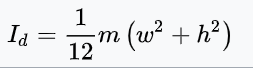
1706585118113.png


Step 2) Multiply by the height??? This is definitely wrong

Step 3) Realize I'm completely clueless and should ask a stranger onlineThanks...
 
  • Like
Likes   Reactions: Delta2
Physics news on Phys.org
Well, you have to start with a diagram showing the body and its axis of rotation. Then you have to figure out how to apply the definition:

$$I = \int r^2 dm $$

Unfortunately, it's probably not trivial.
 
  • Like
Likes   Reactions: Delta2
This problem is wierdly stated. Did the OP quote it verbatim? What causes, at tipping, ##L_1\neq L_2##? This could be an interesting problem, but I don't know what the question is.
Also the moment of inertia depends only upon the object and trivially its axis of rotation ( see parallel axis theorem). You will need to know something about the distribution of mass.
 
Last edited:
You can reduce it to a 2D problem by breaking it into identical thin rectangles all rotating about an axis at the same point within the rectangle.
The formula you quote is for the moment of inertia about the mass centre (of a uniform rectangle). Your axis here is not in the middle of a rectangular element. You need to use the parallel axis theorem.
You certainly do not want to multiply by the third dimension. MoI has dimension ##ML^2##, not ##ML^3##.
 
  • Like
Likes   Reactions: Delta2
eddiezhang said:
Homework Statement: Consider a long rectangular prism with width w, height h and length l (a 'ruler' for brevity, although its height is non-negligible). The 'ruler' balances on a table with length l1 hanging off the side and l2 resting on the table. What is the ruler's moment of inertia if it starts to fall off the table?
Relevant Equations: Contained in attempt, and it's probably wrong too...

I'm sorry for a really basic question, but my physics class was just introduced to moments of inertia and I want to try find them in three dimensions

Attempt:

Step 1) Search up 'moment of inertia of a rectangle' and find this: View attachment 339420

Step 2) Multiply by the height??? This is definitely wrong

Step 3) Realize I'm completely clueless and should ask a stranger onlineThanks...
yes 2) is definitely wrong. The moment of inertia is a triple integral for 3D bodies, which triple integral quite often is misunderstood when it is given in its synoptic form given in post #2 by @erobz .

Also your question "What is the ruler's moment of inertia if it starts to fall off the table" might make someone to think that the MoI definition of an object depends on how the object is behaving, that is not the case, MoI in the general case is a triple integral that depends on the mass density distribution and the geometry of the object both of which are considered to be stable no matter what our object is doing in the world, as long as we consider a rigid object of course.

your 3) made me smile, thx for that.Now in order to solve the problem you have correctly done step 1 to find ##I_d##. Then the aforementioned triple integral for the MoI of ruler, reduces to an integral of the form $$\int_0^H I_d(r)dr$$ where ##H## is the height in the third dimension, and ##r## the variable of integration is the vertical distance of the center of the "current" rectangle from the axis of rotation. You need to find the function ##I_d(r)##.

MENTOR NOTE: The corrected integral was posted in post #11 by @Delta2
 
Last edited by a moderator:
haruspex said:
You certainly do not want to multiply by the third dimension
I think the integral at #5 reduced to a simple multiplication but not exactly of the ##I_d## given in the OP.

P.S I consider the axis of rotation passing through the center of the cuboid and be vertical to the plane of the other two dimensions.

To @eddiezhang to make a long story short all you have to is a multiplication but you got to think what exactly is you want to multiply with the third dimension, and you ll find the MoI around axis passing through the center of the ruler. So you have to take care of what @haruspex says at #4 about the parallel axis theorem.
 
Last edited:
Delta2 said:
the integral at #5 reduced to a simple multiplication but not exactly of the Id given in the OP.
No. The expression for ##I_d## in post #1 includes the mass of the block. If you want to integrate wrt the third dimension then you need to change that to mass per unit length in that direction. But since it is rectangular, integrating that just gets you back to the expression you started with.
 
haruspex said:
But since it is rectangular, integrating that just gets you back to the expression you started with.
Not sure what you mean here exactly but as far as I know the MoI for a 3D rectangle (parallelepiped is the exact word?) is almost the same expression as I_d given in the OP but the mass is the total mass of the parallelepiped, not the mass of a rectangular slice of it.
 
Delta2 said:
Not sure what you mean here exactly but as far as I know the MoI for a 3D rectangle (parallelepiped is the exact word?)
No, a parallelepiped has parallelogram faces. The OP correctly used "rectangular prism", or you can say cuboid.
Delta2 said:
is almost the same expression as I_d given in the OP but the mass is the total mass of the parallelepiped, not the mass of a rectangular slice of it.
Right, so why do you want to integrate? The modification you need to make to the expression for ##I_d## before integrating is to divide by the width, and then integrating just multiplies by that width.
 
  • #10
Ye ok integration is being reduced to a multiplication in this case since the distance from the axis of center is constant (zero in this case).
 
  • #11
I admit that integral is not exactly correct, I should have written it as $$\int_0^H f_d(r(t))dt$$ but it is kind misleading because as it turns (I didn't think of it when I was writing my initial post) that r(t)= the distance of the center of the current rectangle from the axis of rotation, does not depend on t , the height of the current rectangle.
 
Last edited:
  • #12
It is very unfortunate that people who did not know how to work the problem felt compelled to chime in. It is difficult to clear up all the misconceptions but let me at least show how to calculate the moment of inertia.

A moment of inertia has units of mass times length square. We will calculate the moment of inertia about the center of the prism, with axes through the faces. The answer must be of the form:

I_x = m (Ax2 + Ky^2 + Cz^2 + Exy + Fyz + Gxz)

based on dimensional analysis alone. Because filling the coordinate system x to -x (or y to -y, etc.) can't change the answer, E, F and G are zero. Because we are rotating around x, A = 0. Because it doesn't matter what we call x, y and z, K = C. So we have:

I_x = Km (y^2 + z^2)

To get K, consider the case where z is large, and x and y are negligibly small. Now you have a simpel (and famous) integral.

If you want I about another axis, permute x, y and/or z. After all, the physics doesn't care about labels. If you want it about another point, you should know how to do that. There is a theorem.
 
Last edited by a moderator:

Similar threads

Replies
25
Views
2K
  • · Replies 12 ·
Replies
12
Views
2K
  • · Replies 5 ·
Replies
5
Views
5K
  • · Replies 2 ·
Replies
2
Views
12K
  • · Replies 7 ·
Replies
7
Views
1K
  • · Replies 6 ·
Replies
6
Views
6K
  • · Replies 1 ·
Replies
1
Views
4K
  • · Replies 12 ·
Replies
12
Views
2K
  • · Replies 1 ·
Replies
1
Views
1K
Replies
3
Views
4K