Moment of Inertia: Pendulum Problem

Click For Summary
SUMMARY

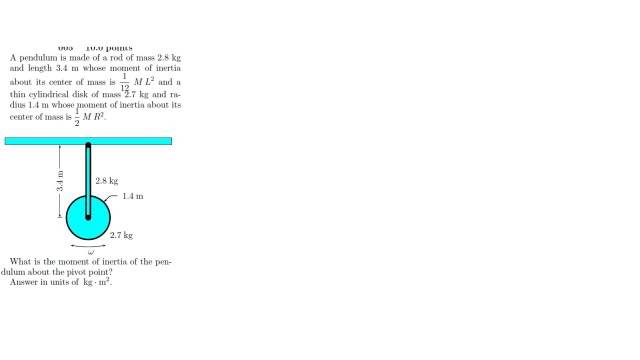
The forum discussion centers on calculating the moment of inertia for a pendulum system consisting of a rod and a disc. The participants utilize the parallel axis theorem (PAT) and specific formulas for moment of inertia, including I = 1/3ML^2 for the rod and I = 1/2MR^2 for the disc. Key calculations reveal that the total moment of inertia is approximately 44.65 kg·m², correcting earlier miscalculations. The discussion emphasizes the importance of ensuring all components are calculated about the same axis and understanding the derivation of moment of inertia equations.

PREREQUISITES
  • Understanding of moment of inertia concepts
  • Familiarity with the parallel axis theorem (PAT)
  • Knowledge of basic physics equations for rotational motion
  • Ability to perform unit conversions and dimensional analysis
NEXT STEPS
  • Study the derivation of moment of inertia equations, particularly I = 1/12MR² and I = 1/3ML²
  • Learn about the perpendicular axis theorem and its applications
  • Practice problems involving the parallel axis theorem with different geometries
  • Explore advanced rotational dynamics concepts, including torque and angular momentum
USEFUL FOR

Students studying physics, particularly those focusing on mechanics and rotational dynamics, as well as educators seeking to clarify concepts related to moment of inertia and its calculations.

Idividebyzero
Messages
64
Reaction score
0
1.
Untitled-16.jpg


2. I = (x/x) M L ^ 2


3i honestly have no idea where to go with this. i do have an attempt so please don't laugh. I took the (L) for the moment for the rod = 3.4 m and divided it into 2 parts. R sub 1 and R sub 2. With R sub 2 on half of R sub 1. The equation i got using the R sub 1 i have the moment for the disc: I = mdiscr12 + Icm and for the R sub 2 i have the moment for the rod: Ir= mrrrod2 + Icm from here i don't know what to do with them or if I am even correct in my assumptions
 
Physics news on Phys.org
my thoughts is to solve those individual moments and add them together for the total moment at the pivot point

and i mispoke on the length of r sub 2 it should be the 3.4 m minus the radius of the disc?
 
123123-1.jpg
 
bumpity need some input
 
My thought is to use the parallel axis theorem, treating the weight at the end of the rod as a point mass.
Itotal=1/3ML^2+m(D)^2
Irod(about its end)=1/3ML^2
where M is the mass of the rod, m the mass of the weight, and D the distance from center of mass of the rod to the end of the rod

I= (1/3)(2.8)(3.4^2) + (2.7)(1.7^2) = 18.59233
 
Last edited:
You can use the parallel axis theorem to find the moment of inertia of each component of the pendulum and then add the resulting moments of inertia about the pivot point together to get the total moment of inertia.

Moments of inertia are additive relative to the same axis.
 
so I am on the right track maybe recheck my equations?
 
Smooth23 said:
My thought is to use the parallel axis theorem, treating the weight at the end of the rod as a point mass.
Itotal=1/3ML^2+m(D)^2
Irod(about its end)=1/3ML^2
where M is the mass of the rod, m the mass of the weight, and D the distance from center of mass of the rod to the end of the rod

I= (1/3)(2.8)(3.4^2) + (2.7)(1.7^2) = 18.59233

the concept is correct but the numbers are off, 18.59233 was incorrect
 
No. For one, you're adding incompatible units (kg*m^2 and kg).

For the rod, the distance is through the rod's CM, or halfway through the total length of the rod.

You need to first calculate the moment of inertia for each object around it's own CM, not the pivot point of the system.
 
  • #10
okay for the rod

I = 1/3 (2.8 kg) ((3.4/2)^2) ...(1)

the center of mass of the disc whose axis is through the center has moment of inertia 1/2mr^2. so this plus eq. (1)?


the question is actually giving me a equation for the I of the rod. as 1/12mr^2, where is the 1/3 coming from
 
  • #11
im still missing something.

I = 1/3 (2.8 kg) ((3.4/2)^2)
+
I= 1/2 ( 2.7) ((1.4)^2)
=
5.343

its wrong...
 
  • #12
Idividebyzero said:
okay for the rod

I = 1/3 (2.8 kg) ((3.4/2)^2) ...(1)

the center of mass of the disc whose axis is through the center has moment of inertia 1/2mr^2. so this plus eq. (1)?


the question is actually giving me a equation for the I of the rod. as 1/12mr^2, where is the 1/3 coming from
The 1/3 comes from using the PAT. If you use the 1/12 eq, It will give you the moment of inertia of the rod about its CM. I made an error here; the r in the equation should be the total length of the rod. Next, you need to find the moment of inertia about the pivot point by adding mr2, where r is the distance of the rod's CM from the pivot point and m is the mass of the rod. Using the 1/3 equation should get you the same answer as this process, without the extra step of using the PAT. (It has already been done in the 1/3 eq for you.)

Then repeat the same process (with the appropriate equations) for the disc, and sum the results,
 
  • #13
Idividebyzero said:
im still missing something.

I = 1/3 (2.8 kg) ((3.4/2)^2)
The r here should be 3.4 m. (My mistake earlier.)

Idividebyzero said:
I= 1/2 ( 2.7) ((1.4)^2)

This is the moment of inertia of the disc about its center of mass. You need to use the parallel axis theorem to find the moment of inertia of the disc about the pivot point (+ 2.7kg(3.4m)2).

Once the moments of inertia are about the same axis, you can sum them.
 
  • #14
cool thanks. we haven't done this in class yet i was trying to get a grasp on it before hand
 
  • #15
for the rod i get
1/3ML^2+M(L/2)^2
(1/3)(2.8kg)(3.4 m )^2 + (2.8 kg)((3.4/2)^2)
10.789+8.092
18.881 = I for rod

For the disc: MR^2 here would be the L of rod plus the radius? or that quantity divided by 2?

I = 1/2 ML^2 + MR^2
I= (1/2)(2.7kg)((1.4)^2) + (2.7kg)((3.4+1.4))^2
 
  • #16
I don't see why we can't treat the disc as a point mass, seeing as the problem says nothing about it actually rotating, and is attached at it's center mass, PAT should be valid.
 
  • #17
Im going to use the PAT. i wasnt adding the MR^2 to my EQ.s i just need to know now for the MR^2 of the disc what the R is.

is it the (Lrod + Radius of disc)/2 or (Lrod + Radius of disc) by itself
 
  • #18
well that was wrong...
 
  • #19
Idividebyzero said:
for the rod i get
1/3ML^2+M(L/2)^2
(1/3)(2.8kg)(3.4 m )^2 + (2.8 kg)((3.4/2)^2)
10.789+8.092
18.881 = I for rod
No, the 1/3mr2 is the moments of inertia about the pivot point already. You don't need to use the PAT. If you had used the 1/12mr2 equation, then you would have to use the PAT.

To see if you understand, you should try to derive the 1/12mr2 equation and the PAT to recover the 1/3mr2 equation.

Idividebyzero said:
For the disc: MR^2 here would be the L of rod plus the radius? or that quantity divided by 2?

I = 1/2 ML^2 + MR^2
I= (1/2)(2.7kg)((1.4)^2) + (2.7kg)((3.4+1.4))^2

No, the R would just be 3.4 m, which is the distance from the center of mass of the disc to the pivot point.

By the way, I'm sorry if I'm being unclear about things, but I'm posting off of a mobile device and it's difficult to post.
 
  • #20
its all good, this is material that has not been covered in class. your helping me make good sense of it

but i make the corrections and its still wrong
 
  • #21
Irod= (1/3)(2.8kg)((3.4m)^2) + (2.8kg)((3.4/2)^2)
Irod= 18.8813

Idisc= (1/2)(2.7kg)((1.4)^2) + (2.7kg)((3.4)^2)
Idisc=33.858

Itotal= Irod + Idisc
Itotal=18.8813 + 33.858
Itotal= 52.739

this 52.739 is incorrect
 
  • #22
What answer is given?
 
  • #23
i still have two more attempts before i miss it, after that i miss the problem and the correct answer is not given.
 
  • #24
here

Idisc= (1/2)(2.7kg)((1.4)^2) + (2.7kg)((3.4)^2)

what would the verbal meaning of changing 3.4 to 1.4...the focal point of the disc on the perpendicular rod
 
  • #25
Try#1: 18.59233

4/13/11 9:19 AM
Try#2: 5.3433

4/13/11 9:29 AM
Try#3: 3.3203

4/13/11 9:55 AM
Try#4: 37.079

4/13/11 10:00 AM
Try#5: 52.739
 
  • #26
I get 44.65 kg∙m2:
<br /> \begin{align*}<br /> I_{rod} &amp;= \frac{1}{3}ML^2 \\<br /> &amp;= \frac{1}{3}(2.8\,\mathrm{kg})(3.4\,\mathrm{m})^2\\<br /> I_{rod} &amp;\approx 10.789\,\mathrm{kg \cdot m^2}\\<br /> \\<br /> I_{disk} &amp;= \frac{1}{2}MR^2 + ML^2 \\<br /> &amp;= \frac{1}{2}(2.7\,\mathrm{kg})(1.4\,\mathrm{m})^2 + (2.7\,\mathrm{kg})(3.4\,\mathrm{m})^2 \\<br /> I_{disk} &amp;= 33.858\,\mathrm{kg \cdot m^2}\\<br /> \\<br /> I_{tot} &amp;= I_{rod} + I_{disk} \\<br /> I_{tot} &amp;= 44.647\,\mathrm{kg \cdot m^2}\\<br /> \end{align*}<br />
 
  • #27
that was correct i see what my problem was it was on the Irod...I had the 1/3ml^2 + MR^2 i should have left that MR^2 off...
 
  • #28
thanks a bunch
 
  • #29
Idividebyzero said:
thanks a bunch

No problem.

I would highly recommend that you use the parallel axis theorem to derive the 1/3MR2 equation for moment of inertia from the 1/12MR2 equation. This, I think, will help you understand better why you don't need to add the MR2 term to the 1/3 eq.; it is already taken into account.
 
  • #30
okay. ill do it probably today I am almost done with this assignment and its not due until next tuesday
 

Similar threads

  • · Replies 21 ·
Replies
21
Views
2K
Replies
2
Views
2K
  • · Replies 3 ·
Replies
3
Views
3K
  • · Replies 4 ·
Replies
4
Views
2K
Replies
5
Views
944
  • · Replies 28 ·
Replies
28
Views
2K
  • · Replies 3 ·
Replies
3
Views
1K
  • · Replies 13 ·
Replies
13
Views
3K
Replies
8
Views
2K
Replies
11
Views
3K