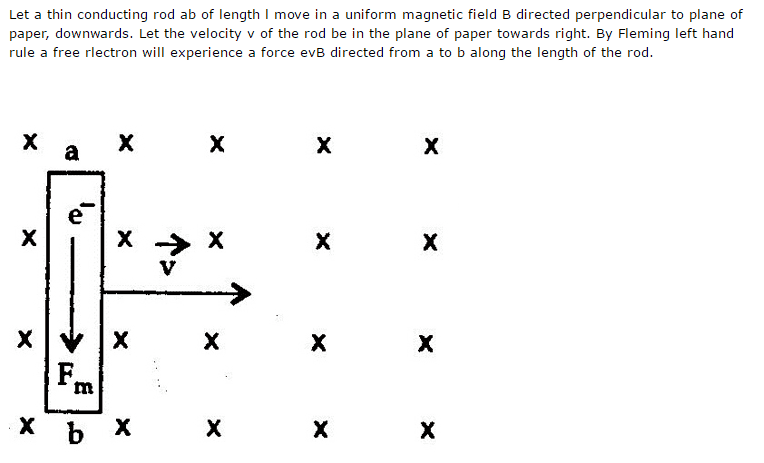
Why is the force pushing electrons downwards in this scenario?

  • Context: High School 
  • Thread starter Thread starter Saracen Rue
  • Start date Start date
  • Tags Tags
    Emf Wire
Click For Summary
SUMMARY

The discussion clarifies the application of the right-hand rule in electromagnetism, specifically regarding the force acting on electrons in a magnetic field. The participants confirm that while positive charges moving left through a magnetic field into the page would experience an upward force, electrons, being negatively charged, experience a downward force due to their negative charge. The correct interpretation of the right-hand rule indicates that the vector resulting from the cross product of velocity and magnetic field, ##\mathbf{v} \times \mathbf{B}##, points upwards, but the force on electrons is downward because of their negative charge.

PREREQUISITES
  • Understanding of electromagnetism principles
  • Familiarity with the right-hand rule in physics
  • Knowledge of vector cross products
  • Basic concepts of charge and particle motion in magnetic fields
NEXT STEPS
  • Study the Lorentz force law in detail
  • Learn about electromagnetic induction and its applications
  • Explore vector calculus, focusing on cross products
  • Investigate the behavior of charged particles in magnetic fields
USEFUL FOR

Students of physics, educators teaching electromagnetism, and anyone interested in understanding the behavior of charged particles in magnetic fields.

Saracen Rue
Messages
150
Reaction score
10
Hello Physics Forums users,

Thank you for taking the time to read my thread. I has just reading through this following article: http://www.sciencehq.com/physics/electromagnetic-induction.html when I came across this:
upload_2017-3-16_11-6-54.png

And became rather confused. The right hand rule dictates that in this scenario; positive particles moving towards the left through a magnetic field into the page should result in a force that acts upwards. Due to the fact that electrons are the only free-moving component inside a metallic lattice, they should be forced upwards. However, this article states that the force pushes them downwards. Any help with understanding what's happening here is much appreciated.

Again, thank you for your time :)
 
Physics news on Phys.org
Remember that ##\mathbf{F} = q \mathbf{v} \times \mathbf{B}##. By the right-hand rule, ##\mathbf{v} \times \mathbf{B}## is a vector that points up in this scenario, and since ##q## is negative (it is the charge of the electron), you know the rest.
 
Last edited:
Ah thank you very much, that makes a lot more sense now. The right hand rule isn't indicating the direction of the force but rather the direction of vector ##v*B##.

Again, thank you for your help! :)
 
Saracen Rue said:
Ah thank you very much, that makes a lot more sense now. The right hand rule isn't indicating the direction of the force but rather the direction of vector ##v*B##.

Again, thank you for your help! :)
You're welcome!

Just a clarification, the vector we're looking at is ##\mathbf{v} \times \mathbf{B}##. What you wrote, ##v*B##, seems like the product of their lengths.
 

Similar threads

  • · Replies 20 ·
Replies
20
Views
5K
  • · Replies 4 ·
Replies
4
Views
4K
  • · Replies 5 ·
Replies
5
Views
2K
  • · Replies 13 ·
Replies
13
Views
2K
  • · Replies 2 ·
Replies
2
Views
2K
  • · Replies 4 ·
Replies
4
Views
2K
  • · Replies 6 ·
Replies
6
Views
6K
  • · Replies 4 ·
Replies
4
Views
3K
  • · Replies 5 ·
Replies
5
Views
2K
  • · Replies 8 ·
Replies
8
Views
2K