MSE estimation with random variables

1 reply · 1K views · last reply
ashah99
Messages
55
Reaction score
2
Homework Statement
Please see below: finding an MSE estimate for random variables
Relevant Equations
Expectation formula, MSE = E( (S_hat - S)^2 )
Hello all, I am wondering if my approach is correct for the following problem on MSE estimation/linear prediction on a zero-mean random variable. My final answer would be c1 = 1, c2 = 0, and c3 = 1. If my approach is incorrect, I certainly appreciate some guidance on the problem. Thank you.

Problem
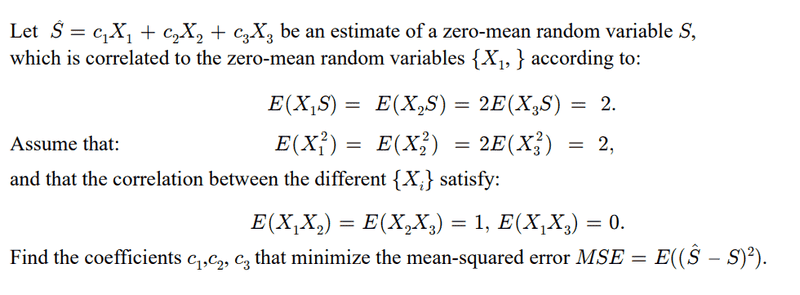
Typeset problem statement: estimate S-hat = c1X1 + c2X2 + c3X3 of zero-mean S; gives E(X1S)=E(X2S)=2E(X3S)=2, E(X1^2)=E(X2^2)=2E(X3^2)=2, E(X1X2)=E(X2X3)=1, E(X1X3)=0; find c1, c2, c3 minimizing MSE E((S-hat - S)^2).

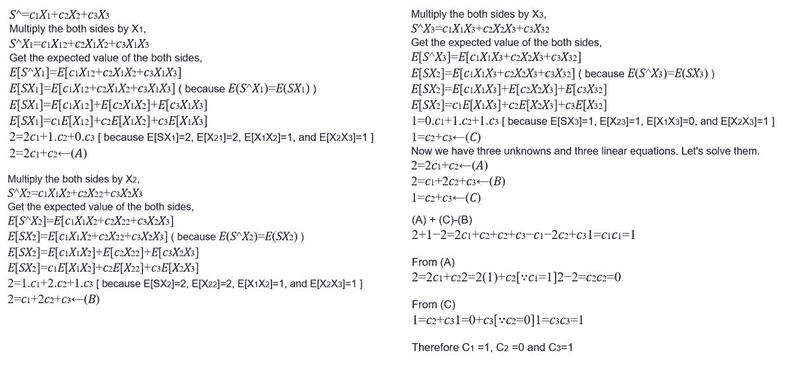
Approach:
Handwritten derivation of linear MSE estimation coefficients c1, c2 and c3 using expected-value equations, ending with the solution C1 = 1, C2 = 0, C3 = 1.
 
Yes, the approach is incorrect. When you take expected values, you assume that
$$E\left[ \hat S X_i\right] = E\left[ S X_i\right]$$
But we have no reason to suppose that is correct. ##\hat S## is only an estimate of ##S##, not identical to it, and cannot be substituted for it, except in very limited circumstances.

Instead, substitute ##\sum c_i X_i## for ##\hat S## in ##E[(\hat S - S)^2]##, then expand to get an expression in expected values of first and second order terms in ##X_1, X_2, X_3, S##, with unknowns ##c_1,c_2,c_3##. We have been given values for all those terms except ##E[S^2]##, which we can ignore, since it it is not multiplied by any of the unknown coefficients. Numerically minimising that expression, I get a solution where two of the coefficients are near 1 and one is near 0. Possibly the optimisation can be solved analytically, but I didn't try.