Multiple fusion: daughter cells different from parent cell?

Click For Summary

Discussion Overview

The discussion revolves around the concept of multiple fusion and multiple fission in cellular reproduction, specifically questioning whether daughter cells are genetically different from the parent cell. Participants explore the implications of these processes in the context of cell division, particularly in relation to malaria and other biological phenomena.

Discussion Character

  • Debate/contested
  • Technical explanation
  • Conceptual clarification

Main Points Raised

  • One participant suggests that in multiple fusion, daughter cells are different from the parent cell based on an image they referenced.
  • Another participant describes schizogony as a process where multiple rounds of nuclear division occur before cytoplasm segmentation, resulting in genetically identical cells.
  • It is noted that sexual reproduction, which introduces genetic changes, occurs in specific contexts such as in the gut of the malaria mosquito.
  • A participant clarifies that the diagram referenced does not depict fusion but rather mitosis without cytokinesis, leading to multinucleated cells that remain genetically identical.
  • There is a question about whether daughter cells in multiple fission are genetically identical to the mother cell, with a concern raised about the size of the daughter cells.

Areas of Agreement / Disagreement

Participants express differing views on the processes of multiple fusion and multiple fission, with some asserting that daughter cells are genetically identical while others question the implications of size and the nature of the processes depicted in the diagrams. The discussion remains unresolved regarding the specifics of genetic differences in daughter cells.

Contextual Notes

There are limitations in the discussion regarding the definitions of multiple fusion and multiple fission, as well as the assumptions about the diagrams referenced. The relationship between the processes and the genetic outcomes is not fully clarified.

gracy
Messages
2,486
Reaction score
83
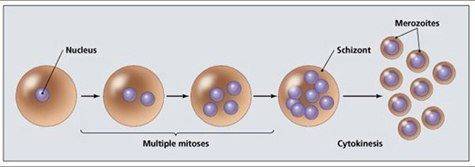
I think in Multiple fusion daughter cells are different from parent cell.I interpreted this by looking at the image below
multiple.jpg

Have I interpreted correctly?Is this image reliable?
 
Biology news on Phys.org
This process is is called schizogony: mitotic division in which multiple rounds of nuclear divisions occur before the cytoplasm segments. So the resulting cells are all genetically the same.

The only time you have sexual reprduction (and therefore changes in genes) is in the gut of the malaria mosquito (Anopheles falciparum).
This picture helps a lot
https://upload.wikimedia.org/wikipedia/commons/0/0b/Plasmodium_lifecycle_PHIL_3405_lores.jpg

Look at the diagram.
Step 1 happens only when the mosquito injects sporozoites. This starts cycle A in your diagram. A only happens after a mosquito bite.
... -> step 4 is what you are talking about: where the schizont makes genetic duplicates of itself.
Step 4 starts another cycle - labelled B. This is the cycle that is the cause of the cyclic nature of malaria. Short periods of violent illness with an interlude of several days - or maybe weeks.

So malaria kills some liver cells, but repeatedly kills off red blood cells. Marlaria is an extreme problem for millions of people on almost every continent.
Malaria deaths in 2013 were ~580,000 with about 198 million infections: http://www.who.int/features/factfiles/malaria/en/
 
  • Like
Likes   Reactions: gracy
jim mcnamara said:
Look at the diagram.
Step 1 happens only when the mosquito injects sporozoites. This starts cycle A in your diagram. A only happens after a mosquito bite.
... -> step 4 is what you are talking about: where the schizont makes genetic duplicates of itself.
Step 4 starts another cycle - labelled B. This is the cycle that is the cause of the cyclic nature of malaria. Short periods of violent illness with an interlude of several days - or maybe weeks.
But this does not really answer my question.Please help.
 
What really is your question - the cells are identical after multiple fusion? They are identical genetically.
 
First, there is no fusion going on in the diagram you're showing. The cells containing multiple nuclei result from mitosis without cytokinesis, not from two cells fusing together. Just as in normal mitosis, this process results in identical nuclei but instead of being segregated into different daughter cells, the two identical nuclei remain in the same cell. The process can repeat to create a cell with many identical nuclei. Here's a section from Molecular Biology of the Cell discussing this phenomenon, with a very nice picture of these multinucleate cells during mitosis: http://www.ncbi.nlm.nih.gov/books/NBK26831/#_A3392_

Multinucleated cells can arise from many cells fusing together (see https://en.wikipedia.org/wiki/Syncytium), but this is not the process shown in the diagram.
 
Sorry I meant Multiple fission in the title .
Ygggdrasil said:
The cells containing multiple nuclei result from mitosis without cytokinesis,
And in multiple fission cytokinesis does occur.Right?
 
Multiple fission is a type of asexual reproduction.So,I think daughter cells would be same as mother cell(cell which gives rise to those daughter cells)genetically,.But what about size?
 

Similar threads

Replies
3
Views
2K
  • · Replies 3 ·
Replies
3
Views
1K
  • · Replies 3 ·
Replies
3
Views
2K
  • · Replies 4 ·
Replies
4
Views
3K
  • · Replies 11 ·
Replies
11
Views
2K
  • · Replies 8 ·
Replies
8
Views
2K
  • · Replies 2 ·
Replies
2
Views
4K
Replies
25
Views
4K
Replies
2
Views
1K