Mutual Thermal Resistances between Pipe Layers

  • Thread starter Thread starter HumanistEngineer
  • Start date Start date
  • Tags Tags
    Pipe Thermal
Click For Summary

Discussion Overview

The discussion revolves around the mutual thermal resistances between different layers in a buried pre-insulated pipe system, specifically focusing on layers such as water, steel, insulation, and ground. Participants are exploring how to model these thermal resistances and seeking references or formulations to aid in their analysis.

Discussion Character

  • Exploratory
  • Technical explanation
  • Debate/contested

Main Points Raised

  • One participant references a source that defines mutual thermal resistances for a buried pre-insulated pipe and seeks to extend this model to include water, steel, insulation, and ground.
  • Another participant suggests looking for keywords related to heat transfer analysis in multi-layered cylindrical geometries and provides links to papers on the subject.
  • A third participant echoes the previous suggestion but expresses skepticism about the relevance of the provided references, emphasizing the need for specific thermal resistance values between layers.
  • One participant mentions that the heat transfer coefficient at the wall between water and steel can be derived from empirical relations involving Reynolds and Prandtl numbers, questioning the absence of such information in the referenced text.

Areas of Agreement / Disagreement

Participants do not appear to reach a consensus on the appropriateness of the references provided, with some expressing doubts about their relevance to the specific thermal resistance calculations needed.

Contextual Notes

There are limitations in the discussion regarding the assumptions made about the flow conditions, such as whether the heat transfer is conduction limited or if convection plays a significant role, which remains unresolved.

HumanistEngineer
Messages
18
Reaction score
2
TL;DR
Mutual thermal resistances between layers of a cylinder (either a pipe or a storage tank) in order to obtain heat transfer between these sections (e.g. from water to steel, steel to insulation, insulation to the ground and vice versa).
Ref: Palsson, Halldor | Analysis of Numerical Methods for Simulating Temperature Dynamics in District Heating Pipes - please check pg. 62 at LINK (CLICK!)

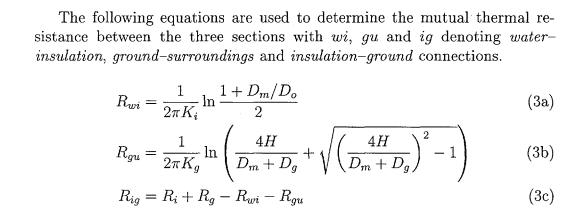
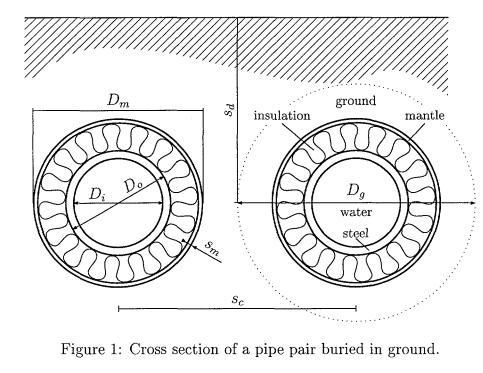
INTRO: In this reference, the mutual thermal resistances between layers as water-insulation, ground-surrounding, and insulation-ground are defined for a buried pre-insulated pipe, figure and formulations given below:
FIGURE:
244535

FORMULATIONS:
244536


QUESTION: I want to improve the model given in this reference by studying the layers as water, steel, insulation, and ground so I need to obtain the mutual thermal resistances between water-steel, steel-insulation, insulation-ground, and ground-surrounding. I couldn't find a reference describing how to find the thermal resistances between layers of a cylinder such as between water and steel and others. Can any of you help me either by giving formulations or by guiding me to a reference?

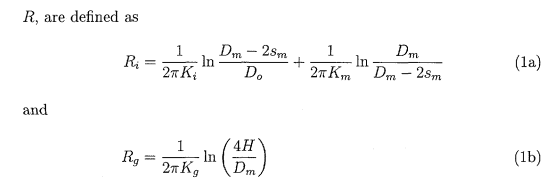
More details (Ri and Rg as given in the formulation above (3c)):
244537
 
  • Like
Likes   Reactions: berkeman
Engineering news on Phys.org
Mech_Engineer said:
Heat transfer analysis through a multi-layered cylindrical geometry is a common topic, you might just need to look for the right key words.

Here is one paper I found on the subject: https://web2.clarkson.edu/projects/subramanian/ch330/notes/Conduction in the Cylindrical Geometry.pdf

This topic is also covered in college-level heat transfer courses: https://www.sfu.ca/~mbahrami/ENSC 388/Notes/Staedy Conduction Heat Transfer.pdf

Thank you Mech_Engineer. But I don't think that such references are good as answer to my question. I want to find the temperature of (i.e.) insulation so I need this, as termed by the reference, the mutual thermal resistance between the layers (for example between water and insulation (as well as between insulation and the ground). Meanwhile, I need to find the temperature of sorrounding ground (its temperature gets affected by the water temperature as result).
 
Usually the heat transfer coefficient at the wall (such as between the water and the steel tube) would be found from empirical relation involving Reynolds and Prandtl numbers (see for example, Dittus-Boelter). I'm not sure why that doesn't seem to appear in your referenced text. Maybe (?) the water flowrate is high enough that the heat transfer is conduction limited (so that the convection coefficient isn't significant)?
 
  • Like
Likes   Reactions: HumanistEngineer

Similar threads

  • · Replies 4 ·
Replies
4
Views
2K
  • · Replies 16 ·
Replies
16
Views
4K
  • · Replies 13 ·
Replies
13
Views
18K
  • · Replies 35 ·
2
Replies
35
Views
94K
  • · Replies 5 ·
Replies
5
Views
3K
  • · Replies 3 ·
Replies
3
Views
13K
  • · Replies 9 ·
Replies
9
Views
10K
  • · Replies 152 ·
6
Replies
152
Views
11K
  • · Replies 3 ·
Replies
3
Views
13K
  • · Replies 10 ·
Replies
10
Views
10K