Why Do Circuit A and Circuit B Show Different Current and Voltage Behaviors?

Click For Summary
SUMMARY

The discussion focuses on the differing current and voltage behaviors in Circuit A and Circuit B due to the application of the passive sign convention and the principles of inductance. In Circuit A, the current i(t) and voltage v(t) decay exponentially, while in Circuit B, the voltage supports the decreasing current, resulting in growth equations for both i(t) and v(t). The inconsistency in sign conventions between the two circuits leads to confusion in applying the equation v = L(di/dt). The final value of the current through the inductor is determined by the sign conventions used in each circuit.

PREREQUISITES
  • Understanding of passive sign convention in electrical circuits
  • Knowledge of inductance and the relationship between current and voltage
  • Familiarity with Kirchhoff's Voltage Law (KVL)
  • Basic calculus for analyzing exponential functions
NEXT STEPS
  • Study the principles of inductors and their voltage-current relationships
  • Learn about Kirchhoff's Voltage Law (KVL) applications in complex circuits
  • Explore the implications of sign conventions in circuit analysis
  • Review exponential decay and growth functions in electrical engineering contexts
USEFUL FOR

Electrical engineers, physics students, and anyone interested in circuit analysis and the behavior of inductors in different configurations.

paulmdrdo
Messages
89
Reaction score
2
as you can see In the image I provided I have derived the equation for i(t) and v(t).

On circuit A I use a passive sign convention(current flowing from positive to negative) on the inductor, hence the equation and their corresponding graph.
i(t) is decaying exponentially, v(t) is decaying exponentially.

On circuit B I did use what I learned in physics, i.e the voltage induced across an inductor is always opposite to the increase/decrease in current
flowing throuhg it. Since the current i(t) is decreasing, the voltage should support that current hence the sign. when I perform kvl on circuit B I ended up having growth equation for both i(t) and v(t). Why is that?

Also in circuit A I expect to have same graph for both i(t) and v(t) (Although they are both decaying).
Please, kindly clear this up for me if you have time. Thanks!
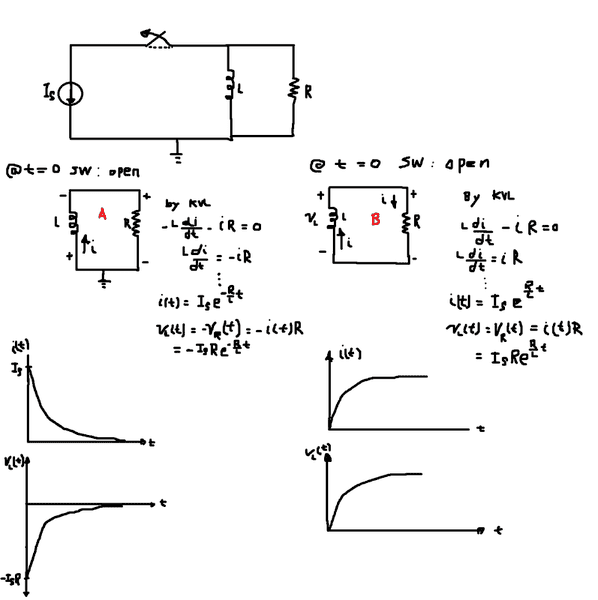
eda.png
 
Last edited by a moderator:
Engineering news on Phys.org
What is the final value of the current through the inductor (when the current does not vary any longer)?
 
The signs are not consistent between the two circuits therefore you can't use v=Ldi/dt (using the symbols from the schematics) in both algebraic solutions. i.e. circuit a has positive current entering the + terminal of L. Circuit B has positive current leaving the + terminal of L and this is why it shows current growth.

Edit: I just realized you made the sign error on purpose. The issue is still a sign error. But you dropped it from the "physics" version of the equation. See the link below.
http://hyperphysics.phy-astr.gsu.edu/hbase/electric/induct.html#c1
 
Last edited:

Similar threads

  • · Replies 4 ·
Replies
4
Views
2K
  • · Replies 3 ·
Replies
3
Views
2K
Replies
93
Views
8K
  • · Replies 15 ·
Replies
15
Views
3K
  • · Replies 19 ·
Replies
19
Views
2K
  • · Replies 4 ·
Replies
4
Views
2K
  • · Replies 12 ·
Replies
12
Views
2K
  • · Replies 7 ·
Replies
7
Views
4K
  • · Replies 1 ·
Replies
1
Views
7K
  • · Replies 22 ·
Replies
22
Views
2K