Why do you need a line 2 on an Alternating Current circuit?

Click For Summary

Discussion Overview

The discussion centers on the necessity of having both a line 1 and a line 2 in an alternating current (AC) circuit, particularly in relation to why a circuit depicted in one diagram would not function without a return line. Participants explore the implications of circuit closure, current flow, and the nature of electrical power in AC systems.

Discussion Character

  • Debate/contested
  • Technical explanation
  • Conceptual clarification

Main Points Raised

  • Some participants assert that current will only flow if there is a closed circuit, applicable to both AC and DC systems.
  • One participant emphasizes that electric power is defined as voltage times current, and that current alone does not constitute power.
  • Another viewpoint suggests that current cannot leave the power source on line 1 unless an equal amount returns on line 2, indicating the need for a complete circuit.
  • A participant notes that a potential difference is required for current to flow, which necessitates two different voltages at the load terminals.
  • Some participants argue that the original question about why AC cannot flow back and forth on the same line remains unanswered, despite various explanations provided.
  • One participant proposes that in the real world, a tiny current may flow initially, but without a return path, the flow will diminish, necessitating the second line for effective current flow.

Areas of Agreement / Disagreement

Participants express disagreement on the adequacy of responses to the original question. While some believe certain posts adequately address the OP, others contend that the explanations do not fully answer the inquiry about the necessity of a return line in AC circuits.

Contextual Notes

There are unresolved aspects regarding the nature of current flow in AC circuits and the implications of circuit closure. Some statements rely on specific interpretations of electrical concepts that may not be universally accepted among participants.

timmeister37
Messages
124
Reaction score
25
TL;DR
Why cannot AC go back and forth on an AC circuit on the same line?
Preface to thread: The power source in both diagram 1 and diagram 2 is a wall outlet with alternating current power, not a battery. The load in both diagram 1 and diagram 2 is a light bulb, even though I forgot to label the load in diagram 2.

__________________________________________________________________________________________________

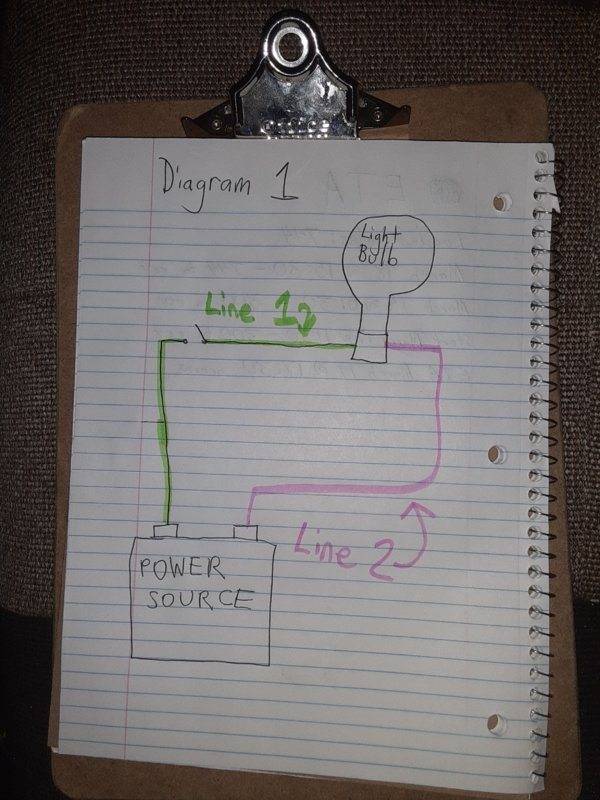
I know that on an alternating current circuit, you have to have both a line 1 and a line 2 to have a circuit. Here is a pictorial diagram of an alternating current circuit:
Circuit Diagram 1.jpg


Diagram 1 is the diagram in the photograph posted above. Notice how in diagram 1 you have a line 1 in green, and there is a line 2 after the load in pink. I know that if the switch was closed in diagram 1, alternating current would flow in the circuit, and the light bulb would light up.

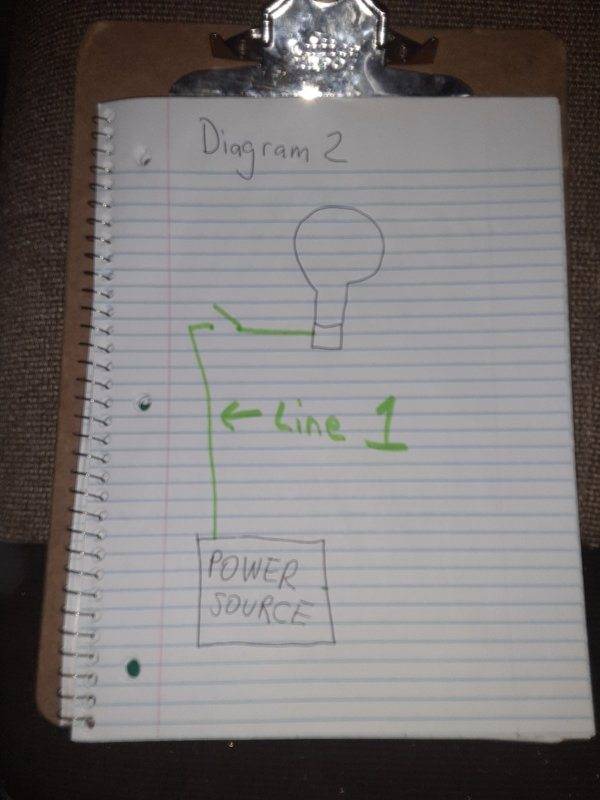
Why would an alternating current circuit like in Diagram 2 not work? Here is diagram 2:
Circuit Diagram 2.jpg


If I closed the switch in diagram 2, why would alternating current not flow from the power source to the light bulb and then back to the power source? Since the direction of the alternating current switches back and forth sixty times per second with 60hz power, why couldn't the power flow from the power source to the light bulb for 1/60th of a second, light up the light bulb, and then flow back to the power source using the same wire in the next 1/60th of a second? I know that diagram 2 would not function as a circuit. I know that there would have to be a line two going from the load back to power for there to be a circuit. My question is: Why does one need a line 2 to make a circuit?
 
Engineering news on Phys.org
Current will only flow if there is a closed circuit. Doesn't matter whether it's AC or DC, that's always true.
 
Electric power is not like water. Power is voltage times current. Current alone does not make power. So stop thinking of power flowing like water in a pipe.

Another way to look at it is this. Current does not leave the power source on line 1 unless the same amount of current returns to the power source on line 2 instaneously. So no current flows through a wire with two dead ends.

Note to others: please let's not confuse this student with talk about parasitic capacitance or self capacitance.
 
  • Like
Likes   Reactions: cnh1995 and timmeister37
phinds said:
Current will only flow if there is a closed circuit. Doesn't matter whether it's AC or DC, that's always true.
Yes. That is why i asked why alternating current would not flow in diagram 2 IF I CLOSED THE SWITCH.

Your comment does not answer the OP.
 
anorlunda said:
Electric power is not like water. Power is voltage times current. Current alone does not make power. So stop thinking of power flowing like water in a pipe.

Another way to look at it is this. Current does not leave the power source on line 1 unless the same amount of current returns to the power source on line 2 instaneously. So no current flows through a wire with two dead ends.

Note to others: please let's not confuse this student with talk about parasitic capacitance or self capacitance.
I think you have answered the OP.
 
A potential difference requires a potential subtraction = two different voltages.

The differential voltage from the two terminals of the power source must reach the light globe terminals, then a current can flow through the light globe. The product of the differential voltage and the current is power.
 
timmeister37 said:
Yes. That is why i asked why alternating current would not flow in diagram 2 IF I CLOSED THE SWITCH.
Your comment does not answer the OP.

It did answer the OP, you just didn't understand :wink:

There MUST be a complete circuit, your diag 1 shows that

Your diag 2 is not a complete circuit. It's only half a circuit

There must be a go and a return line
in DC a + and a - (positive and negative)
in AC commonly called a phase and a neutral ( hot and neutral, live and neutral)
 
davenn said:
It did answer the OP, you just didn't understand :wink:

No. Phinds' post does not answer the OP.
There MUST be a complete circuit, your diag 1 shows that

Your diag 2 is not a complete circuit. It's only half a circuit

There must be a go and a return line
in DC a + and a - (positive and negative)
in AC commonly called a phase and a neutral ( hot and neutral, live and neutral)

LOL I said all that myself in the OP. In the OP, I said there MUST be a line 1 AND a line 2, which is the same as your "go line and return line." The question in the OP (which anorlunda answered already) is WHY must there be both a go line and a different line that is a return line.

Re-read my OP
 
  • Skeptical
Likes   Reactions: davenn
Baluncore said:
A potential difference requires a potential subtraction = two different voltages.

The differential voltage from the two terminals of the power source must reach the light globe terminals, then a current can flow through the light globe. The product of the differential voltage and the current is power.
This does not answer the OP.
 
  • Haha
Likes   Reactions: davenn
  • #10
anorlunda said:
Another way to look at it is this. Current does not leave the power source on line 1 unless the same amount of current returns to the power source on line 2 instaneously. So no current flows through a wire with two dead ends.

This is from anorlunda's post #3. This is the ONLY post on the thread that actually answers the OP.
 
  • Skeptical
Likes   Reactions: davenn
  • #11
timmeister37 said:
This does not answer the OP.
Yes. It does.

Since you refuse to accept the correct answers we are giving you, I don't see what help you can expect here.
 
  • Like
Likes   Reactions: cnh1995
  • #12
timmeister37 said:
This is from anorlunda's post #3. This is the ONLY post on the thread that actually answers the OP.
How do you see this as different from post #2?
 
  • #13
timmeister37 said:
This is from anorlunda's post #3. This is the ONLY post on the thread that actually answers the OP.
timmeister37 said:
This does not answer the OP.
You are not in a position to make that assessment either way.

Until you understand that the conductors guide the electric field from source to load, and that the current on the surface of the conductors guides the magnetic field, you will not see that the energy travels between the wires at the speed of light, and not in the wires like water in a pipe.
https://en.wikipedia.org/wiki/Poynting_vector#Interpretation

If there is no return circuit, the voltage will not reach the load, the current cannot flow, and no energy can be transferred. But that concept and reasoning is beyond your ability at the moment.
 
  • Like
Likes   Reactions: cnh1995 and phinds
  • #14
This seems like an awful lot of hubbub about a very simple answer. Let's look at the OP:

timmeister37 said:
Summary:: Why cannot AC go back and forth on an AC circuit on the same line?

Why would an alternating current circuit like in Diagram 2 not work? Here is diagram 2:
The answer is that in the real world a tiny current will flow. But as soon as the charge builds up at the far end it will diminish the flow (almost to nothing), unless you carry that charge away. This requires the other wire and that charge must in fact end up back at the source one way or other. Otherwise no useful current. Finis
 
  • Like
Likes   Reactions: tech99
  • #15
phinds said:
How do you see this as different from post #2?
Post #2 does not say that current will not leave the power source and go onto line 1 unless power leaves line 2 and goes into the power source instantaneously.
 
  • #16
hutchphd said:
This seems like an awful lot of hubbub about a very simple answer. Let's look at the OP:The answer is that in the real world a tiny current will flow. But as soon as the charge builds up at the far end it will diminish the flow (almost to nothing), unless you carry that charge away. This requires the other wire and that charge must in fact end up back at the source one way or other. Otherwise no useful current. Finis

LOL I already wrote all what you boldfaced in the OP. Hahaha i cannot get over the fact nobody here except anorlunder answered the question.
 
  • Skeptical
Likes   Reactions: davenn
  • #17
timmeister37 said:
Post #2 does not say that current will not leave the power source and go onto line 1 unless power leaves line 2 and goes into the power source instantaneously.
OK, I see how you are interpreting it. By the way, power does NOT leave the source. CURRENT leaves the source and it creates power at the load. At the same time, the generator generates power to satisfy the current demands of the load. What move through the line is current, not power.

Think of current as a bicycle chain. It either all moves or none of it moves.
 
  • Like
Likes   Reactions: davenn
  • #18
anorlunda said:
Electric power is not like water. Power is voltage times current. Current alone does not make power. So stop thinking of power flowing like water in a pipe.

Another way to look at it is this. Current does not leave the power source on line 1 unless the same amount of current returns to the power source on line 2 instaneously. So no current flows through a wire with two dead ends.
Question for anorlunda: wouldn't it be both more accurate and more descriptive to use the word simultaneously instead of instantaneously?
 
  • Skeptical
Likes   Reactions: davenn
  • #19
phinds said:
OK, I see how you are interpreting it. By the way, power does NOT leave the source. CURRENT leaves the source and it creates power at the load. At the same time, the generator generates power to satisfy the current demands of the load. What move through the line is current, not power.

Think of current as a bicycle chain. It either all moves or none of it moves.
The bicycle chain analogy is relevant to the OP. Phinds, respectfully, your post #2 did not answer the OP in the slightest.
 
  • Haha
Likes   Reactions: davenn
  • #20
Everyone (except anotlunda), please re-read the OP. I made it CRYSTAL CLEAR in the OP that i know that there has to be a line 2 (distinct from line 1) after the load that returns current to the power source. Why does everyone keep pretending that i don't know that? LOL
 
  • Haha
Likes   Reactions: davenn
  • #21
Thread closed for Moderation...

Thread re-opened, but on a short leash...
 
Last edited:
  • #22
timmeister37 said:
Everyone (except anotlunda), please re-read the OP. I made it CRYSTAL CLEAR in the OP that i know that there has to be a line 2 (distinct from line 1) after the load that returns current to the power source. Why does everyone keep pretending that i don't know that?
Because you posted this drawing in your OP. Either you are trolling, or you need to take a basic circuits class. I can tell that this is a very frustrating thread for other posters. Do you understand the basic concept of a closed circuit versus an open circuit?

1585357490057.png
 
  • #23
On a second reading of the thread, it is locked now for trolling. OP -- check your messages.
 
  • Like
Likes   Reactions: russ_watters

Similar threads

Replies
13
Views
2K
  • · Replies 27 ·
Replies
27
Views
2K
  • · Replies 3 ·
Replies
3
Views
3K
  • · Replies 3 ·
Replies
3
Views
2K
  • · Replies 12 ·
Replies
12
Views
5K
Replies
9
Views
2K
Replies
12
Views
3K
  • · Replies 4 ·
Replies
4
Views
2K
Replies
14
Views
2K
  • · Replies 26 ·
Replies
26
Views
3K