Navier Stokes Eqn for const. density and viscosity

Click For Summary
SUMMARY

The discussion focuses on the derivation of the Navier-Stokes Equations for constant density and viscosity, specifically addressing a potential error in the derivation presented by Roger Rangel. The first equation, representing the stress tensor, is given as $$\vec{σ}=-P\vec{I}+\vec{τ}$$, while the second equation is the momentum balance equation $$∇\centerdot \vec{σ}+ρ\vec{g}=ρ\vec{a}$$. Participants emphasize the importance of correctly applying the divergence of the stress tensor and note that the constant density assumption does not account for temperature and volume effects. The book "Transport Phenomena" by Bird, Stewart, and Lightfoot is recommended for further study.

PREREQUISITES
  • Understanding of the Navier-Stokes Equations
  • Familiarity with tensor notation and manipulation
  • Knowledge of fluid mechanics principles
  • Basic concepts of stress and strain in fluids
NEXT STEPS
  • Study the derivation of the Navier-Stokes Equations in detail
  • Learn about the application of dyadic tensor notation in fluid mechanics
  • Explore the impact of temperature and volume changes on fluid density
  • Read "Transport Phenomena" by Bird, Stewart, and Lightfoot for comprehensive fluid mechanics knowledge
USEFUL FOR

Students and professionals in fluid mechanics, engineers working with fluid dynamics, and anyone seeking to deepen their understanding of the mathematical foundations of the Navier-Stokes Equations.
Gohar Shoukat
Messages
8
Reaction score
1
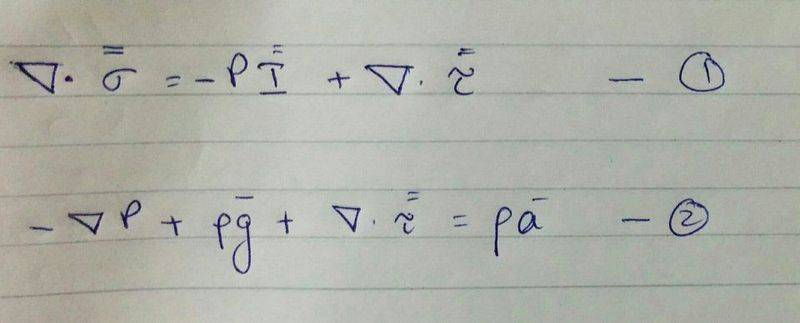
I was watching a lecture in which the professor derived the Navier Stokes Equations for const density and viscosity. He however skipped a step and directly went from one equation to another without giving any explanation. I have attached an image file in which the 2nd equation is derived from the first equation. Can anyone please explain how this came to be?
I apologize in advance for uploading a handwritten equation.

oh 'I' in the image below is the identity matrix
IMG_20150727_232544~2.jpg
 

Attachments

  • IMG_20150727_232544~2.jpg
    IMG_20150727_232544~2.jpg
    23.5 KB · Views: 545
Engineering news on Phys.org
I think in equation one, sigma represents a molecular stress which is equivalent to a pressure (stress) plus a viscous stress. The pressure stress always exists in the fluid (I believe due to random motion of molecules, but can't remember precisely) but the viscous stress arises from velocity gradients. If you want more information on this, consult a transport textbook like Bird, Stewart and Lightfoot Ch 1.

The identity matrix (or sometimes the kronecker delta function is used) is required since pressure is defined as a perpendicular (normal to a surface) "stress" only. Also note that the viscous stress acts in an arbitrary direction, and it can then be decomposed into perpendicular and parallel (against a surface) components.

Then in equation two, we have a balance of forces, which the Navier-Stokes equation is, and he has that molecular stress term + gravity forces = mass*acceleration

The mass multiplied by acceleration is written in terms of density and often referred to as an "inertial" term. He then substitutes the molecular stresses into equation 2 from equation 1.

Also note he has neglected body forces in equation 2, and, as I understand it, the "constant" density strictly means that the density does not change due to pressure variations - it can still change due to temperature and volume effects.
 
Last edited:
The first equation is incorrect. There should be a del in front of the P. This equation is supposed to give the divergence of the stress tensor. This is substituted into the general equation of motion (momentum balance equation) to yield your second equation (the NS equation).
 
Chestermiller said:
The first equation is incorrect. There should be a del in front of the P. This equation is supposed to give the divergence of the stress tensor. This is substituted into the general equation of motion (momentum balance equation) to yield your second equation (the NS equation).

This equation was given by Roger Rangel, the guy who teaches intro to fluid mechanics at UC Irvine and has online lectures available. Are you sure there is a mistake in this equation? and if yes, even then how do you reach on to the second equation
 
With all due respect to Roger Rangel, he's only human, and humans do make mistakes. Please don't hold it against him. What I'm surprised about is that you didn't catch this mistake yourself. In his equation, the term in question is not even dimensionally consistent with the other terms.

The two equations that were used to derive your two equations were:
$$\vec{σ}=-P\vec{I}+\vec{τ}\tag{1}$$
and
$$∇\centerdot \vec{σ}+ρ\vec{g}=ρ\vec{a}\tag{2}$$

Eqn. 1 expresses the stress tensor for a viscous fluid in terms of the isotropic pressure plus the deviatoric viscous stress tensor. Eqn. 2 is the momentum balance equation (aka, Equation of Motion). If you take the divergence of Eqn. 1, you get what Roger Rangel should have gotten. If you substitute Eqn. 1 into Eqn. 2, you get Roger's second equation.

Chet
 
  • Like
Likes   Reactions: Gohar Shoukat
Chestermiller said:
With all due respect to Roger Rangel, he's only human, and humans do make mistakes. Please don't hold it against him. What I'm surprised about is that you didn't catch this mistake yourself. In his equation, the term in question is not even dimensionally consistent with the other terms.

The two equations that were used to derive your two equations were:
$$\vec{σ}=-P\vec{I}+\vec{τ}\tag{1}$$
and
$$∇\centerdot \vec{σ}+ρ\vec{g}=ρ\vec{a}\tag{2}$$

Eqn. 1 expresses the stress tensor for a viscous fluid in terms of the isotropic pressure plus the deviatoric viscous stress tensor. Eqn. 2 is the momentum balance equation (aka, Equation of Motion). If you take the divergence of Eqn. 1, you get what Roger Rangel should have gotten. If you substitute Eqn. 1 into Eqn. 2, you get Roger's second equation.

Chet

I want to polish up on the mathematics involved in Fluid Mechanics because I will be pursuing this field for some time to come now. however, I do not know of any good resource where I can learn the Mathematics involved in Fluid Mechanics. Can you please guide me? if there is a book which i can go over which has derivations of these formulae and explanations too would really help.
 
Gohar Shoukat said:
I want to polish up on the mathematics involved in Fluid Mechanics because I will be pursuing this field for some time to come now. however, I do not know of any good resource where I can learn the Mathematics involved in Fluid Mechanics. Can you please guide me? if there is a book which i can go over which has derivations of these formulae and explanations too would really help.
I like Bird, Stewart, and Lightfoot (BSL), Transport Phenomena. It has an excellent appendix on "dyadic tensor notation and manipulation" that I feel makes things much easier to follow. On the other hand, it uses an unconventional sign convention on stress, in which compressive stresses are positive and tensile stresses are negative. This is exactly the opposite of the version that you have been learning about. It is also opposite to the sign convention used throughout all of solid mechanics and most of fluid mechanics. The only other places I've seen their sign convention used is in the area of geophysical rock mechanics and biological tissue mechanics. You would think that all you would need to do is to think of it with all the signs flipped. But, psychologically its much more difficult than that. I liken it to trying to transpose music on the fly. It seems very simple also, since all you need to do is index all the notes by the same amount (until you actually have to do it). That being said, I still maintain that BSL is a wonderful book that has stood the test of time.

Chet
 
Chestermiller said:
Bird, Stewart, and Lightfoot
Does this book explain only the 'dyadic tensor notation and manipulation' or goes into the depth of fluid mechanics in general with excellent mathematical explanation? what i want is a book that i can use for Fluid Mechanics in general and not just a single topic.
 
Gohar Shoukat said:
Does this book explain only the 'dyadic tensor notation and manipulation' or goes into the depth of fluid mechanics in general with excellent mathematical explanation? what i want is a book that i can use for Fluid Mechanics in general and not just a single topic.
It has everything you want. It's great. It also covers heat transfer.
 

Similar threads

  • · Replies 4 ·
Replies
4
Views
6K
  • · Replies 14 ·
Replies
14
Views
8K
  • · Replies 4 ·
Replies
4
Views
3K
  • · Replies 0 ·
Replies
0
Views
2K
Replies
3
Views
2K
  • · Replies 7 ·
Replies
7
Views
2K
  • · Replies 3 ·
Replies
3
Views
1K
  • · Replies 6 ·
Replies
6
Views
2K
  • · Replies 8 ·
Replies
8
Views
3K
Replies
9
Views
3K