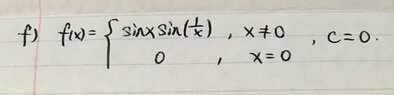
Need help, are these functions differentiable?

Click For Summary
SUMMARY

The discussion centers on determining the differentiability of the piecewise function defined as \( f(x) = \begin{cases} \tan x & \text{if } -\frac{\pi}{2} \le x < \frac{\pi}{3} \\ x^2 & \text{if } x \ge \frac{\pi}{3} \end{cases} \). It is concluded that the function is not differentiable at \( x = c \) due to discontinuity and the non-existence of certain limits. Specifically, the one-sided limits at \( x = c \) do not converge, confirming the lack of differentiability. The intermediate value property of derivatives is also highlighted as a relevant concept.

PREREQUISITES
  • Understanding of piecewise functions
  • Knowledge of limits and continuity
  • Familiarity with trigonometric functions, particularly tangent
  • Basic concepts of derivatives and differentiability
NEXT STEPS
  • Study the properties of piecewise functions in calculus
  • Learn about the intermediate value theorem in the context of derivatives
  • Explore the concept of limits and their applications in differentiability
  • Investigate the behavior of trigonometric functions near their discontinuities
USEFUL FOR

Students and educators in calculus, mathematicians analyzing differentiability, and anyone studying the behavior of piecewise functions and their derivatives.

FallArk
Messages
127
Reaction score
0
View attachment 6498
View attachment 6499

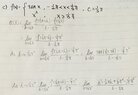
I want to figure out whether the functions are differentiable at c. I think I should use some of the trig identities, but I'm not sure which ones. Any tips?
 

Attachments
  • IMG_2545.JPG
    IMG_2545.JPG
    42.5 KB · Views: 137
  • IMG_2546.JPG
    IMG_2546.JPG
    35.7 KB · Views: 114
Physics news on Phys.org
FallArk said:
I want to figure out whether the functions are differentiable at c. I think I should use some of the trig identities, but I'm not sure which ones. Any tips?

Hey FallArk! (Smile)

Let's start with the proper definition of the derivative.
That is:
$$f(x)=\begin{cases}\tan x &\text{if } -\frac\pi 2 \le x <\frac \pi 3 \\
x^2 & \text{if } x \ge \frac \pi 3
\end{cases} \quad\Rightarrow\quad
f'(\frac\pi 3) = \lim_{h\to 0} \frac{f(\frac\pi 3+h)-f(\frac\pi 3)}{h}
$$
Now let's look at the lower limit:
$$\lim_{h\to 0^-} \frac{f(\frac\pi 3+h)-f(\frac\pi 3)}{h}
= \lim_{h\to 0^-} \frac{\tan(\frac\pi 3+h)-(\frac\pi 3)^2}{h}
\to \frac{\sqrt 3 - \frac{\pi^2}{9}}{0^-} = -\infty
$$
It's not convergent is it? (Wondering)
 
Hi FallArk,

The function in part (c) is not differentiable at $x = c$, for it is discontinuous at that point. Just check the one-sided limits.

The function in part (f), although continuous at $x = c$, is not differentiable at $x = c$; the limit $\lim\limits_{x\to 0} \dfrac{f(x)}{x}$ does not exist. Indeed, consider the sequences $x_n = \dfrac{2}{(4n+1)\pi}$ and $y_n = \dfrac{2}{(4n-1)\pi}$. Then $x_n, y_n \to 0$, but $$\lim\limits_{n\to \infty} \frac{f(x_n)}{x_n} = 1 \neq -1 = \lim\limits_{n\to \infty} \frac{f(y_n)}{y_n}$$
 
I like Serena said:
Hey FallArk! (Smile)

Let's start with the proper definition of the derivative.
That is:
$$f(x)=\begin{cases}\tan x &\text{if } -\frac\pi 2 \le x <\frac \pi 3 \\
x^2 & \text{if } x \ge \frac \pi 3
\end{cases} \quad\Rightarrow\quad
f'(\frac\pi 3) = \lim_{h\to 0} \frac{f(\frac\pi 3+h)-f(\frac\pi 3)}{h}
$$
Now let's look at the lower limit:
$$\lim_{h\to 0^-} \frac{f(\frac\pi 3+h)-f(\frac\pi 3)}{h}
= \lim_{h\to 0^-} \frac{\tan(\frac\pi 3+h)-(\frac\pi 3)^2}{h}
\to \frac{\sqrt 3 - \frac{\pi^2}{9}}{0^-} = -\infty
$$
It's not convergent is it? (Wondering)
I was so concentrated on getting rid of the h, I did not even see that I can just evalute it. Thanks!

- - - Updated - - -

Euge said:
Hi FallArk,

The function in part (c) is not differentiable at $x = c$, for it is discontinuous at that point. Just check the one-sided limits.

The function in part (f), although continuous at $x = c$, is not differentiable at $x = c$; the limit $\lim\limits_{x\to 0} \dfrac{f(x)}{x}$ does not exist. Indeed, consider the sequences $x_n = \dfrac{2}{(4n+1)\pi}$ and $y_n = \dfrac{2}{(4n-1)\pi}$. Then $x_n, y_n \to 0$, but $$\lim\limits_{n\to \infty} \frac{f(x_n)}{x_n} = 1 \neq -1 = \lim\limits_{n\to \infty} \frac{f(y_n)}{y_n}$$

Thanks! I get it now
 
While the derivative, f', of a differentiable function, f, is not necessarily continuous, it does satisfy the "intermediate value property" (f'(x), for x between a and b, takes on all values between f'(a) and f'(b)). In particular, the two limits, \lim_{x\to a^-} f&#039;(x) and \lim_{x\to a^+} f&#039;(x) must be equal.
 

Similar threads

Replies
1
Views
1K
Replies
7
Views
2K
Replies
21
Views
2K
  • · Replies 1 ·
Replies
1
Views
2K
  • · Replies 2 ·
Replies
2
Views
2K
  • · Replies 2 ·
Replies
2
Views
2K
  • · Replies 4 ·
Replies
4
Views
3K
Replies
4
Views
2K
  • · Replies 1 ·
Replies
1
Views
2K
Replies
3
Views
2K