Need help finding magnitude of A - B + C given 3 vectors

  • Thread starter Thread starter iadg87
  • Start date Start date
  • Tags Tags
    Magnitude Vectors
Click For Summary
SUMMARY

The discussion focuses on calculating the resultant vector from three given vectors: A = 46.0 at θ1 = 56.6°, B = 25.0 at θ2 = 34.4° (negative x-axis), and C = 32.0 (negative y-axis). The correct approach involves determining the components of each vector and performing the operation A - B + C accurately. A common error identified was incorrectly adding the x components instead of subtracting B's components from A's. The correct resultant magnitude and angle must be recalculated based on these adjustments.

PREREQUISITES
  • Understanding of vector components and their representation in Cartesian coordinates.
  • Familiarity with trigonometric functions for calculating vector components (sine and cosine).
  • Knowledge of vector addition and subtraction principles.
  • Ability to convert polar coordinates to Cartesian coordinates and vice versa.
NEXT STEPS
  • Review vector component calculations using trigonometric functions.
  • Learn about vector addition and subtraction in two dimensions.
  • Practice converting between polar and Cartesian coordinates.
  • Explore examples of resultant vectors in physics problems.
USEFUL FOR

Students in physics or engineering, educators teaching vector analysis, and anyone needing to solve problems involving vector operations and resultant calculations.

iadg87
Messages
2
Reaction score
0
You are given three vectors.
A = 46.0 at θ1 = 56.6° above the +x axis
B = 25.0 at θ2 = 34.4° above the −x axis
C = 32.0 along the −y axis.Determine A - B + C (magnitude and angle from the positive x axis).
Determine the angle relative to the positive x-axis, positive above and negative belowI have attempted the solution many times and ended up with 44.6 and -9.96 deg. but it is incorrect
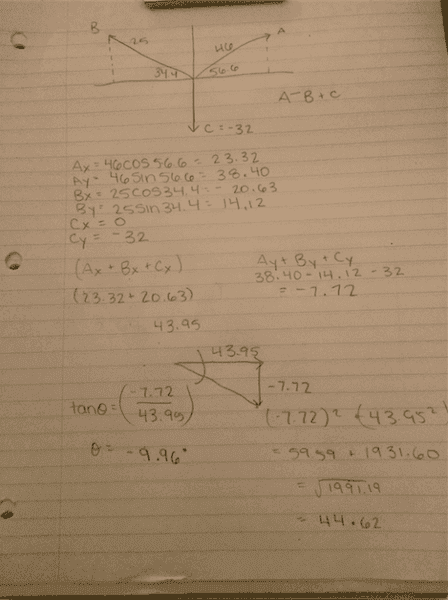
Screen Shot 2015-09-22 at 10.41.39 PM.png


Any help would be appreciated!

Regards,
 
Physics news on Phys.org
Looks like you've made a simple sign error. You have the correct sign for the vector B's components, but then you added the values for the resultant's x component rather than subtracting.
 

Similar threads

Replies
1
Views
3K
  • · Replies 4 ·
Replies
4
Views
2K
  • · Replies 5 ·
Replies
5
Views
2K
  • · Replies 6 ·
Replies
6
Views
2K
  • · Replies 2 ·
Replies
2
Views
10K
Replies
11
Views
2K
  • · Replies 4 ·
Replies
4
Views
14K
  • · Replies 9 ·
Replies
9
Views
2K
Replies
2
Views
3K
Replies
9
Views
2K