Need help finding the restraining reaction force for a beam

Join the discussion
Ask a follow-up here, or get your own question answered by working scientists, mathematicians and engineers — people, not an autocomplete.
Real named experts · corrections over time · the nuance an AI answer skips
15 replies · 2K views
Kile
Messages
12
Reaction score
0
1. The illustrated structure is affected by a known couple, and try to figure out the restraining reaction force of the hinge A and hinge E.
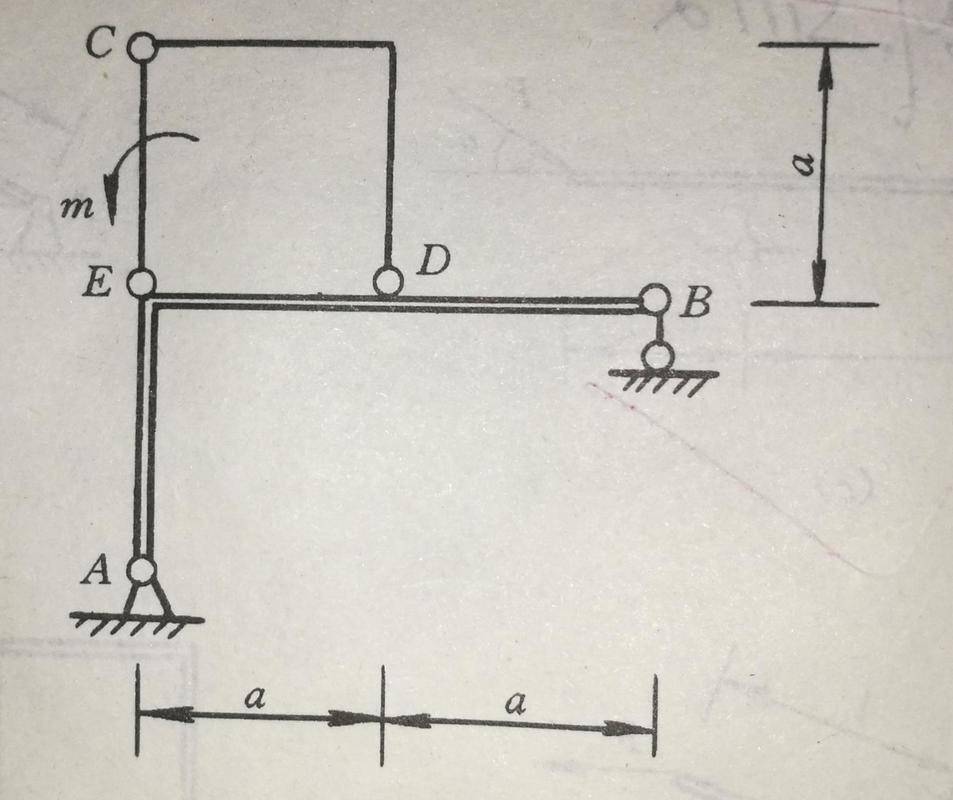
LW9hyYP.jpg


We should analyse ECD instead. Since arm CD is a two force members, so N(C) in in the direction where CD connects by these two points. The distance from E to diagonal CD is a/√2. So we have N(C)=√2 m/a. Because N(C)=N(E) ( N(C) and N(E) together form a couple), N(E)=√2 m/a.
Where did I go wrong?
 

Attachments

  • LW9hyYP.jpg
    LW9hyYP.jpg
    57 KB · Views: 813
Physics news on Phys.org
haruspex said:
I agree with your reasoning and answer. Who says it is wrong? What other answer is given ?
The official answer just doesn't match mine.
 
R_A= \frac m 2a, R_E=\frac \sqrt {{2} m} a,
 
haruspex said:
Your latex had some errors. In fixing it up I arrived at

But that makes the reaction at E the same as you got, so perhaps you meant something else.
Yes. You did it in the right format. Do u know how to get this official answer?
 
How did u get ##N_A## ?
Can u draw a diagram to illustrate?
 
How can u get it? can u help me out?
 
zcrgSYO.png
Because point B has a pulley on the ground, ##N_B## is vertical.
Choose A be centroid
$$\sum m_A (F)=0, ~2a N_B + m=0$$
$$\Rightarrow N_B=\frac {-m} {2a},$$ So it's downward.
X-axis, $$X_A=0$$
Y-axis, $$Y_A=0 $$ $$N_B + Y_A=0$$
$$\Rightarrow Y_A= -N_B = \frac {m} {2a}$$ So ##Y_A## it's upward.
 

Attachments

  • zcrgSYO.png
    zcrgSYO.png
    150.9 KB · Views: 790
Last edited:
Kile said:
View attachment 240415 Because point B has a pulley on the ground, ##N_B## is vertical.
Choose A be centroid
$$\sum m_A (F)=0, 2a N_B + m=0$$
$$\Rightarrow N_B=\frac {-m} {2a},$$ So it's downward.
X-axis, $$X_A=0$$
Y-axis, $$Y_A=0 $$ $$N_B + Y_A=0$$
$$\Rightarrow Y_A= -N_B = \frac {m} {2a}$$ So ##Y_A## it's upward.
Right... except, strictly speaking there could be equal and opposite horizontal forces at A and B, making the problem indeterminate.
 
haruspex said:
Right... except, strictly speaking there could be equal and opposite horizontal forces at A and B, making the problem indeterminate.
You mean $$X_A = X_ B$$ It may not equals to 0.
We just can't calculate it from the information already given.
Is that what you are trying to say here?
 
Kile said:
You mean $$X_A = X_ B$$ It may not equals to 0.
We just can't calculate it from the information already given.
Is that what you are trying to say here?
Right, except XA=-XB. And if not zero then it changes YA and YB so as to balance the torque.