Negative sign in Newton's Law of Viscosity?

Click For Summary

Discussion Overview

The discussion revolves around the presence of a negative sign in Newton's Law of Viscosity and its implications for understanding shear stress and momentum flux. Participants explore the relationship between viscosity, shear stress, and analogies to other physical laws such as Fick's Law of Mass Diffusion and Fourier's Law of Heat Conduction.

Discussion Character

  • Exploratory
  • Technical explanation
  • Conceptual clarification
  • Debate/contested

Main Points Raised

  • Some participants suggest that the sign convention for stresses depends on whether they are considered positive for compressive or extensive forces.
  • Others propose that Newton's Law of Viscosity can be viewed as a "diffusion" of momentum, similar to how Fick's Law describes mass diffusion and Fourier's Law describes heat conduction.
  • A participant questions how to interpret the sign convention discrepancy in relation to shear stress, suggesting it may depend on the orientation of the shear stress acting on a fluid parcel.
  • One participant notes that the momentum flux and shear stress may have opposite signs, which could clarify the sign convention issue.
  • Another participant mentions that the sign also indicates whether the force is a deforming force (from the plate to the fluid) or a restoring force (from the fluid to the plate).
  • A participant acknowledges a correction regarding tensor notation, indicating the importance of the indices in the context of momentum flux and shear stress.
  • References to external texts and concepts, such as the Cauchy Stress Relationship and Transport Phenomena by Bird et al., are provided for further exploration.

Areas of Agreement / Disagreement

Participants express differing views on the sign convention in Newton's Law of Viscosity, with no consensus reached on the interpretation of the negative sign or its implications for shear stress and momentum flux.

Contextual Notes

There are unresolved aspects regarding the assumptions behind the sign conventions used, as well as the dependence on specific definitions of stress and momentum flux.
curious_ocean
Messages
36
Reaction score
7
TL;DR
Sometimes there is a negative sign and sometimes there is not?
Hi Physics Forums,

I'm wondering why Newton's Law of Viscosity sometimes has a negative sign in front of the viscosity and sometimes it doesn't?

Thanks for your help!
 
Engineering news on Phys.org
It depends on whether stresses are considered positive if compressive or extensive, and how. this sign convention is used in determining the force exerted by A on B or by B on A.
 
  • Like
Likes   Reactions: curious_ocean
Thanks for responding Chestermiller,

I'm trying to understand the analogies between Fick's 1st Law of Mass Diffusion and Fourier's Law of Heat Conduction.

In the case of Fick's 1st Law the diffusive mass flux happens in the direction opposite to the concentration gradient, smoothing out concentration gradients rather than amplifying them. In Fourier's Law the heat flux is in the direction opposite of the temperature gradient, smoothing out temperature gradients. It makes sense to me that Newton's Law of viscosity would be a "diffusion" of momentum, where gradients in momentum are also smoothed out, but I'm not sure how to draw that diagram.

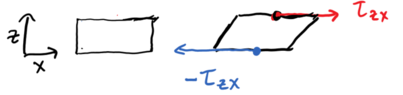
I'm not quite sure how to interpret your explanation because Newton's Law of viscosity deals with a shear stress, not a normal stress? Is the sign convention discrepancy something like the attached? Where it depends on whether your shear stress is operating on the top or bottom of your infinitely small fluid parcel?

Thanks for your help!
 

Attachments

  • shear_stress.png
    shear_stress.png
    6.3 KB · Views: 113
In my googling I found something that says the momentum flux and shear stress have opposite signs... I wonder if this is where my answer lies...

So for the red stress in the picture I drew before (attached above)...Imagine that there are solid plates on the top and bottom of a fluid column. The top plate is moving to the right and the bottom plate is stationary. The force of the top plate on the fluid is applied to the top of a fluid parcel in the positive x direction. $$TauFluidParcelTop_{zx} > 0$$. The force of the fluid on the top plate is in the opposite direction $$TauTopPlate_{zx} < 0$$

If we think of the fluid column as being composed of fluid layers then the force of the fluid above acting on the top of the fluid parcel below is in the positive x direction. $$TauFluidParcelTop_{zx} > 0$$. The force of the fluid below acting on the bottom of the parcel above is in the opposite direction $$TauFluidParcelBottom_{zx} < 0$$.

If the bottom of the fluid parcel (or the next fluid parcel below) also was dragged a bit to the right due to the fluid having some viscosity, there would be a flux of x-momentum in the negative z-direction. So $$MomentumFlux_{zx} < 0$$. This would cause a positive velocity gradient in the positive z direction (velocity is more positive at the top of the fluid column.) So $$ \frac{d (\rho u_x)}{dz} > 0$$. I believe this is where I get the Fickian relationship that is analogous to Fick's 1st Law of Diffusion and Fourier's Law. When I write it this way I preserve the negative sign in the analogy. So we get $$MomentumFlux_{zx} = - \nu \frac{d (\rho u_x)}{dz} $$

To continue on with the scenario...Then the parcel on the bottom of the fluid column would also impart a force on the top of the bottom plate. It is applied to the top of the plate in the positive x direction. So $$TauBed_{zx}>0$$. This force imparted to the bed per unit area is often called the bed stress. So we would get $$ TauBed_{zx} = + \nu \frac{d (\rho u_x)}{dz} |_{z=0} $$. In this version of the equation there is no negative sign.
 
Last edited:
I had my tensor notation messed up. The first index should be the direction of the velocity and the second index should be the surface it is fluxing through.
 
Chestermiller I think I understand what you meant now.


The sign also determines whether the force is the deforming force (plate acting on fluid) or restoring force (fluid acting on plate).
 
See Appendix A of Transport Phenomena by Bird et al. Also Google Cauchy Stress Relationship.
 
Thanks, I have plenty of good texts to reference (including Bird et al.) but they are not always the most user friendly. I'm curious what folks think about the momentum flux relationship to the shear stress. Am I on the right track there?
 

Similar threads

  • · Replies 2 ·
Replies
2
Views
2K
  • · Replies 12 ·
Replies
12
Views
3K
  • · Replies 0 ·
Replies
0
Views
2K
  • · Replies 39 ·
2
Replies
39
Views
4K
  • · Replies 2 ·
Replies
2
Views
2K
  • · Replies 2 ·
Replies
2
Views
1K
  • · Replies 11 ·
Replies
11
Views
3K
  • · Replies 9 ·
Replies
9
Views
17K
Replies
44
Views
4K
  • · Replies 2 ·
Replies
2
Views
1K