Negative work, positive work problems

Join the discussion
Ask a follow-up here, or get your own question answered by working scientists, mathematicians and engineers — people, not an autocomplete.
Real named experts · corrections over time · the nuance an AI answer skips
4 replies · 4K views
cuongbui1702
Messages
31
Reaction score
0
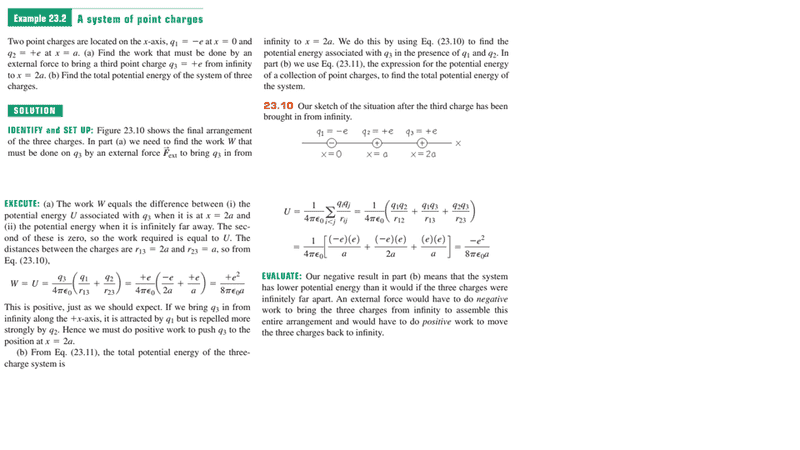
Example 23.2 in University Physics of Young and Freedman, i have a confusion with Negative work, positive work
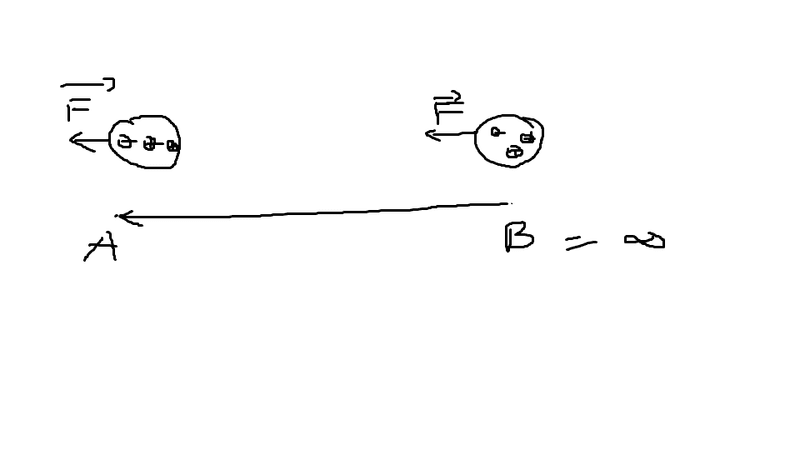
In question b, Why the external force does a negative work (as i know, when you put three charges from infinity to the point of need identified, we will always do a force has the same way with objects)
Example 23.2:
Question-chapter23_zps499536d7.png

My picture:
Question_zps64ca29da.png
 
on Phys.org
cuongbui1702 said:
Example 23.2 in University Physics of Young and Freedman, i have a confusion with Negative work, positive work
In question b, Why the external force does a negative work (as i know, when you put three charges from infinity to the point of need identified, we will always do a force has the same way with objects)
I don't understand your question or your diagram.

Imagine each charge is brought one at a time from infinity to its final position. Figure out the work done in each case. Add the work up to get the total work.
 
The external force is in the opposite direction to the attraction between the opposite charges so it does negative work as the charges approach each other.
 
Sorry because english is second language, so that i writte so bad. I mean external force is same direction of movement, why the work is negative
 
cuongbui1702 said:
Sorry because english is second language, so that i writte so bad. I mean external force is same direction of movement, why the work is negative
Again, you must consider how the charge distribution is assembled from infinity. Start with the first charge in its final position. Then bring in the second charge from infinity to its final position. Since that charge is attracted to the first, you must exert an outward force to bring it there (at uniform speed), thus moving that second charge involves negative work. Adding the third charge, as you've seen in part a, involves positive work. But the net work is negative.