aslan666
- 3
- 0
This post raises a fundamental question about the violation of Newton's third law in electromagnetism and possible conclusions.
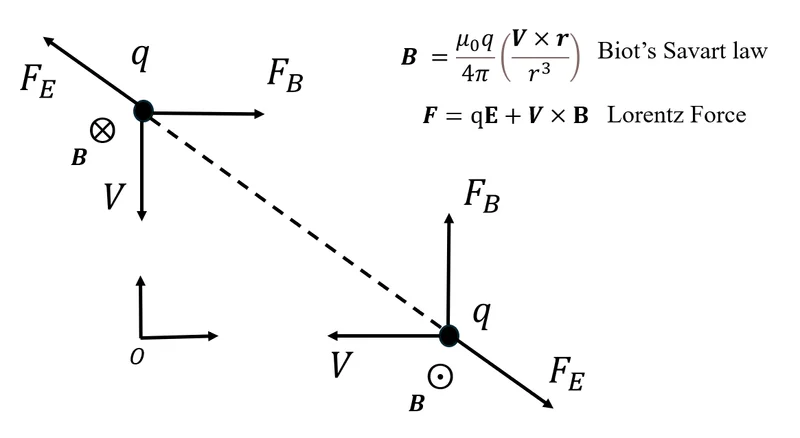
There are textbook examples in electromagnetism in which you may notice that the third law of Newton may not hold in its conventional form. That does not necessarily mean that momentum balance is violated, as briefly mentioned in [1]. One example you can easily check is the magnetic force between two perpendicularly moving charges as they approach a reference point. If you use the Biot-Savart law, you will notice that the forces are not canceling and are not aligned with the interaction line (See the picture below). There is no miscalculation here. Please see Feynmann's lecture notes[1], chapter 27, or see Griffith's textbook [2] section 8.2.1.
Another example similar to the one above is two perpendicular wires carrying currents i1 and i2; you can see that the magnetic forces are not in the same direction and do not cancel. This is similar to the example above because currents are the movement of many single charge carriers at a drift velocity.
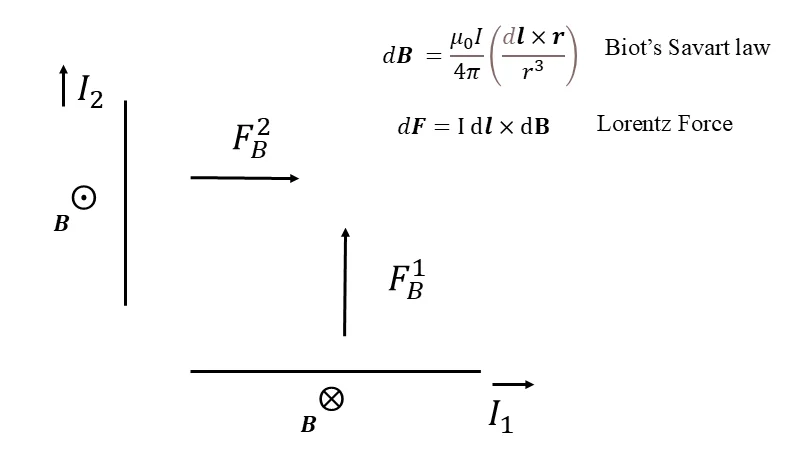
Wire 1 lies along the x-axis carrying current [itex]i_1[/itex] in the [itex]+\hat{x}[/itex] direction
Wire 2 lies along the y-axis carrying current [itex]i_1[/itex] in the [itex]+\hat{y}[/itex] direction
The proof that these two magnetic wires are non-canceling is as follows
The Biot-Savart Law
The magnetic field produced at point [itex]\vec{r}[/itex] by a current element [itex]Id\vec{l}[/itex] is:
[tex]d\vec{B} = \frac{\mu_0}{4\pi}\frac{I d\vec{l}\times \hat{r}}{r^2}[/tex]
Magnetic Field from Wire 1 at a Point on Wire 2
A point on Wire 2 has coordinates [itex](0, y, 0)[/itex], where [itex]y > 0[/itex] . For a sufficiently long straight wire along the x-axis, the magnetic field at [itex](0, y, 0)[/itex] from the element [itex]d\vec l = dx \hat{x}[/itex] with [itex]\vec r = y\hat{y} - x \hat{x}[/itex] using [itex]\hat{y}\times\hat{x} = -\hat{z}[/itex] is:
[tex]d\vec{B}_1 = \frac{\mu_0 i_1 dx}{2\pi (x^2+y^2)} \hat{z}[/tex]
Force on a Differential Element of Wire 2
The force on a current element in a magnetic field is:
[tex]d\vec{F} = I d\vec{l}\times d\vec{B}[/tex]
Take the element [itex]d\vec{l}_2 = dy \hat{y}[/itex] at position [itex](0, y, 0)[/itex]:
[tex]d\vec{F}_{1\to 2} = i_2 d\vec{l}_2 \times d\vec{B}_1 = i_2 (dy \hat{y}) \times \left(\frac{\mu_0 i_1 dx}{2\pi (x^2+y^2)} \hat{z}\right)[/tex]
Using [itex]\hat{y}\times\hat{z} = \hat{x}[/itex]:
[tex]d\vec{F}_{1\to 2} = \frac{\mu_0 i_1 i_2}{2\pi (x^2+y^2)} dx dy \hat{x}[/tex]
This force points in the +x direction — pushing the element of Wire 2 along the direction of Wire 1's current.
Force on a Differential Element of Wire 1
If we take the same derivation for wire 2, then we can conclude
[tex]d\vec{F}_{2\to 1} = \frac{\mu_0 i_1 i_2}{2\pi (x^2+y^2)} dx dy \hat{y}[/tex]
This force points in the +y direction — pushing the element of Wire 1 along the direction of Wire 2's current.
We can see that magnetic forces can be non-central, meaning that interactions do not strictly act along the straight line connecting the centers of two objects.
At this point, one can propose " We can have a propulsion system by just having two wires with an engineered configuration. " However, mathematically it can be shown, in closed circuits, no matter what shape or configuration we choose, the magnetic force always cancels, and action and reaction are symmetric and cancel each other(See Equations 5.8- 5.10 of Jackson[3]).
Until now, everything has been fine. Now, I want to run a hypothetical experiment. I take two closed circuits and put a sufficiently small gap in one of them so that it is no longer a closed circuit. The gap acts as a capacitor, helping maintain the electric field needed to keep the current flowing. I calculate the magnetic forces of these two cases:
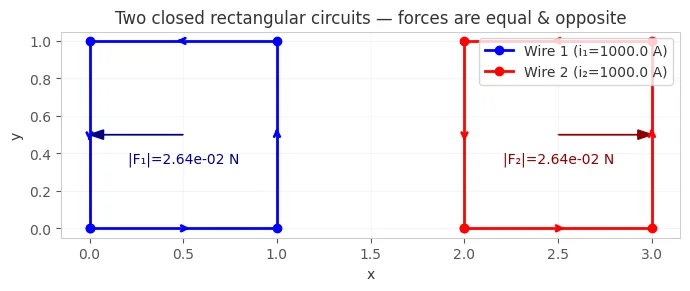
Case 1: Two closed circuits
As we should expect, two closed circuits should apply equal and opposite forces on each other. Please find the online Python code compiler and the code for it here (It will take time the first time you run because of installing dependent libraries for plotting)
Case 2: Discontinuous circuits
Now, I slightly change the geometry of the wires by introducing a gap, modifying the code, and computing the magnetic force using the Lorentz force and Biot-Savart law (Please find the code and online compiler here)
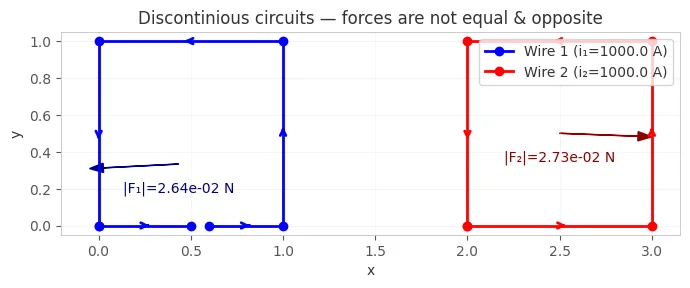
We see that introducing a discontinuity prevents the magnetic forces from canceling each other. Is it because magnetic forces are non-central? These forces are computed numerically, and you may doubt their correctness, but an analytical general proof is possible, as we did above. (Let me know if you are interested)
Now my question comes. By this example, can we state that a system can change its center of mass without external force or external stimulation? I don't mean necessarily permanently, even periodically, so the center of mass vibrates? Even if a system can have its own net force for an instance of time, can we conclude self-force is possible? Can we conclude that a change in the center of mass is possible with some other mechanism other than a photon thruster by purely using the near-field part of the electromagnetic field?
What do I or we need to reconsider here?
Thanks for any explanation you may provide.
[1] R. P. Feynman, R. B. Leighton, M. Sands, The Feynman Lectures on
Physics, Vol. 2, Addison-Wesley, 1964.
[2] D. J. Griffiths, Introduction to electrodynamics (2005).
[3] D. Jackson, Classical Electrodynamics, 3rd Edition, Wiley, New York, 1999
There are textbook examples in electromagnetism in which you may notice that the third law of Newton may not hold in its conventional form. That does not necessarily mean that momentum balance is violated, as briefly mentioned in [1]. One example you can easily check is the magnetic force between two perpendicularly moving charges as they approach a reference point. If you use the Biot-Savart law, you will notice that the forces are not canceling and are not aligned with the interaction line (See the picture below). There is no miscalculation here. Please see Feynmann's lecture notes[1], chapter 27, or see Griffith's textbook [2] section 8.2.1.
Another example similar to the one above is two perpendicular wires carrying currents i1 and i2; you can see that the magnetic forces are not in the same direction and do not cancel. This is similar to the example above because currents are the movement of many single charge carriers at a drift velocity.
Wire 1 lies along the x-axis carrying current [itex]i_1[/itex] in the [itex]+\hat{x}[/itex] direction
Wire 2 lies along the y-axis carrying current [itex]i_1[/itex] in the [itex]+\hat{y}[/itex] direction
The proof that these two magnetic wires are non-canceling is as follows
The Biot-Savart Law
The magnetic field produced at point [itex]\vec{r}[/itex] by a current element [itex]Id\vec{l}[/itex] is:
[tex]d\vec{B} = \frac{\mu_0}{4\pi}\frac{I d\vec{l}\times \hat{r}}{r^2}[/tex]
Magnetic Field from Wire 1 at a Point on Wire 2
A point on Wire 2 has coordinates [itex](0, y, 0)[/itex], where [itex]y > 0[/itex] . For a sufficiently long straight wire along the x-axis, the magnetic field at [itex](0, y, 0)[/itex] from the element [itex]d\vec l = dx \hat{x}[/itex] with [itex]\vec r = y\hat{y} - x \hat{x}[/itex] using [itex]\hat{y}\times\hat{x} = -\hat{z}[/itex] is:
[tex]d\vec{B}_1 = \frac{\mu_0 i_1 dx}{2\pi (x^2+y^2)} \hat{z}[/tex]
Force on a Differential Element of Wire 2
The force on a current element in a magnetic field is:
[tex]d\vec{F} = I d\vec{l}\times d\vec{B}[/tex]
Take the element [itex]d\vec{l}_2 = dy \hat{y}[/itex] at position [itex](0, y, 0)[/itex]:
[tex]d\vec{F}_{1\to 2} = i_2 d\vec{l}_2 \times d\vec{B}_1 = i_2 (dy \hat{y}) \times \left(\frac{\mu_0 i_1 dx}{2\pi (x^2+y^2)} \hat{z}\right)[/tex]
Using [itex]\hat{y}\times\hat{z} = \hat{x}[/itex]:
[tex]d\vec{F}_{1\to 2} = \frac{\mu_0 i_1 i_2}{2\pi (x^2+y^2)} dx dy \hat{x}[/tex]
This force points in the +x direction — pushing the element of Wire 2 along the direction of Wire 1's current.
Force on a Differential Element of Wire 1
If we take the same derivation for wire 2, then we can conclude
[tex]d\vec{F}_{2\to 1} = \frac{\mu_0 i_1 i_2}{2\pi (x^2+y^2)} dx dy \hat{y}[/tex]
This force points in the +y direction — pushing the element of Wire 1 along the direction of Wire 2's current.
We can see that magnetic forces can be non-central, meaning that interactions do not strictly act along the straight line connecting the centers of two objects.
At this point, one can propose " We can have a propulsion system by just having two wires with an engineered configuration. " However, mathematically it can be shown, in closed circuits, no matter what shape or configuration we choose, the magnetic force always cancels, and action and reaction are symmetric and cancel each other(See Equations 5.8- 5.10 of Jackson[3]).
Until now, everything has been fine. Now, I want to run a hypothetical experiment. I take two closed circuits and put a sufficiently small gap in one of them so that it is no longer a closed circuit. The gap acts as a capacitor, helping maintain the electric field needed to keep the current flowing. I calculate the magnetic forces of these two cases:
Case 1: Two closed circuits
As we should expect, two closed circuits should apply equal and opposite forces on each other. Please find the online Python code compiler and the code for it here (It will take time the first time you run because of installing dependent libraries for plotting)
Case 2: Discontinuous circuits
Now, I slightly change the geometry of the wires by introducing a gap, modifying the code, and computing the magnetic force using the Lorentz force and Biot-Savart law (Please find the code and online compiler here)
We see that introducing a discontinuity prevents the magnetic forces from canceling each other. Is it because magnetic forces are non-central? These forces are computed numerically, and you may doubt their correctness, but an analytical general proof is possible, as we did above. (Let me know if you are interested)
Now my question comes. By this example, can we state that a system can change its center of mass without external force or external stimulation? I don't mean necessarily permanently, even periodically, so the center of mass vibrates? Even if a system can have its own net force for an instance of time, can we conclude self-force is possible? Can we conclude that a change in the center of mass is possible with some other mechanism other than a photon thruster by purely using the near-field part of the electromagnetic field?
What do I or we need to reconsider here?
Thanks for any explanation you may provide.
[1] R. P. Feynman, R. B. Leighton, M. Sands, The Feynman Lectures on
Physics, Vol. 2, Addison-Wesley, 1964.
[2] D. J. Griffiths, Introduction to electrodynamics (2005).
[3] D. Jackson, Classical Electrodynamics, 3rd Edition, Wiley, New York, 1999
Last edited: