Newton's 3rd Law interactions with 2nd and 1st Law Partners

  • Context: High School 
  • Thread starter Thread starter skybee
  • Start date Start date
  • Tags Tags
    Force Interaction
Click For Summary

Discussion Overview

The discussion centers on the interactions described by Newton's laws of motion, particularly the third law, in the context of forces acting on a box resting on a table. Participants explore the nature of partner forces, the implications of gravity, and how these forces relate to the second law of motion. The conversation includes free body diagrams and the effects of additional forces applied to the box.

Discussion Character

  • Exploratory
  • Technical explanation
  • Conceptual clarification
  • Debate/contested

Main Points Raised

  • Some participants clarify that third law partners act on different objects, emphasizing that the force of gravity on the box and the force from the table on the box are not third law pairs because they act on the same object.
  • There is a discussion about how the forces acting on the box can change if additional forces are applied, such as pushing down on the box or if the table accelerates upward.
  • One participant notes that the analysis of forces on the box is valid only in an inertial frame, where the forces can be considered equal and opposite.
  • Participants identify specific action/reaction pairs, including those between the box and table, the table and floor, and the box and Earth, highlighting the distinction between contact and body forces.
  • There is mention of the challenges in understanding action/reaction pairs that occur at a distance, particularly in the context of gravitational interactions and relativistic theories.

Areas of Agreement / Disagreement

Participants generally agree on the definitions of action/reaction pairs and the distinction between forces acting on the same object versus different objects. However, there remains some uncertainty and exploration regarding the implications of these forces in various scenarios, particularly with respect to gravity and additional applied forces.

Contextual Notes

Some participants express confusion regarding the interpretation of forces and free body diagrams, indicating a need for clarity on these concepts. The discussion also touches on the limitations of Newtonian gravity in explaining action at a distance.

Who May Find This Useful

This discussion may be useful for students and enthusiasts of physics seeking to understand the nuances of Newton's laws, particularly in relation to force interactions and free body diagrams.

skybee
Messages
3
Reaction score
0
TL;DR
Where do partner forces come into play?
I was over on the stack but got asked to move over here.
https://physics.stackexchange.com/questions/804903/newtons-3rd-law-force-on-a-rocket

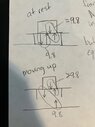
I've been at it all day trying to understand what partner forces are and how you can have a change in force with regard to them, or why gravity is special and not a partner force to the upward force on this table. Suppose you have a table sitting on the ground with a box on top. I've been told the partner force is between box A and table B (an equal and opposite force), but there is also a partner force between A and the ground g. And somehow at the same time there's only gravity pulling this box down and the table pushing it up. At some point force increases to push the table upward, I would like to know how that affects the rest of the forces. It really does not make sense. I've been trying different variations of free body diagrams to see if something clicks but no matter what I put it seems like something is contradicting something else.
 

Attachments

  • partner force diagram.jpg
    partner force diagram.jpg
    16.6 KB · Views: 113
  • at rest vs moving.jpg
    at rest vs moving.jpg
    28.3 KB · Views: 85
Physics news on Phys.org
The third law partners never act on the same object. This is the thing to remember. The third law states that if object A acts on object B with a force ##\vec F##, then B acts on A with a force ##-\vec F##.

In the case of gravity from the Earth on the box, the third law partner is the force of gravity from the box on the Earth. When you are considering equilibrium for the box, the force from gravity on the box and the force from the table on the box are equal in magnitude and opposite in direction, but they are not a third law pair. They cannot be because they act on the same object. The reason they are equal in magnitude and opposite in direction is that they are the only forces on the box and the box is assumed to be in equilibrium. As such it is a result from the second law and the equilibrium assumption. If the box was not in equilibrium, these forces would not necessarily be the same - such as when the box stops when you drop it on the table - nor do they need to be the same if there are additional forces acting on the box - such as you attempting to lift the box.
 
  • Like
Likes   Reactions: cianfa72, skybee, Ibix and 1 other person
Also note that your drawings are not free body diagrams. A free body diagram draws a single object and the forces acting upon it.
 
  • Like
Likes   Reactions: Chestermiller and skybee
I get that they aren't a pair. The pair is between the box/ground and then the box/table. I think I'm starting to understand, but originally I had previously taken "only forces" to mean only half of a pair. That's why I was so confused about that because that wouldn't make sense. Now I understand that to mean these pairs are the only forces on the box. I've been browsing and saw one of your old posts talking about adding force to the box like putting a hand on it and the forces changing. My understanding now is that if there is force applied to the box or if the table were to accelerate upward like in my example, that the weight of the box would not change but the force between the box and table would.

So I think I get it now. The weight of the box is not partnered with the upward force of the table, but at rest it happens to equal the partnered force of the box on the table.

Single object = free body diagram. Gotcha.

Please let me know if I'm still getting it wrong or if it's finally correct.
 
skybee said:
I've been browsing and saw one of your old posts
There are a couple to choose from … 😂

skybee said:
talking about adding force to the box like putting a hand on it and the forces changing.
I am nothing if not consistent… although apparently I change direction of the extra force from time to time. Pushing the box down is an easier example though as you don’t have to limit the magnitude. I must be getting dumber… 🤔
 
  • Like
Likes   Reactions: skybee
Orodruin said:
There are a couple to choose from … 😂


I am nothing if not consistent… although apparently I change direction of the extra force from time to time. Pushing the box down is an easier example though as you don’t have to limit the magnitude. I must be getting dumber… 🤔
Thanks for your help!
 
Just to add to what @Orodruin said in post #2: the analysis about the forces acting on the box as done (in particular the use of Newton 2nd law on it) makes sense only with respect to an inertial frame. In that case we can conclude that the two forces acting on the box are actually equal in magnitude and opposite.
 
Here are the action/reaction pairs:

1. (Downward) force box exerts on table and (Upward) force table exerts on box.
2. (Downward) force table exerts on floor and (Upward) force floor exerts on table.
3. (Downward ) body force earth exerts on box and (Upward) body force box exerts on earth.

Contact action/reaction pairs are easy to spot since they happen at the same contact surface (e.g. 1 and 2). Body action/reaction pairs are more difficult to spot because they occur at a spatial distance (e.g., 3)
 
Chestermiller said:
Body action/reaction pairs are more difficult to spot because they occur at a spatial distance (e.g., 3)
Here it helps having a fully relativistic field theory at hand - such as Maxwell’s electromagnetism. There simply are no actions at a distance and everything is local. You can do similar things in gravity as well but it is somewhat less nice due to the infinite propagation speed in Newtonian gravity (and the relativistic theory doesn’t have gravity as a force really).
 
  • Like
Likes   Reactions: Chestermiller

Similar threads

  • · Replies 14 ·
Replies
14
Views
2K
Replies
4
Views
1K
  • · Replies 14 ·
Replies
14
Views
1K
  • · Replies 24 ·
Replies
24
Views
2K
  • · Replies 8 ·
Replies
8
Views
1K
  • · Replies 10 ·
Replies
10
Views
4K
  • · Replies 39 ·
2
Replies
39
Views
4K
  • · Replies 40 ·
2
Replies
40
Views
4K
  • · Replies 18 ·
Replies
18
Views
2K
  • · Replies 35 ·
2
Replies
35
Views
5K