How can I better understand Newton's Principia beyond just reading the words?

  • Thread starter Thread starter Solomon Chang
  • Start date Start date
  • Tags Tags
    Physics
Click For Summary
Understanding Newton's Principia can be challenging, especially with its complex language and concepts. Readers are encouraged to explore modern translations and guides that clarify the text, such as a recent edition that includes a comprehensive guide. Numerical interpretations, like relating position and time through equations of motion, can also aid comprehension. The discussion highlights the importance of visualizing concepts, such as graphing position versus time. Engaging with these resources can significantly enhance the understanding of Newton's work.
Solomon Chang
Messages
2
Reaction score
0
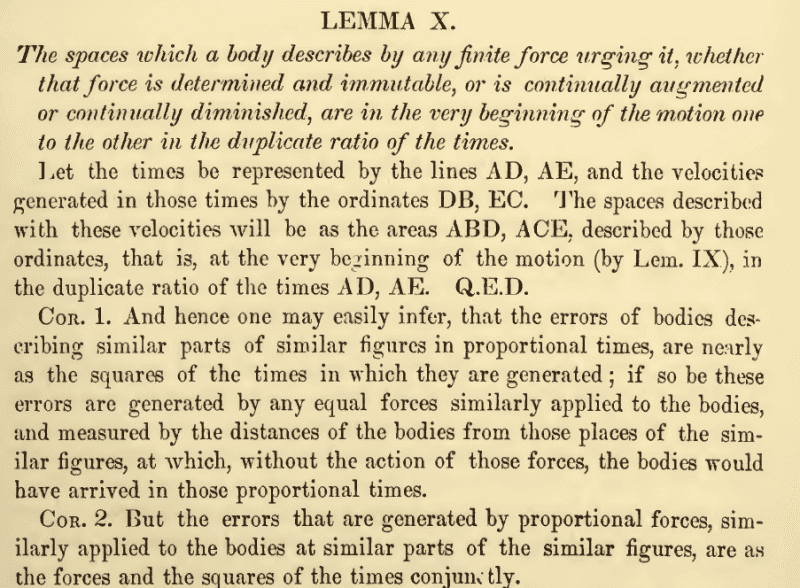
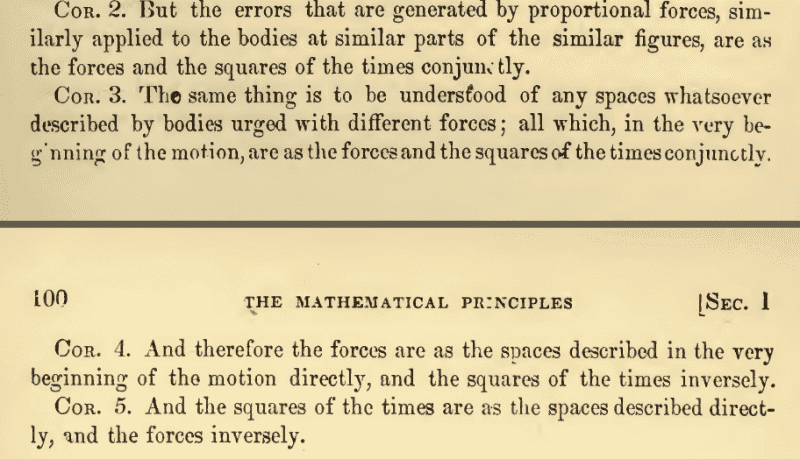
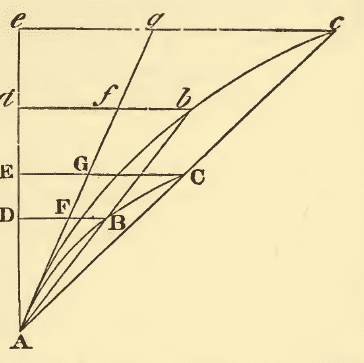
Hello everyone, I am reading Principia Lemma 10 and I cannot understand it. Can someone please help explaining? Thank you very much.
1.png

23.png

2.png

Furthermore, is there any way of understanding the Principia in a more numerical ways rather than words like this? Just asking.
Again, thank you very much.
 
Physics news on Phys.org
S. Chandrasekhar Newton's Principia for the Common Reader Chapter 3, Section 15, pp 50-52 in modern integral notation.
 
I think that in modern terms, this is s = \frac{1}{2} a t^2. So \frac{s_1}{s_2} = (\frac{t_1}{t_2})^2. This is constant acceleration from rest. Since it's at the very beginning off the motion, the force won't have had time to change?
 
Last edited:
It would interesting to know whether Newton is representing a graph of a function of position vs time with time on the y-axis or whether he is thinking of the curves as trajectories of an object in 2-D space.
 
Wao, thank you everyone, this helps much
 
The English translation (of Newton's original Latin) that you are reading dates from around 1730 and can be difficult to read, even for native English speakers. This book contains a new translation from the late 1990s, along with an extensive "guide to the Principia" which is as long as the Principia itself (i.e. half the book)!

https://www.amazon.com/dp/0520088174/?tag=pfamazon01-20
 
Last edited by a moderator:
For simple comparison, I think the same thought process can be followed as a block slides down a hill, - for block down hill, simple starting PE of mgh to final max KE 0.5mv^2 - comparing PE1 to max KE2 would result in finding the work friction did through the process. efficiency is just 100*KE2/PE1. If a mousetrap car travels along a flat surface, a starting PE of 0.5 k th^2 can be measured and maximum velocity of the car can also be measured. If energy efficiency is defined by...

Similar threads

  • · Replies 2 ·
Replies
2
Views
2K
  • · Replies 18 ·
Replies
18
Views
2K
  • · Replies 3 ·
Replies
3
Views
3K
  • · Replies 14 ·
Replies
14
Views
6K
  • · Replies 5 ·
Replies
5
Views
3K
  • · Replies 2 ·
Replies
2
Views
2K
  • · Replies 5 ·
Replies
5
Views
3K
Replies
5
Views
2K
Replies
11
Views
2K
  • · Replies 2 ·
Replies
2
Views
2K