Noetherian Modules .... Cohn Theorem 2.2 .... ....

  • Context: Undergrad 
  • Thread starter Thread starter Math Amateur
  • Start date Start date
  • Tags Tags
    Modules Theorem
Click For Summary
SUMMARY

This discussion centers on understanding the proof of Theorem 2.2 from P.M. Cohn's "Introduction to Ring Theory," specifically regarding Noetherian and Artinian modules. The key point is that if elements \( a_j \) belong to submodules \( N_{i_j} \) and \( k \) is the maximum index of these submodules, then equality holds in the chain from \( N_k \) onwards. The proof demonstrates that \( N_{k+1} \subseteq N_k \) by showing that any element \( n \) in \( N_{k+1} \) can be expressed as a linear combination of generators \( a_1, \dots, a_r \), which are contained in \( N_k \) due to the increasing nature of the chain.

PREREQUISITES
  • Understanding of Noetherian and Artinian rings and modules
  • Familiarity with chain conditions in module theory
  • Knowledge of linear combinations in the context of modules
  • Basic concepts from ring theory as presented in Cohn's work
NEXT STEPS
  • Study the definitions and properties of Noetherian and Artinian modules
  • Explore the implications of chain conditions in module theory
  • Review linear combinations and their closure properties in modules
  • Read further sections of Cohn's "Introduction to Ring Theory" for deeper insights
USEFUL FOR

Mathematicians, particularly those focused on algebra, graduate students studying ring theory, and anyone seeking to deepen their understanding of module theory and chain conditions.

Math Amateur
Gold Member
MHB
Messages
3,920
Reaction score
48
I am reading P.M. Cohn's book: Introduction to Ring Theory (Springer Undergraduate Mathematics Series) ... ...

I am currently focused on Section 2.2: Chain Conditions ... which deals with Artinian and Noetherian rings and modules ... ...

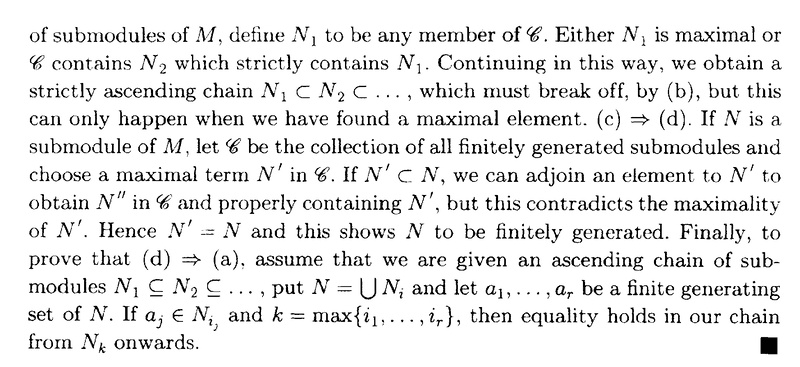
I need help with understanding an aspect of the proof of Theorem 2.2 ... ...Theorem 2.2 and its proof (including some preliminary relevant definitions) read as follows:
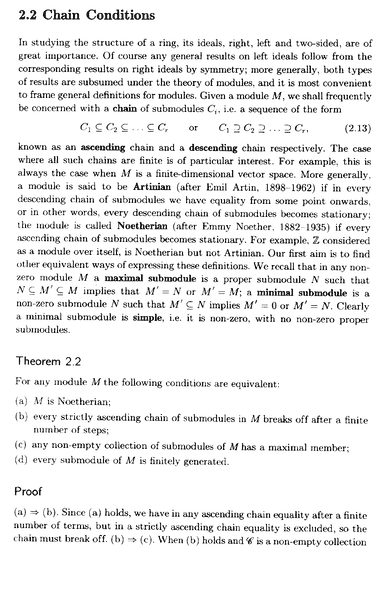
Cohn - 1 - Theorem 2.2 ... PART 1 ... .png

Cohn - 2 - Theorem 2.2 ... PART 2 ... .png

At the end of the above proof by Cohn we read the following:

" ... ... If ##a_j \in N_{i_j} ## and ##k = \text{ max} \{ i_1, \ ... \ ... \ , i_r \}##, then equality holds in our chain from ##N_k## onwards. ... ... "
Can someone please explain how/why ##a_j \in N_{i_j} ## and ##k = \text{ max} \{ i_1, \ ... \ ... \ , i_r \}## implies that equality holds in our chain from ##N_k## onwards. ... ... ?Help will be appreciated ...

Peter
 

Attachments

  • Cohn - 1 - Theorem 2.2 ... PART 1 ... .png
    Cohn - 1 - Theorem 2.2 ... PART 1 ... .png
    41.9 KB · Views: 984
  • Cohn - 2 - Theorem 2.2 ... PART 2 ... .png
    Cohn - 2 - Theorem 2.2 ... PART 2 ... .png
    44.1 KB · Views: 981
Last edited:
Physics news on Phys.org
Math Amateur said:
I am reading P.M. Cohn's book: Introduction to Ring Theory (Springer Undergraduate Mathematics Series) ... ...

I am currently focused on Section 2.2: Chain Conditions ... which deals with Artinian and Noetherian rings and modules ... ...

I need help with understanding an aspect of the proof of Theorem 2.2 ... ...Theorem 2.2 and its proof (including some preliminary relevant definitions) read as follows:View attachment 222878
View attachment 222879
At the end of the above proof by Cohn we read the following:

" ... ... If ##a_j \in N_{i_j} ## and ##k = \text{ max} \{ i_1, \ ... \ ... \ , i_r \}##, then equality holds in our chain from ##N_k## onwards. ... ... "
Can someone please explain how/why ##a_j \in N_{i_j} ## and ##k = \text{ max} \{ i_1, \ ... \ ... \ , i_r \}## implies that equality holds in our chain from ##N_k## onwards. ... ... ?Help will be appreciated ...

Peter

It suffices to show that ##N_{k+1} \subseteq N_k##.

Take ##n \in N_{k+1} \subseteq N = (a_1, \dots, a_r)##. Then ##n = \sum \lambda_i a_i## for elements ##\lambda_i##. Now, ##a_1, \dots, a_r## are contained in ##N_k##, because we have an increasing chain, and hence ##n\in N_k## as well, since modules are closed under linear combinations.
 
Last edited by a moderator:
  • Like
Likes   Reactions: Math Amateur
Math_QED said:
It suffices to show that ##N_{k+1} \subseteq N_k##.

Take ##n \in N_{k+1} \subseteq N = (a_1, \dots, a_r)##. Then ##n = \sum \lambda_i a_i## for elements ##\lambda_i##. Now, ##a_1, \dots, a_r## are contained in ##N_k##, because we have an increasing chain, and hence ##n\in N_k## as well, since modules are closed under linear combinations.
Thanks for the help Math_QED ...

BUT ... just some clarifications ...

You write:

" ... ... Take ##n \in N_{k+1} \subseteq N = (a_1, \dots, a_r)##. ... ... "

This means ##N_{k+1} \subseteq N## and also ##N = (a_1, \dots, a_r)## ... is that correct ...

But then surely ##n## may equal ##\sum_{ i = 1}^t \lambda_i a_i## where ##t \lt r## ... and so ##a_1, \dots, a_r## may not all be contained in ##N_{k + 1} ## let alone ##N_k## ...

I am really puzzled as to exactly why ##(a_1, \dots, a_r)## are contained in ##N_k## ... ... what is the exact argument?

Can you clarify?

Peter
 
Math Amateur said:
Thanks for the help Math_QED ...

BUT ... just some clarifications ...

You write:

" ... ... Take ##n \in N_{k+1} \subseteq N = (a_1, \dots, a_r)##. ... ... "

This means ##N_{k+1} \subseteq N## and also ##N = (a_1, \dots, a_r)## ... is that correct ...

But then surely ##n## may equal ##\sum_{ i = 1}^t \lambda_i a_i## where ##t \lt r## ... and so ##a_1, \dots, a_r## may not all be contained in ##N_{k + 1} ## let alone ##N_k## ...

I am really puzzled as to exactly why ##(a_1, \dots, a_r)## are contained in ##N_k## ... ... what is the exact argument?

Can you clarify?

Peter

For your first question, yes that's exactly what it means, for your second question:

We can find coefficients such that ##n = \sum_{i=1}^r \lambda_i a_i##, because ##n \in (a_1 \dots, a_r)##. But ##a_1 \in N_{i_1}##

and ##k = \max\{i_1, \dots, i_r\}##, so ##k \geq i_1##. This implies that ##N_{i_1} \subseteq N_k##, because the chain is increasing, so ##a_1 \in N_k## and you can do the same thing for the other indices, obtaining that ##a_1, \dots, a_r \in N_k##

EDIT: Maybe you don't know what I mean with ##(a_1, \dots, a_r)##. This is the module generated by the elements ##a_1, \dots a_r##. I.e., the smallest submodule that contains these elements.
 
Last edited by a moderator:
  • Like
Likes   Reactions: Math Amateur

Similar threads

  • · Replies 2 ·
Replies
2
Views
1K
  • · Replies 2 ·
Replies
2
Views
1K
Replies
3
Views
2K
  • · Replies 10 ·
Replies
10
Views
4K
  • · Replies 1 ·
Replies
1
Views
2K
  • · Replies 1 ·
Replies
1
Views
1K
  • · Replies 3 ·
Replies
3
Views
2K
  • · Replies 4 ·
Replies
4
Views
2K
  • · Replies 5 ·
Replies
5
Views
2K
  • · Replies 4 ·
Replies
4
Views
2K