Non-parallel double slit experiment

4 replies · 2K views · last reply
Devin-M
Messages
1,078
Reaction score
771
Is it possible to tell which slit some of the light went through when the slits aren’t parallel (green & red boxes in option 3)?

I used a Bahtinov mask to cover the aperture of my 600mm f/9 lens while observing the star Polaris. Various open slits were tested while others were covered with masking tape. -
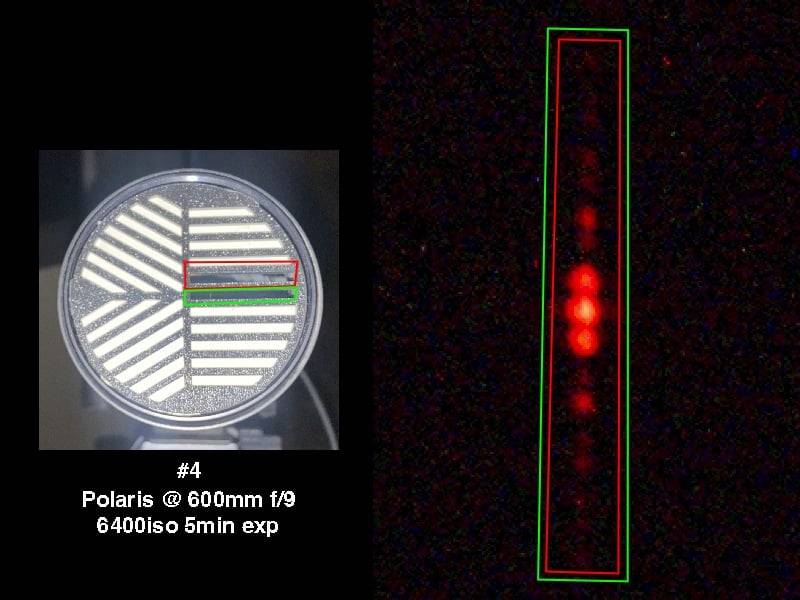
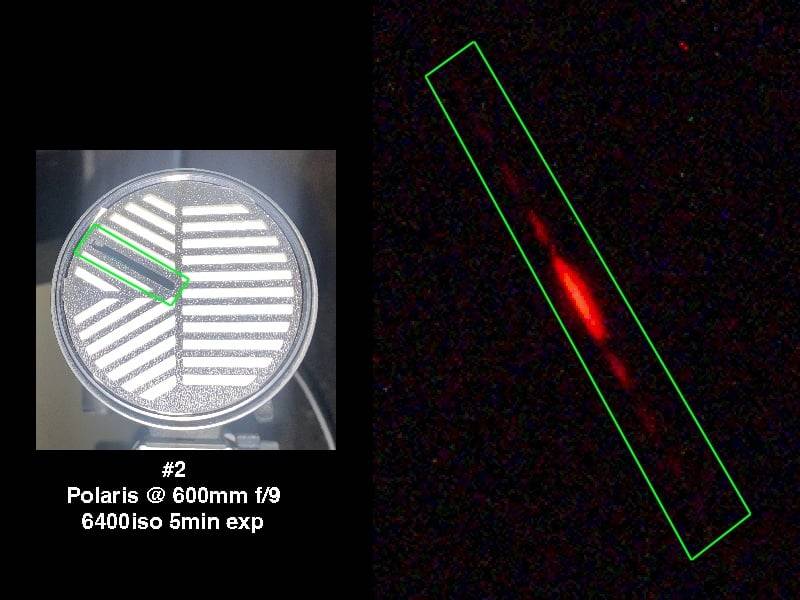
All exposures were 5 minutes with a 656nm narrowband filter on a Nikon D800 @ 6400iso. Only option 4 appears to show a double slit interference pattern while options 1, 2 & 3 appear to show a single slit interference pattern.

Three horizontal red interference strip patterns labelled 1) single horizontal slit, 3) horizontal slit plus diagonal slit, and 4) horizontal slit plus second horizontal slit, with a dark gap between panels.

Five panels: top row shows a Bahtinov mask with differing open slit arrangements; bottom row shows the resulting red point-source diffraction patterns numbered 1) to 4) and a fifth unlabelled pattern.


Left: photo of a Bahtinov mask over a telescope lens with slit-like openings, some covered by tape, labelled #3, Polaris @ 600mm f/9, 6400iso 5min exp. Right: red star-spot diffraction pattern with green and red rectangles marking slit directions.
Left: photo of a Bahtinov mask over a telescope lens, with several white slit openings and two outlined rectangles (red and green) on the central slits, labelled #4, Polaris @ 600mm f/9, 6400iso 5min exp. Right: dark star image with a vertical column of red diffraction spots inside red and green outlined boxes.


Left: photo of a Bahtinov mask over a telescope lens, showing a pattern of white slits on black, with one slit outlined in green and labelled #2, Polaris at 600mm f/9, 6400 ISO, 5 min exposure. Right: dark star field with a red blurred spot and green rectangle outline.

Left: photo of a Bahtinov mask over a telescope lens, showing a pattern of white slits with one slit area outlined in red. Right: dark astronomical exposure of Polaris with a red-outlined vertical strip showing a bright red spot and faint diffraction spots above and below.

RAW Files: https://u.pcloud.link/publink/show?code=kZcjE2VZR1eBfOCgGAYfuGOv9EMgPH3KIR07

A bit of prior discussion…
Post in thread 'Diffraction Effects and Artifacts in Telescopes like the JWST'
https://www.physicsforums.com/threa...telescopes-like-the-jwst.1047305/post-6823238
 
Last edited:
Devin-M said:
Is it possible to tell which slit some of the light went through when the slits aren’t parallel
I was going to say what I said in the thread you linked to, that you can't tell which slit the light went through. But after thinking about the problem more, I have to confess that I don't actually know. I'm assuming the more your rotate the slits relative to each other, the less correlation their patterns have, as image #3 appears to show.
 
The point is that if you make it possible to observe, through which slit a photon comes with certainty, you completely loose the interference pattern. On the other hand, if you want an interference pattern with the best contrast you can get you need perfect ignorance of the which-way information. You can of course have everything between these two extremes, i.e., you can have some probabilistic information through which slit the photon came (i.e., with some probability larger than 1/2 a photon came through one of the slits instead of the other) at the cost of lower contrast of the interference pattern and vice versa. This, of course, is a typical wave phenomenon applying to both classical waves as well as single quanta (photons) of the quantized field.
 
  • Like
Likes   Reactions: kered rettop, DrChinese and DrClaude
vanhees71 said:
On the other hand, if you want an interference pattern with the best contrast you can get you need perfect ignorance of the which-way information.

The picture below seems a strange case… on the one hand, for the circled light (vertical spikes) we see a strong interference pattern and don’t know exactly which slit the light went through, on the other hand it seems like we also can deduce with high probability the circled light didn’t go through the diagonal slits…

Two-panel photo of a telescope with a slotted grille cap on a mount, beside matching laser-spot diffraction patterns; top panel circles two vertical spike groups, bottom panel shows an X-shaped pattern.
 
Last edited: