Diffraction Effects and Artifacts in Telescopes like the JWST
- Level: Graduate
- Thread starter collinsmark
- Start date
-
- Tags
- Diffraction Effects jwst Telescopes
Join the discussion
Registration is free. Ask a follow-up in this thread, or start your own.
125 replies · 12K views · last reply
Astronomy news on Phys.org
Devin-M
- 1,078
- 771
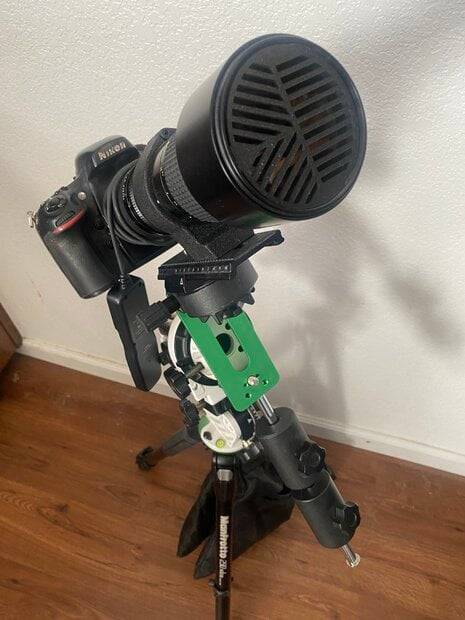
I compared the brightness of the center of the 5th diffaction order of the middle spike vs an adjacent spike with the fully uncovered bahtinov mask (same exposure file for both samples). Both samples were copied to separate files and had a 3.0 pixel gaussian blur applied (averaging the values of adjacent pixels to reduce noise), then the central value was sampled. The 5th diffraction order of the middle spike has roughly twice the brightness (144 of 255) of the 5th diffraction order from the adjacent spike (76 of 255). I note that the horizontal slits have roughly twice the collection area compared to each of the other sets of parallel (diagonal) slits...
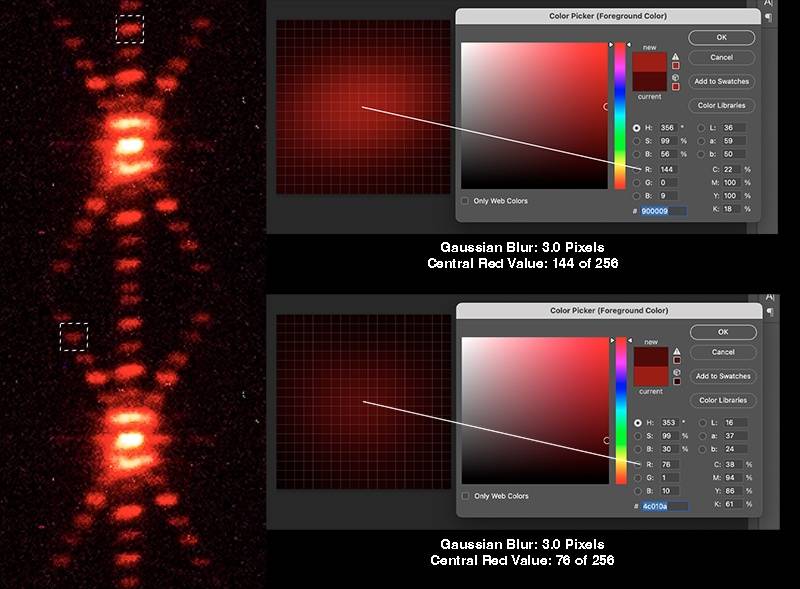
Last edited:
Devin-M
- 1,078
- 771
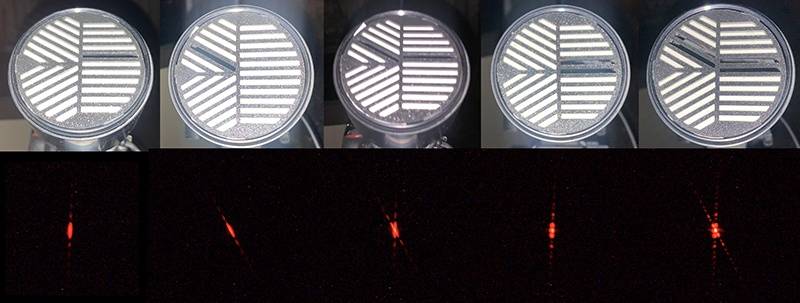
Did some more tests with 1, 2 & 4 slits...
RAW Files: https://u.pcloud.link/publink/show?code=kZcjE2VZR1eBfOCgGAYfuGOv9EMgPH3KIR07
RAW Files: https://u.pcloud.link/publink/show?code=kZcjE2VZR1eBfOCgGAYfuGOv9EMgPH3KIR07
Devin-M
- 1,078
- 771
vanhees71 said:The problem is that people abuse the word "photon" to mean localized (massless) particles to describe "light". That's an idea which goes back to the socalled "old quantum theory" and Einstein's very early ideas on wave-particle duality. This is all outdated for about 100 years. The only correct quantum description of light is quantum electrodynamics, and you are always better off when thinking about light in terms of fields and waves. According to QED a photon is an asymptotic free one-quantum Fock state of the electromagnetic field and as such not localizable in the usual sense, i.e., you cannot even define a position operator in the full meaning of a position observable.
If it comes to the resolution of optical instruments like telescopes it's all about diffraction, i.e., a wave phenomenon, and even if you handle very "dim light", i.e., merely detecting indeed single photons, still the wave nature of light has to be taken into account. Although you'll detect any single photon as one spot (say in a CCD cam), which in some sense is the "particle aspect" of the notion of a photon, the information on the observed object is in collecting sufficiently many photons, and the distribution of the photons is according to the wave picture, i.e., it's given by the energy-density distribution of the electromagnetic field.
1) Here I have only one horizontal slit creating a vertical single slit interference pattern. Is it ok to say the photons forming the pattern "went through" the single slit?
2) Here I have only one diagonal slit creating a diagonal single slit interference pattern. Is it ok to say the photons forming the pattern "went through" the single slit?
3) Here I have both slits open creating what appears to be 2 partially intersecting single slit interference patterns. There are twice as many 2nd and 3rd order diffraction maxima, and some of them don't appear to overlap. Is it ok to say the 2nd & 3rd order diagonal pattern photons in the picture "went through" the diagonal slit and the 2nd & 3rd order vertical pattern photons "went through" the horizontal slit?
4) Here I have 2 horizontal slits open creating an entirely vertical 2 slit interference pattern. Is it ok to say some photons went through one slit, some went through the other, but both patterns entirely overlap so we can't tell which photon went through which slit anymore?
- 24,488
- 15,064
It's not ok to say the photon went through a specific slit in the two-slit situation. If this were the case, you'd not see the double-slit interference pattern. As I tried to argue above, an electromagnetic wave is a wave and not a localized particle. That's also true for a single-photon state.
Devin-M
- 1,078
- 771
vanhees71 said:It's not ok to say the photon went through a specific slit in the two-slit situation. If this were the case, you'd not see the double-slit interference pattern.
I stretched out a single pixel vertical strip from the 1) Single Horizontal Slit, 3) Horizontal + Diagonal Slit, & 4) 2 Horizontal Slits. Opening up the diagonal slit in 3) didn't appear to change the position of the dark minima compared to 1) single horizontal slit, but for 4) opening up a 2nd horizontal slit did change the positions of the dark minima (or areas of destructive interference). In other words 3) still looks like a single slit interference pattern compared to 1) from the positions of the dark minima, even though there are 2 slits, but in 4), the positions of the dark minima have changed. Both 3) & 4) have 2 slits.
Single Slit Interference: http://hyperphysics.phy-astr.gsu.edu/hbase/phyopt/sinslit.html
Double Slit Interference: http://hyperphysics.phy-astr.gsu.edu/hbase/phyopt/mulslid.html#c2
Last edited:
Similar threads
- BigTanker22
- · Replies 1 ·
- Optics
- Replies
- 1