Waaaaaaaa
- 11
- 0
Hello
So i saw this video on youtube explaining some basics of general relativity and they used example with 2 rockets moving paralelly with laser pointed from rocket A to mirror on rocket B.
Heres my picture of it :D

Where we are stationary observer watching those two rockets A and B move paralelly.
Here when we consider speed of light as maximal its possible to deduce lorentz factor as factor of speed at which our light beam Y closes from A to B and then back and everything looks fine and works great. But if i try to imagine situation where those two ships do not move paralelly but one after the other.. like on this great picture..
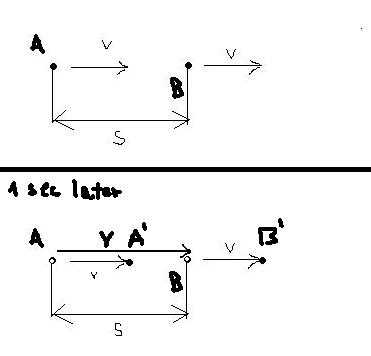
Everything just breaks down in my head... let's say velocity of both rockets is c/2 [m/s]
their distance s= c [m] ( one light second)
So i have a few questions and just to be sure I am not making some very bad assumptions, here is what i think must happen :
1] from our (stationary) point of view the light beam will reach ship B in t=2 seconds
2] from our point of view the light beam will reflect back to ship A and reach it in t=2.66 seconds
lets say on ship B is machine which every 0.1 second ejects a signal flag from the ship.
The flag will be green if no light beam hit the mirror and red if ligh beam has allready hit the mirror.
now let's go on board of ship A and beam that light on to them.. now we are 1.9 seconds after beam and they are still pushing out green flags,now they switch, only 7 flags comes out red and then there's our light beam... So what am i missing here ?? I mean the light could not travel different speed on its way back. Also the number of flags may be different due to some time dilatation but i don't think that could hamper the experiment at v= c/2 which is lorentz factor 1.15
Dont bash me pls
Thanks for answers
So i saw this video on youtube explaining some basics of general relativity and they used example with 2 rockets moving paralelly with laser pointed from rocket A to mirror on rocket B.
Heres my picture of it :D
Where we are stationary observer watching those two rockets A and B move paralelly.
Here when we consider speed of light as maximal its possible to deduce lorentz factor as factor of speed at which our light beam Y closes from A to B and then back and everything looks fine and works great. But if i try to imagine situation where those two ships do not move paralelly but one after the other.. like on this great picture..
Everything just breaks down in my head... let's say velocity of both rockets is c/2 [m/s]
their distance s= c [m] ( one light second)
So i have a few questions and just to be sure I am not making some very bad assumptions, here is what i think must happen :
1] from our (stationary) point of view the light beam will reach ship B in t=2 seconds
2] from our point of view the light beam will reflect back to ship A and reach it in t=2.66 seconds
lets say on ship B is machine which every 0.1 second ejects a signal flag from the ship.
The flag will be green if no light beam hit the mirror and red if ligh beam has allready hit the mirror.
now let's go on board of ship A and beam that light on to them.. now we are 1.9 seconds after beam and they are still pushing out green flags,now they switch, only 7 flags comes out red and then there's our light beam... So what am i missing here ?? I mean the light could not travel different speed on its way back. Also the number of flags may be different due to some time dilatation but i don't think that could hamper the experiment at v= c/2 which is lorentz factor 1.15
Dont bash me pls
Thanks for answers
