Normal force at the base of a ladder

  • Thread starter Thread starter iceice655
  • Start date Start date
  • Tags Tags
    Friction Normal
Click For Summary
SUMMARY

The discussion focuses on calculating the normal force and friction force at the base of a ladder leaning against a frictionless wall. The key variables include the angle θ between the ladder and the ground, the coefficient of friction μ, the mass M of the ladder, and its length L. The derived formula for the normal force at the base is F_N = (mg cos(θ)) / (2μ sin(θ)). The relationship between the normal force at the wall and the friction force at the base is established, emphasizing that the normal force at the wall equals the friction force at the base when in equilibrium.

PREREQUISITES
  • Understanding of static equilibrium and forces
  • Knowledge of torque and its calculation
  • Familiarity with friction coefficients and their implications
  • Basic principles of mechanics involving ladders and inclined planes
NEXT STEPS
  • Study the derivation of forces in static equilibrium scenarios
  • Learn about torque calculations in mechanical systems
  • Explore the implications of friction coefficients in real-world applications
  • Investigate the effects of varying angles on stability in ladder mechanics
USEFUL FOR

Physics students, mechanical engineers, and anyone interested in understanding the mechanics of static equilibrium and forces acting on inclined structures.

iceice655
Messages
7
Reaction score
1
Misplaced Homework Thread
Hello, I was recently tested on finding the normal force at the base of a ladder leaning against a wall as well as its friction force. So this is the question from memory.

Given:
θ the acute angle between the ground and the ladder
μ as the coefficient of friction between the ground and the ladder
M as the mass of the ladder at the center of the ladder, evenly distributed so the inertia if rotated around the center is I=1/12(mL^2), and I = 1/3(mL^2) at the edges
L as the length of the ladder

Known: there is no friction between the wall and the ladder

What is the normal force at the base of the ladder and what is its friction force in terms of θ, μ, g (the gravity constant)M, and L.
 
Physics news on Phys.org
iceice655 said:
Hello, I was recently tested on finding the normal force at the base of a ladder leaning against a wall as well as its friction force. So this is the question from memory.

Given:
θ the acute angle between the ground and the ladder
μ as the coefficient of friction between the ground and the ladder
M as the mass of the ladder at the center of the ladder, evenly distributed so the inertia if rotated around the center is I=1/12(mL^2), and I = 1/3(mL^2) at the edges
L as the length of the ladder

Known: there is no friction between the wall and the ladder

What is the normal force at the base of the ladder and what is its friction force in terms of θ, μ, g (the gravity constant)M, and L.
Share your analysis attempt, so it can be examined. For math formatting see the latex guide ( bottom left of the reply window )
 
Ok what I tried doing was make ##\sum{\tau} = 0## and ##\sum{F} = 0##.

Taking the base as the pivot point, I found the perpendicular (to the ladder) force of M at the center to be ##mg \cos(\theta)##, and the normal force of the wall on the ladder at the top to be ##\mu F_N \sin(\theta)##

Using ##\sum{\tau} = 0##, the normal force of the wall on the ladder is at L from the pivot, and the weight of the ladder is at ##\frac L 2##, then ##\mu F_N \sin(\theta) = \frac 1 2 \cdot Mg \cos(\theta)##, is this correct?

Solving for ##F_N##, I would have ##F_N = \frac {mg \cos{\theta}} {2 \mu \sin{\theta}}##
 
iceice655 said:
Ok what I tried doing was make ##\sum{\tau} = 0## and ##\sum{F} = 0##.

Taking the base as the pivot point, I found the perpendicular (to the ladder) force of M at the center to be ##mg \cos(\theta)##, and the normal force of the wall on the ladder at the top to be ##\mu F_N \sin(\theta)##

Using ##\sum{\tau} = 0##, the normal force of the wall on the ladder is at L from the pivot, and the weight of the ladder is at ##\frac L 2##, then ##\mu F_N \sin(\theta) = \frac 1 2 \cdot Mg \cos(\theta)##, is this correct?

Solving for ##F_N##, I would have ##F_N = \frac {mg \cos{\theta}} {2 \mu \sin{\theta}}##
The forces involved are largely independent of ##\mu##, which is only relevant if you are looking for the maximum distance of the foot of the ladder from the wall.
 
iceice655 said:
Ok what I tried doing was make ##\sum{\tau} = 0## and ##\sum{F} = 0##.

Taking the base as the pivot point, I found the perpendicular (to the ladder) force of M at the center to be ##mg \cos(\theta)##, and the normal force of the wall on the ladder at the top to be ##\mu F_N \sin(\theta)##

Using ##\sum{\tau} = 0##, the normal force of the wall on the ladder is at L from the pivot, and the weight of the ladder is at ##\frac L 2##, then ##\mu F_N \sin(\theta) = \frac 1 2 \cdot Mg \cos(\theta)##, is this correct?

Solving for ##F_N##, I would have ##F_N = \frac {mg \cos{\theta}} {2 \mu \sin{\theta}}##
Why does the normal force of the frictionless wall on the ladder involve ##\mu## in your expression? How about a sharing FBD of the ladder as you see it?
 
erobz said:
Why does the normal force of the frictionless wall on the ladder involve ##\mu## in your expression?
There are only two horizontal forces, so the normal force at the wall must equal the friction force at the ground.
 
erobz said:
Why does the normal force of the frictionless wall on the ladder involve ##\mu## in your expression? How about a sharing FBD of the ladder as you see it?
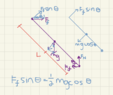
So I was thinking in the y-direction, the normal force of the wall on the ladder would equal the friction force at the base of the ladder. (Sorry, touchpads aren't the best writing tools, if there needs to be more clarification in the drawing, I will modify it)
 

Attachments

  • Screenshot 2024-03-26 at 3.04.57 AM.png
    Screenshot 2024-03-26 at 3.04.57 AM.png
    40.1 KB · Views: 97
iceice655 said:
So I was thinking in the y-direction, the normal force of the wall on the ladder would equal the friction force at the base of the ladder. (Sorry, touchpads aren't the best writing tools, if there needs to be more clarification in the drawing, I will modify it)
That diagram looks okay, except why you think the friction force is ##\mu Mg##?
 
PeroK said:
That diagram looks okay, except why you think the friction force is ##\mu Mg##?
I assumed the friction force at the base was ##\mu \cdot F_N##. ##F_N## being that of the ground on the ladder and what I am looking for. Is this correct?
 
  • #10
iceice655 said:
I assumed the friction force at the base was ##\mu \cdot F_N##. ##F_N## being that of the ground on the ladder. Is this correct?
No. Friction is a reactive force. It is whatever is needed to maintain equilibrium, up to a maximum possible.
 
  • #11
PeroK said:
There are only two horizontal forces, so the normal force at the wall must equal the friction force at the ground.
Oh, they were jumping ahead. I don’t jump ahead at 6 am🥱.
 
  • #12
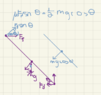
So at this point I know ##F_N## of the wall on the ladder is equal to the ##F_f## at the base of the ladder. So my equation is ##F_f \sin{\theta} = \frac 1 2 Mg \cos{\theta}##. Is it right at this step? My next step should be replacing ##F_f## with the given values, but I am stuck.
 

Attachments

  • Screenshot 2024-03-26 at 3.27.55 AM.png
    Screenshot 2024-03-26 at 3.27.55 AM.png
    20.6 KB · Views: 73
  • #13
You have balanced vertical and horizontal forces. There was no need to look at forces perpendicular to the ladder.

In your OP you mentioned looking at the torque on the system. So, pick a suitable point and calculate the torque about that point.
 
  • #14
I chose the point where the ladder and floor touch as my pivot point, I thought this is what I have been doing?
Don't only forces perpendicular to the lever arm result in torque on the ladder?

On another note, looking at just the vertical forces on the FBD, why couldn't I say the ##F_N## of the ground on the ladder is equal to ##Mg##?
 

Attachments

  • Screenshot 2024-03-26 at 3.43.13 AM.png
    Screenshot 2024-03-26 at 3.43.13 AM.png
    8.2 KB · Views: 72
  • Like
Likes   Reactions: erobz
  • #15
iceice655 said:
I chose the point where the ladder and floor touch as my pivot point, I thought this is what I have been doing?
Perhaps I missed that.
iceice655 said:
Don't only forces perpendicular to the lever arm result in torque on the ladder?
Okay, I see why you wanted those force components. Ultimately, it's the dot product of the force and the vector from the pivot point to the point where the force is applied. The simplest way to calculate this is the force times the perpendicular distance to the force.
iceice655 said:
On another note, looking at just the vertical forces on the FBD, why couldn't I say the ##F_N## of the ground on the ladder is equal to ##Mg##?

I thought you had already done that.
 
  • #16
So currently what is incorrect, and what is correct?

Based on what you said, am I right to say
##F_{N (wall on ladder)} = F_{f (ground on ladder)}## so that
##L \cdot F_{N (wall on ladder)} \sin{\theta} = \frac L 2 Mg \cos{\theta}##

then I need to figure out how to replace ##F_{N (wall on ladder)}## with the given values? This is where I am stuck.
 
  • #17
iceice655 said:
So currently what is incorrect, and what is correct?

Based on what you said, am I right to say
##F_{N (wall on ladder)} = F_{f (ground on ladder)}## so that
##L \cdot F_{N (wall on ladder)} \sin{\theta} = \frac L 2 Mg \cos{\theta}##

then I need to figure out how to replace ##F_{N (wall on ladder)}## with the given values? This is where I am stuck.
##N_f = Mg ## as you suspected as a consequence of the sum of the forces in the vertical direction.

That implies ##f_r= \mu Mg ## as you stated

And by sum of forces in horizontal ## f_r = N_w \implies N_w \leq \mu M g ##

Now apply sum of the torques about the floor contact point( I suppose this should be an inequality to call attention to @PeroK, and @haruspex point about static friction ), and sub for ##N_w## to get ##\mu##

Once you have ##\mu## you can get ##f_r##

You should be all good to go.

Edit: Geeze, I forgot what the question was! You can get ##N_f## right away.
 
Last edited:
  • #18
erobz said:
##N_f = Mg ## as you suspected as a consequence of the sum of the forces in the vertical direction.

That implies ##f_r= \mu Mg ## as you stated
Unless I have missed something, and assuming the scenario is static, it only implies ##f_r<= \mu Mg ##, as pointed out by @PeroK in post #10.
The friction coefficient is provided in order to test the student's understanding of that point.
 
  • Like
Likes   Reactions: PeroK
  • #19
haruspex said:
Unless I have missed something, and assuming the scenario is static, it only implies ##f_r<= \mu Mg ##, as pointed out by @PeroK in post #10.
The friction coefficient is provided in order to test the student's understanding of that point.
Ahh. I see what you’re saying. I’m wrong. Thanks.
 
  • #20
I thought I saw what you are saying, but now I'm unsure. I thought about PM you and Pero , but given the confusion I'm probably causing the OP it might be best to air this publicly and cut my losses.

I believe it is true that ##\mu## fixes the minimum angle ##\theta## the ladder can be placed in without slipping. So if ##\theta \to \pi/2##, ##\mu## is able to go to zero, and ##\theta \to 0##, ##\mu## must go to ##\infty##.

I get that for any ##\theta##, the coefficient of static friction (or "stiction" as @hutchphd prefers):

$$\mu \geq \frac{1}{2}\cot \theta $$

However, given this ##\mu## condition is (at least) minimally satisfied for some angle ##\theta##, it must be the case that friction force at the base of the ladder ( when equated to the normal force at the wall) is such that ##\sum \tau = 0 ## is satisfied, which says to me that:

$$ \frac{l}{2}Mg \cos \theta = l F_{fr} \sin \theta $$

Meaning:

$$ F_{fr} \equiv \frac{1}{2}Mg\cot \theta $$

no more, no less?
 
Last edited:
  • #21
iceice655 said:
##F_{N (wall on ladder)} = F_{f (ground on ladder)}## so that
##L \cdot F_{N (wall on ladder)} \sin{\theta} = \frac L 2 Mg \cos{\theta}##

then I need to figure out how to replace ##F_{N (wall on ladder)}## with the given values? This is where I am stuck.
I don't understand your difficulty. You have found ##F_{N (ground on ladder)}## and that
##LF_{f (ground on ladder)}\sin{\theta} = \frac L 2 Mg \cos{\theta}##.
Isn’t it trivial to find ##F_{f (ground on ladder)}## from there?
 
  • Like
Likes   Reactions: PeroK

Similar threads

Replies
6
Views
3K
  • · Replies 9 ·
Replies
9
Views
3K
  • · Replies 5 ·
Replies
5
Views
3K
Replies
9
Views
2K
  • · Replies 1 ·
Replies
1
Views
5K
  • · Replies 5 ·
Replies
5
Views
3K
  • · Replies 10 ·
Replies
10
Views
3K
Replies
5
Views
3K
  • · Replies 11 ·
Replies
11
Views
5K
  • · Replies 3 ·
Replies
3
Views
4K