Norton's Theorem with Dependent Sources?

  • Thread starter Thread starter Master1022
  • Start date Start date
  • Tags Tags
    Sources Theorem
Click For Summary
The discussion revolves around the application of Norton's Theorem in circuits with dependent sources. The original poster is confused about their method for finding the short circuit current (i_{sc}) and believes they are making an error, despite obtaining consistent results with their calculations. They highlight that the solution provided by others uses a method of setting sources to zero, which they were taught is invalid for dependent sources. Clarifications suggest that superposition can be applied by treating dependent sources as resistors while keeping them active. Ultimately, the poster seeks to understand the discrepancy between their results and the expected solution.
Master1022
Messages
590
Reaction score
116
Homework Statement
Find the short circuit current and hence the Norton equivalent circuit.
Relevant Equations
V = IR
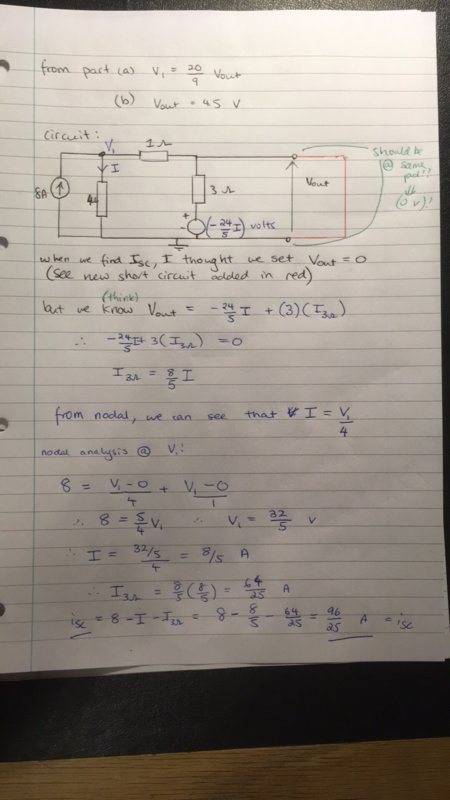
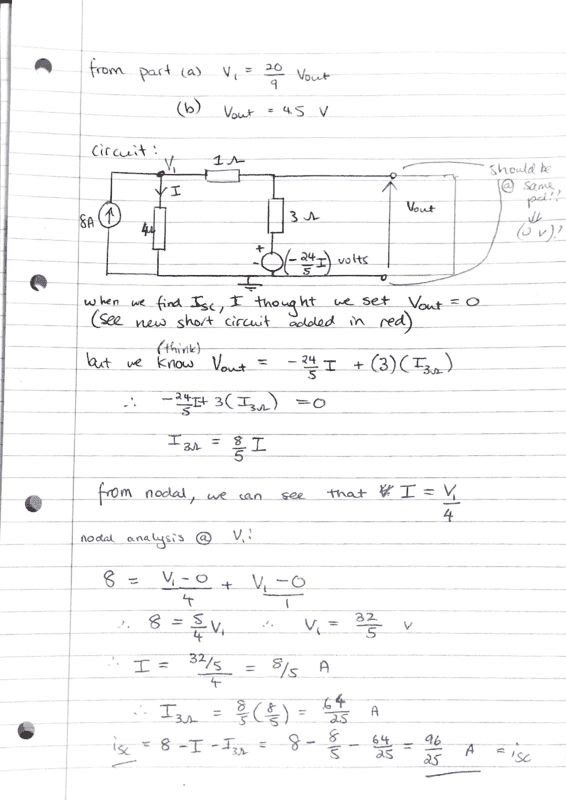
My question is: What is wrong with my working/ method (in the attached pictures) to find i_{sc}? I can get the Norton equivalent from there, but seem to get the same answer as the solution scheme.

Context: we are given the circuit depicted in the picture (initially with no connection between the V_{out} nodes) and the question is building up to us finding the Norton equivalent circuit. From the previous parts, we have shown:
- V_1 = \frac{20}{9} V_{out} for the open circuit condition
- V_{out} = 4.5 Volts

The answer uses the method of setting the sources to 0, but we have been told (in lectures) that method is not valid when there are dependent current sources.

I have asked a peer and they suggested that the error may lie in the fact that I let V_{out} = 0 volts, but I cannot see why that is the error.

I have attached two versions of the working, but hopefully, it is legible.

I would appreciate any help.
Scannable Document on 24 Apr 2019 at 20_54_13.png
Image-1.jpg
 
Last edited:
Physics news on Phys.org
When doing Norton/Thevenin Equivalent circuits you need## i_{sc}## (short circuit current) and ##v_{oc} ##(open circuit voltage). You correctly found ## i_{sc}## for the short/closed circuit as or 3.84 A.

.

If you solve the open circuit condition you will get ##V_{out}## =4.5 V. Then to get ##R_{N}##, you simply use the equation:$$R_{N} =\frac{V_{oc}}{I_{sc}}=1.17\Omega$$

You seem to have everything right, so could you clarify why you believe you have an error.

Also, you can use superposition applying one independent source at a time. Treat the dependent sources as resistors and always leave them on.

 
LeafNinja said:
When doing Norton/Thevenin Equivalent circuits you need## i_{sc}## (short circuit current) and ##v_{oc} ##(open circuit voltage). You correctly found ## i_{sc}## for the short/closed circuit as or 3.84 A.

.

If you solve the open circuit condition you will get ##V_{out}## =4.5 V. Then to get ##R_{N}##, you simply use the equation:$$R_{N} =\frac{V_{oc}}{I_{sc}}=1.17\Omega$$

You seem to have everything right, so could you clarify why you believe you have an error.

Also, you can use superposition applying one independent source at a time. Treat the dependent sources as resistors and always leave them on.

Thank you for your response. The solution to the problem gets a different answer to me and it sets the sources to 0 (the shortcut method). However, I was previously led to believe that method only worked for independent sources.

EDIT: sorry, I just re-read my first post. It should say "cannot get the same answer as the solution scheme..."
 
The book claims the answer is that all the magnitudes are the same because "the gravitational force on the penguin is the same". I'm having trouble understanding this. I thought the buoyant force was equal to the weight of the fluid displaced. Weight depends on mass which depends on density. Therefore, due to the differing densities the buoyant force will be different in each case? Is this incorrect?

Similar threads

Replies
1
Views
1K
  • · Replies 2 ·
Replies
2
Views
2K
  • · Replies 3 ·
Replies
3
Views
988
  • · Replies 5 ·
Replies
5
Views
2K
  • · Replies 2 ·
Replies
2
Views
2K
  • · Replies 4 ·
Replies
4
Views
1K
Replies
7
Views
1K
  • · Replies 7 ·
Replies
7
Views
2K
Replies
4
Views
905
  • · Replies 8 ·
Replies
8
Views
2K