Master1022
- 590
- 116
- Homework Statement
- Find the short circuit current and hence the Norton equivalent circuit.
- Relevant Equations
- V = IR
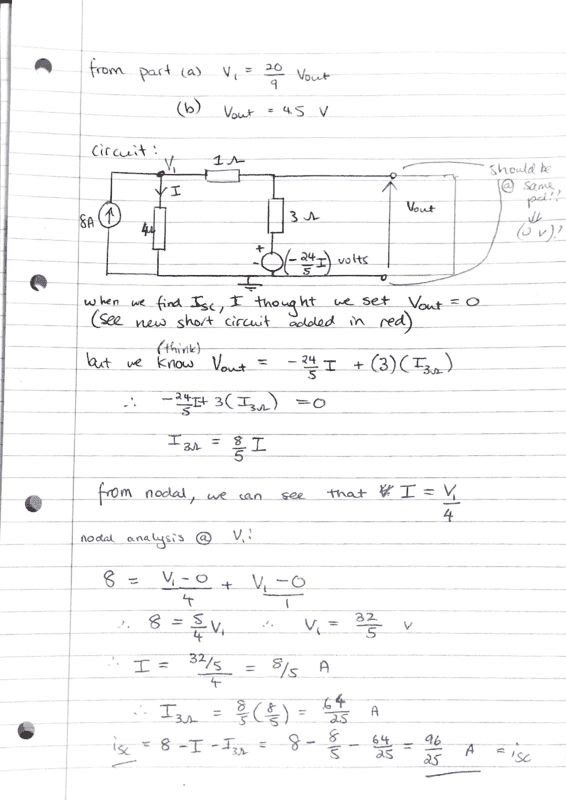
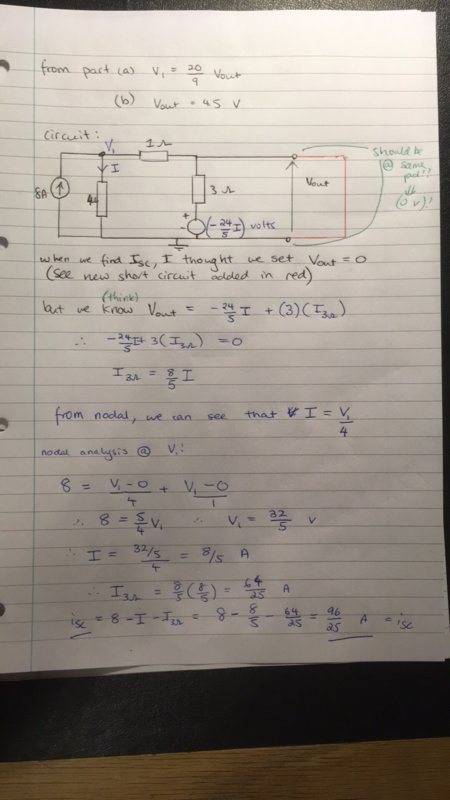
My question is: What is wrong with my working/ method (in the attached pictures) to find [itex]i_{sc}[/itex]? I can get the Norton equivalent from there, but seem to get the same answer as the solution scheme.
Context: we are given the circuit depicted in the picture (initially with no connection between the [itex]V_{out}[/itex] nodes) and the question is building up to us finding the Norton equivalent circuit. From the previous parts, we have shown:
- [itex]V_1 = \frac{20}{9} V_{out}[/itex] for the open circuit condition
- [itex]V_{out} = 4.5[/itex] Volts
The answer uses the method of setting the sources to 0, but we have been told (in lectures) that method is not valid when there are dependent current sources.
I have asked a peer and they suggested that the error may lie in the fact that I let [itex]V_{out} = 0[/itex] volts, but I cannot see why that is the error.
I have attached two versions of the working, but hopefully, it is legible.
I would appreciate any help.
Context: we are given the circuit depicted in the picture (initially with no connection between the [itex]V_{out}[/itex] nodes) and the question is building up to us finding the Norton equivalent circuit. From the previous parts, we have shown:
- [itex]V_1 = \frac{20}{9} V_{out}[/itex] for the open circuit condition
- [itex]V_{out} = 4.5[/itex] Volts
The answer uses the method of setting the sources to 0, but we have been told (in lectures) that method is not valid when there are dependent current sources.
I have asked a peer and they suggested that the error may lie in the fact that I let [itex]V_{out} = 0[/itex] volts, but I cannot see why that is the error.
I have attached two versions of the working, but hopefully, it is legible.
I would appreciate any help.
Last edited: