Not Satisfied with Answer to Thermodynamics Question

Click For Summary

Discussion Overview

The discussion revolves around a thermodynamics question related to the behavior of steam under specific conditions, particularly focusing on the quantitative analysis of temperature changes and energy transfers in a system involving steam. The participants explore various concepts and approaches to address the problem, which includes elements of both qualitative and quantitative analysis.

Discussion Character

  • Exploratory
  • Technical explanation
  • Debate/contested
  • Mathematical reasoning

Main Points Raised

  • One participant expresses dissatisfaction with a qualitative answer and seeks a quantitative approach to the thermodynamic question, mentioning challenges due to insufficient information such as mass.
  • Another participant notes the discrepancy in temperature changes for the same power input, suggesting that the steam may be partly water between states 1 and 2, which could explain the low temperature increase.
  • A third participant introduces concepts such as wet vs. dry steam and the quality of steam, indicating these may be relevant to the problem.
  • A later reply emphasizes the importance of enthalpy over internal energy in this context, suggesting that the change in enthalpy should be analyzed along lines of constant pressure to solve the problem.

Areas of Agreement / Disagreement

Participants present multiple competing views and approaches to the problem, with no consensus reached on a definitive solution. There are differing opinions on the relevance of certain parameters and the correct thermodynamic functions to use.

Contextual Notes

Participants highlight the need for specific information such as mass and pressure to accurately analyze the problem, indicating that the discussion is limited by these missing assumptions.

Sirsh
Messages
262
Reaction score
10
I have a thermodynamic question which has been answered by my lecturer in a qualitative rather than a quantitative fashion.

The question is:
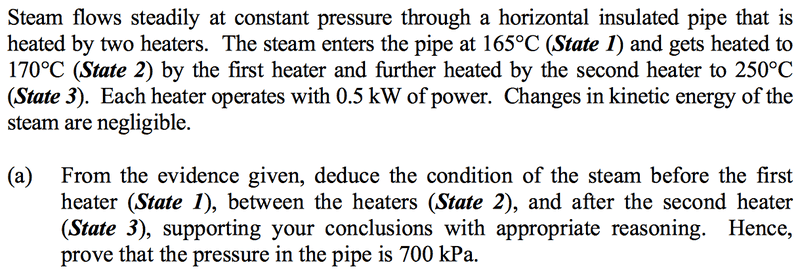
jz9s83.png


My question is can this be answered in a quantitative fashion? I've been trying to find a way but to no avail.

My thought process is such that using the SFEE you could some how find a difference of internal energy between two of the three temperatures within the steam tables. But I cannot figure out how to do this explicitly, due to the fact the heat energy supplied is so small and that no other information is given such as masses etc..

Thanks!
 
Engineering news on Phys.org
That's a tricky problem, I think an important clue is that State 1-2 only rises 5 degrees with 500W input, yet State 2-3 rises 80 degrees with 500W input. Because this is at constant pressure, you may be able to follow a constant pressure line on a steam chart and find a state where this seems possible? Given the mismatch between temperature rises for the same power input, I might guess the steam was partly water between states 1 and 2, which could account for the low temperature increase; maybe this is a starting point?
 
Actually, this is a pretty nice question.

I think Mech Engr might be onto something. Remember that steam is only a name given to a state of water, but it doesn't define what it is. Some concepts that might help you answer the question are:

i) Wet vs. Dry steam, quality of steam
ii) Saturated heated vs superheated steam
ii) Entrained condensate in steam flowGood luck!
 
To elaborate on what Mech_Engineer said, the 0.5 kW is not as relevant as the fact that the two heat loads are identical. Therefore, the change in enthalpy of the steam (per unit mass) through each of the two heaters is exactly the same. This is basically a trial-and-error problem to figure out the pressure. Get an enthalpy-pressure diagram for water. You will be moving along lines of constant pressure on the diagram. You have the inlet and outlet temperatures to each section of the pipe. So you basically need to find an isobar for which the change in enthalpy in going from 165C to 170 C (including perhaps phase change) is equal to the enthalpy change in going from 170 C to 250 C. Start with the known answer of 700 kPa so you can see why it works, and then try some other pressures so that you can see why it doesn't work at those pressures.

Incidentally, I should mention that, unlike what you said in your original post about working with the internal energy, you should be working with the enthalpy. In a steady state flow system, it is the enthalpy change that is the correct thermodynamic function to use in going from the inlet to the outlet of the system.

Chet
 

Similar threads

  • · Replies 5 ·
Replies
5
Views
2K
Replies
15
Views
3K
Replies
25
Views
5K
Replies
5
Views
1K
  • · Replies 1 ·
Replies
1
Views
3K
Replies
2
Views
3K
  • · Replies 3 ·
Replies
3
Views
3K
Replies
9
Views
3K
  • · Replies 13 ·
Replies
13
Views
3K
Replies
7
Views
6K