Not sure what square brackets indicate when dealing with partial derivates

  • Thread starter Thread starter Kushwoho44
  • Start date Start date
  • Tags Tags
    Partial Square
Click For Summary
The discussion clarifies the meaning of square brackets in the context of partial derivatives, specifically regarding the notation ∇phi[r(t)]. It explains that ∇phi represents the gradient of the scalar function phi, which involves taking partial derivatives with respect to each coordinate axis. The notation phi[vec{r}(t)] indicates that phi is a function of vec{r}, which is parameterized by time t. The use of square brackets instead of parentheses is simply a stylistic choice to avoid confusion with the existing parentheses around vec{r}(t). Ultimately, both notations convey the same mathematical meaning.
Kushwoho44
Messages
25
Reaction score
1
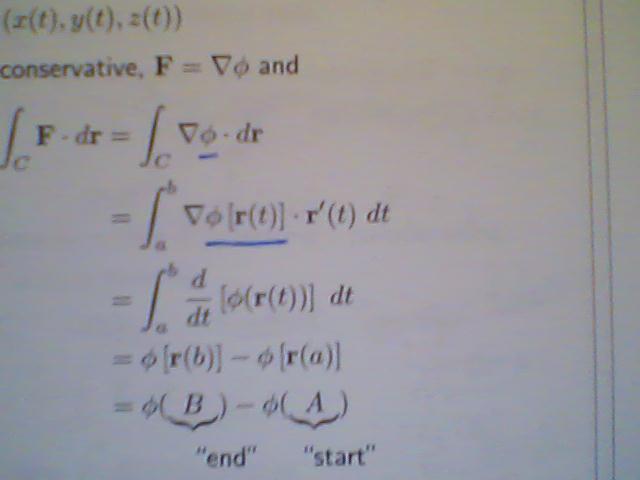
Hi guys, attached is a picture of my problem and it is also underlined.
5zil9k.jpg


I've been reading through this theory and I just don't understand what the square brackets indicate.

I understand that ∇phi is the partial derivative with respect to the scalar function phi.

But what is ∇phi [r(t)] ?

I feel ashamed asking this like I'm going to be laughed at.
 
Physics news on Phys.org
##\nabla\phi## is the the gradient of ##\phi##: it is read "grad phi" or "del phi".
So it involved taking the partial derivative of phi with respect to each coordinate axis.
http://en.wikipedia.org/wiki/Gradient

##\phi[\vec{r}(t)]## is just telling you that ##\phi## is a function of ##\vec{r}## which, in turn, is a function of ##t##. What they've done is parameterized the path represented by the C. Having turned ##\phi## into a function of just one variable, the gradient is much simplified.
 
They are just using "[ ]" in place of "( )" because they are already using "( )" for the "\vec{r}(t)" and don't want to have "))". There is no difference in meaning.
 
Relativistic Momentum, Mass, and Energy Momentum and mass (...), the classic equations for conserving momentum and energy are not adequate for the analysis of high-speed collisions. (...) The momentum of a particle moving with velocity ##v## is given by $$p=\cfrac{mv}{\sqrt{1-(v^2/c^2)}}\qquad{R-10}$$ ENERGY In relativistic mechanics, as in classic mechanics, the net force on a particle is equal to the time rate of change of the momentum of the particle. Considering one-dimensional...

Similar threads

  • · Replies 4 ·
Replies
4
Views
3K
  • · Replies 6 ·
Replies
6
Views
2K
  • · Replies 1 ·
Replies
1
Views
1K
  • · Replies 4 ·
Replies
4
Views
2K
  • · Replies 5 ·
Replies
5
Views
3K
  • · Replies 16 ·
Replies
16
Views
5K
Replies
5
Views
6K
  • · Replies 4 ·
Replies
4
Views
3K
  • · Replies 6 ·
Replies
6
Views
2K
  • · Replies 33 ·
2
Replies
33
Views
3K