Now it is a simple matter to find the current in each of the resistors.

  • Thread starter Thread starter hobo skinoski
  • Start date Start date
Click For Summary
SUMMARY

The forum discussion focuses on analyzing a circuit with four resistors connected to a battery, where the resistors have values R1 = R, R2 = 2R, R3 = 4R, and R4 = 3R. Participants discuss determining the potential difference across each resistor and the current flowing through them in terms of the battery current I and emf E. The method involves calculating the equivalent resistance of the circuit, specifically using the series and parallel resistance formulas to derive the total current from the battery.

PREREQUISITES
  • Understanding of Ohm's Law (V = IR)
  • Knowledge of series and parallel resistor combinations
  • Familiarity with equivalent resistance calculations
  • Basic circuit analysis techniques
NEXT STEPS
  • Study the calculation of equivalent resistance in complex circuits
  • Learn about Kirchhoff's laws for current and voltage in circuits
  • Explore the concept of current division in parallel circuits
  • Investigate the effects of infinite resistance on circuit behavior
USEFUL FOR

Electrical engineering students, circuit designers, and anyone interested in understanding resistor networks and current distribution in electrical circuits.

hobo skinoski
Messages
2
Reaction score
0
Four resistors are connected to a battery as shown in the figure. The current in the battery is I, the battery emf is E, and the resistor values are R1 = R, R2 = 2R, R3 = 4R, and R4 = 3R.
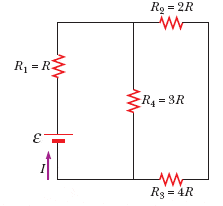
p21-32.gif


-Determine the potential difference across each resistor in terms of E.
-Determine the current in each resistor in terms of I.
-In the limit that R3 → infinity, what are the new values of the current in each resistor in terms of I, the original current in the battery?


Homework Equations


V=IR
Rtotal=R1+R2+... (Series)
1/2Rtotal=1/R1 + 1/R2 ... (Parallel)


The Attempt at a Solution


I've tried a bunch of different combos, and I'm just wondering if there is some sort of way to do this.
 
Physics news on Phys.org
hmm still trying. anyone out there?
 
R2 and R3 are in series...we'll call their combination Rs. R4 is parallel to Rs...we'll call their combination Rp. R1 is in series with Rp...we'll call their combination Rt. Once you find Rt, the circuit should simply be a battery in series with a resistance of Rt. From this, you could find I1, the current running through the battery and R1. I1 splits into I2 and I3 at a junction. Note that the voltage between the junctions is the same per path.
 
hobo skinoski said:
Four resistors are connected to a battery as shown in the figure. The current in the battery is I, the battery emf is E, and the resistor values are R1 = R, R2 = 2R, R3 = 4R, and R4 = 3R.-Determine the potential difference across each resistor in terms of E.
-Determine the current in each resistor in terms of I.
-In the limit that R3 → infinity, what are the new values of the current in each resistor in terms of I, the original current in the battery?


Homework Equations


V=IR
Rtotal=R1+R2+... (Series)
1/2Rtotal=1/R1 + 1/R2 ... (Parallel)

The Attempt at a Solution


I've tried a bunch of different combos, and I'm just wondering if there is some sort of way to do this.

As Gear300 suggests you should first find the equivalent resistance of the entire network because that will yield the current from the E source. Then it is simply a matter of splitting the current between the legs as you go through the network.

The equivalent resistance R1234 is found by finding
R23 = R2 + R3
Then
R234 = R4 || R23
Then
R1234 = R1 + R234

Then I = E/R1234
 

Similar threads

  • · Replies 4 ·
Replies
4
Views
2K
  • · Replies 7 ·
Replies
7
Views
2K
  • · Replies 1 ·
Replies
1
Views
2K
  • · Replies 3 ·
Replies
3
Views
4K
  • · Replies 1 ·
Replies
1
Views
3K
  • · Replies 3 ·
Replies
3
Views
2K
  • · Replies 3 ·
Replies
3
Views
2K
  • · Replies 4 ·
Replies
4
Views
2K
  • · Replies 5 ·
Replies
5
Views
5K
  • · Replies 6 ·
Replies
6
Views
3K