Numerical Differentiation: Comparing Central & Other Formulas

Click For Summary
SUMMARY

This discussion centers on the comparison of different numerical differentiation formulas, specifically focusing on central differentiation for first derivatives. The user expresses confusion regarding the notation and appearance of various formulas encountered in scholarly articles, particularly contrasting a new multipoint approximation with familiar central differentiation formulas. The reference to a specific slide show from the University of Notre Dame provides additional context and examples of multipoint approximations, highlighting the diversity in notation and methodology within numerical differentiation.

PREREQUISITES
  • Understanding of numerical differentiation concepts
  • Familiarity with central differentiation formulas
  • Knowledge of multipoint approximation techniques
  • Basic calculus, particularly derivatives
NEXT STEPS
  • Research the differences between forward, backward, and central differentiation formulas
  • Explore multipoint approximation methods in numerical analysis
  • Review the slide show from the University of Notre Dame on numerical differentiation
  • Study the notation and terminology used in numerical differentiation literature
USEFUL FOR

Mathematicians, engineering students, and anyone involved in numerical analysis or computational methods who seeks to deepen their understanding of differentiation techniques.

t0mm02
Messages
49
Reaction score
0
Homework Statement
Central, Forward, and Backward difference equations.
Relevant Equations
Central, Forward, and Backward difference equations.
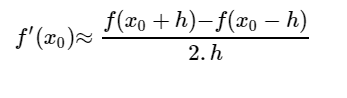
Hello there, I have found a different central differentiation formula for a first derivate from what I am used to seeing and I was wondering if they were the same one. I am struggling to find the Numerical Differentiation formulas (forward, backward and central) in scholarly articles and I have found one with the supposed formulas but they look so different from how I normally see them.
This is the formula I have seen:

,k,yyui,.png


This is the formula I normally see:
6th5h.png
 
Physics news on Phys.org
t0mm02 said:
This is the formula I have seen:
View attachment 276503

I'm not sure what the ##d## symbol denotes, but this looks like a formula for a "multipoint" approximation of ##f'##. For example, the slide show https://www3.nd.edu/~gtryggva/CFD-Course/2011-Lecture-8.pdf gives examples of multipoint approximations in simpler notation.
 
Question: A clock's minute hand has length 4 and its hour hand has length 3. What is the distance between the tips at the moment when it is increasing most rapidly?(Putnam Exam Question) Answer: Making assumption that both the hands moves at constant angular velocities, the answer is ## \sqrt{7} .## But don't you think this assumption is somewhat doubtful and wrong?

Similar threads

Replies
4
Views
2K
  • · Replies 1 ·
Replies
1
Views
1K
  • · Replies 7 ·
Replies
7
Views
2K
  • · Replies 3 ·
Replies
3
Views
1K
Replies
9
Views
5K
  • · Replies 4 ·
Replies
4
Views
2K
  • · Replies 63 ·
3
Replies
63
Views
4K
  • · Replies 5 ·
Replies
5
Views
1K
Replies
2
Views
1K
  • · Replies 14 ·
Replies
14
Views
2K